
In Memoriam
Able administrator
Died: Bazun Framroze Dittia, 80, respected officer of the Indian Administrative Service (IAS) who had served as home secretary, commissioner of enquiries, agricultural production commissioner and second secretary to the government of Andhra Pradesh (A.P.), and erstwhile president of the Parsi Zoroastrian Anjuman of Secunderabad and Hyderabad (PZASH) on July 5, 2004 at Care Hospital, Hyderabad, following cardiac arrest.
"He was a perfect gentleman, a man of his words whose integrity cannot ever be doubted... full of affection, warmth and sincerity... generous to a fault and extremely helpful to anyone in need,” wrote Abid Hussain, former ambassador to the USA.
After he joined the IAS in 1950 in the first decade he served as collector and district magistrate in Nanded, Adilabad, Kurnool, Hyderabad. In the next decade he consolidated his position in AP being appointed at different times as director of survey, settlement and land records, of stores, purchase and stationery, of commerce and export promotion and as joint secretary to the government in the home department. Thereafter Dittia was in charge of different public sector undertakings: he was chairman and managing director of Hyderabad Allwyn Metal Works, vice chairman and managing director of A.P. Agro Industries Corporation, chairman and managing director of A.P. Automobile Tyres and Tubes Company.
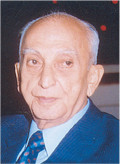
Dittia: "worked with a passion”
During the three years he spent as principal administrator, International Crops Research Institute for the Semi Arid Tropics (ICRISAT) in Hyderabad he had overall responsibility for all the support activities of the Institute. As recalls Leslie D. Swindale, director general (emeritus) of ICRISAT, presently based in USA, "We have many memories of that fine young man going back into the 1970s when we first came to Hyderabad...and later when we became colleagues in ICRISAT and how he helped and advised me through several rough spots and problems.”
For 32 years he was with the IAS during which he was "remembered for his bonhomie and warmth,” as noted an editorial in the ias house bulletin of July 2004. "He did not distinguish between seniors and juniors and showed the same affection and friendliness to all,” added the editorial. Recalling his posting as sub collector under Dittia, S. R. Sankaran wrote, "I distinctly remember the warmth and personal attention with which he received me. I felt encouraged by his kindness and professional guidance.”
Soon after his retirement from the IAS Dittia was appointed a member of the A.P. State Minorities Commission. "Indeed he was a towering personality whose contribution to the Parsi community and the minorities was immense. He was a role model...worked with a passion and had indefatigable energy,” remarked Prof F. D. Vakil, vice chairman of the Commission.
An active participant in the deliberations of the Federation of Parsi Zoroastrian Anjumans of India he was elected its vice president (south zone) and ultimately designated a permanent invitee. He strongly advocated the need to provide seats for Parsi students in institutions founded by Parsis. "He was such an amiable and charming personality, soft spoken and very well mannered and I used to enjoy his company during the meetings of the Federation and even otherwise,” stated a condolence message from former chairman of the Bombay Parsi Punchayet, Eruch Desai. "With built in skills of advocacy” he offered to sort out differences among the anjumans of the Federation, noted Dittia’s life profile.
The activist was always exhorting the Parsi community to be transparent and accountable, especially those holding public office. Although a past president and trustee of PZASH recent developments which had resulted in Dittia seeking legal redress and the intervention of the state administration to run the affairs of the Anjuman had antagonized some members of the community. His trustees attacked him for undermining the autonomy of a community trust by asking for an administrator to be appointed. When they expressed their objections to the Federation, Dittia stopped attending the meetings. As managing trustee of the Old Fire Temple Trust in Secunderabad, he was "a pillar of strength for the Trust and his contribution to the Trust in its affairs (had) been immense,” acknowledged president H. S. Moos. He was also president of the Zoroastrian Club and had worked tirelessly to preserve the precious land of the Club, according to his life sketch.
Following his retirement Dittia took over as chairman of Nagarjuna Fertilizers and Chemicals and was advisor to companies like ASSIA Corporation, Duncan Agro Limited, Ferro Alloys Corporation Limited, Jaganath Group of Companies, Laxmi Starch and Enviro Clean. "Bazun always had a very helpful attitude and tried to find a pragmatic solution to Bakelite’s issues while he was on the board,” commented its managing director S. P. Vohra.
"A bibliophile, an avaricious reader from classics to modern fiction, he collected a vast treasure of rare books... His travels within India and abroad were mainly as a seeker of knowledge,” mentions his wife Perin. He enjoyed listening to both western classical and Hindustani music. His sphere of interests extended to initiating social welfare measures. As acknowledges Perin, "I am proud to say as a wife of a responsible officer I plunged into social work, more so in empowering the hopeless and helpless women coming from remote rural India and also the underprivileged from Hyderabad slums.”
A graduate in Arts from Nizam College, Madras University, Hussain recalls Dittia during their college days, "While participating in inter-university debates (where I knew we had no chance to win) he would still demonstrate a seriousness and application which was never my forte...He would never agree with me that it is much better to lose a debate without making much preparation than to lose it after making many hours of serious preparations.” As summed up Hussain, "His zest for life and the burst of energy he displayed belied his age.”
The able administrative officer is survived by his wife Perin and son Mernosh.
◆ ◆ ◆
From the archive