
Politics and Policy
World Zoroastrian Orthodoxy?
The orthodox are zealous to protect the community from the liberals
That the membership of the proposed world body — the International Zoroastrian Organisation (IZO) and its two arms, World Zoroastrian Organisation of Federations (WZO-F) and World Zoroastrian Organisation of Individuals (WZO-I) — will be open to all those who "profess” the Zoroastrian faith as against "born” Parsi/Irani Zoroastrians has incensed orthodox passion.
The conservatives are now actively working to form a rival world body of Parsi/Irani Zarathushtis, though the two senior most high priests Dasturs (Drs) Kaikhusroo JamaspAsa and Firoze Kotwal are divided in their opinion. Parsiana spoke to some of the main protagonists on the telephone to ascertain their action plan.
JamaspAsa declared he was against the formation of any world body — either under the World Zoroastrian Organisation (WZO) banner or the traditional one contemplated by the orthodox. "Jèm chaalyaa karéch tèm chaalvaa dévanu. (Let things continue as they have been going on). For years and centuries we have been proceeding without such a body. Baddhu addhar chè; divasé divasé vasti ochhi thayech (It’s all up in the air, when the community’s numbers are dwindling day by day).”
According to Kotwal, "No one says so, but the world body that the Federation [of Parsi Zoroastrian Anjumans of India (FPZAI)] is seeking to form has a secret agenda.” His support to the contemplated traditional body is assured: "Koibi reeté kom ni rakhsha karnaar né téko aapvo joiyé (one must support the protectors of the community). Revolutions occur because of highhandedness, lack of transparency. The majority of the community wants to maintain the community and the religion. Where the high priests support, the community supports... My sympathy is with them. I will give them advice if I am asked.”
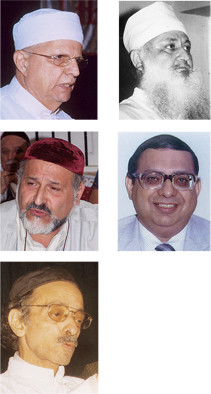
Clockwise from top left: Jamasp-Asa, Kotwal, Ranina, Doctor and Mistree
After a public meeting, scouring of the countryside for likeminded anjumans, disruption of the Federation meeting at Ahmedabad in December 2004 and a power point presentation to the Bombay Parsi Punchayet (BPP) trustees (no hard copy available for now) to make them see the error of their way before they agree to join the world body, Khojeste Mistree of Zoroastrian Studies says he has a "whole team of people — individuals as well as anjumans — behind his proposed world alliance of Parsi/Irani Zarathushtis.” Though the name of the body is not yet finalized, the body "will protect Parsi/Irani interests — and maintain the Parsi/Irani nomenclature intact — in harmony with the definition in the FPZAI constitution which is in consonance with what our settlors had intended.” Mistree says his power point presentation had "analyzed line by line the draft constitution (of the IZO) given to us.” He claims that his "opposition is both legally and intellectually strong... The draft constitution at the level of principle, after so many years of discussion, is flawed in structure and membership requirement.” He says he has had it professionally analyzed "from an India-centric point of view” and the results are "absolutely appalling...the constitution drafters have made a hash...It’s pathethic because the formulation is so amateur, it’s not worth looking at. Or there is a secret agenda to promote conversion over a 10-15-year period... The draft should be sound in principle so that (the interpretation) can’t change unless we change it. If our own Federation had thrown out the Delhi Parsi Anjuman (DPA) (for accepting non-Zoroastrian spouses as members) with what face can the FPZAI join such a world body?” (The DPA withdrew as part of a compromise formula to draw the BPP back into the Federation — Editors).
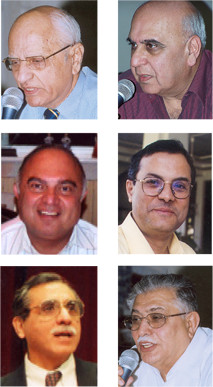
Clockwise from top left: Shroff, Tamboly, Mistry, Gandhi, Rivetna and Mehta
Claiming the support of 49-50 anjumans of India, Mistree says he is "sad that the media has not recorded the mood of the people.” According to him the "Hullabaloo (in Ahmedabad) was for just under 10 minutes. On Sunday they (the Federation secretary/president) could have taken a vote, yet they dismissed it out of hand. We will battle democratically but efficiently. The leadership will have to take cognizance. They can’t go on with this sethia mentality... If the voice of the people is not followed, then the Ahmedabad kind of situation (is bound to occur)... Is it right that the (world body) matter was not put on the agenda?
"The issue as far as I am concerned is respect the voice of the people... As against the BPP claim to represent 45,000 people, we have support from across the globe...I expect that (our) new organization will be based in Bombay. We’ll be launching it quite soon. I can’t say when. We’ll decide on an auspicious day and launch it. It depends on how soon we get the feedback. To date the BPP has been the traditional Parsi Irani body. It has de facto looked after the traditional point of view until 20 years ago...(On our side) everything is open, above board. At the Congress [Eighth World Zoroastrian Congress (WZC) scheduled for June 24, 2005] we will succeed in our objective. The high priests are sure they would be respected by Parsi/Irani interests. We have consulted them, sought their blessings. They see merit in what we are doing...
"Tell us where we are wrong. How much more democratic/open can one be in view of all the terrible things hurled at me? Did the Federation secretary bother to call us up when 29 anjumans wrote to him? There was not a pipsqueak of a letter from him. If people say there was agitation, who’s to blame?
"We are firm on our side. Our movement will not stop. Don’t discuss the whole thing as Khojeste Mistree and his group of supporters. Reassess the position. Listen to the tapes. What are these people making such a noise about?” Mistree advised us, adding, "Firdosh Mehta (president of FEZANA — Federation of Zoroastrian Associations of North America) is scheduled to launch the world body in July. We have to be proactive. Ethnicity is a part of the Zoroastrian religion... I am curious to know about non-Iranian Zoroastrians. How have they survived? It is not just a question of ethnicity in terms of race. These Zoroastrians are coming with Muslim baggage. The Gathas are promoted at the expense of other scriptures...(Ali) Jafarey is trying to promote the Gathas as the only scriptural body at the expense of the tradition. It is very similar to what Muslims follow as the supremacy of the Koran and the Hadith. An Islamicised version of Zoroastrianism is palatable to those whose ritual base is very weak because in Islam there is no strong ritual base as we have in Zoroastrianism. Jafarey’s version will gain currency in North America and in other parts of the world where his missions are converting. He has a right to do whatever he thinks, whatever he wants, just as we are doing.”
"Let us immediately form a world body with headquarters at Bombay in which membership is open only to Parsi/Irani Zoroastrians as per our federation constitution as well as all the anjumans of India also,” writes Areez Khambatta, vice president of the FPZAI and president of the Ahmedabad Parsi Panchayat, in an open letter dated February 7, 2005 addressd to the presidents/trustees/secretaries of all Parsi/Irani Zoroastrian anjumans of India.
According to taxation expert and former BPP trustee Homi Ranina it is "still premature to talk about” the intended body of Parsi/Irani Zoroastrians. There should be no objection to joining the WZO body if its membership rules conform to those of the FPZAI. The resistance is to the membership of some "so-called converts” who have no statutory existence. "We have no mechanism to convert. Who has the right? The authority?” he questions, comparing the Zoroastrian situation with that of Muslims, Christians. "It’s a commonsense approach. Even for membership of a sports club the candidate is interviewed by the managing committee. What converts are you talking about? I understand that FEZANA/WZO consist (mainly) of Parsi Zoroastrians.” Ranina says they can form the world body. But "where are the millions, now or in the future?” If membership is open to anyone who professes the Zoroastrian faith, "we must know if he has renounced the religion of his birth.” Else, Ranina says, a man may profess one faith today and another faith tomorrow. "Go to the other religions and find out what is the procedure they follow if you want to convert to them.”
Ranina says he is not aware of the body Mistree is setting up but will support it if it protects Parsi/Irani Zoroastrians. Registering his opposition to the world body as currently conceived, he says, "The BPP/Federation have no right to join it. Driven to the wall we will not stop from taking legal steps. People have not applied their mind. I get confused with what’s happening. Why do you need the world body? FEZANA, ZTFE (Zoroastrian Trust Funds of Europe), WZO fall into the traditional definition. Narrow down the controversy to spouses. Set up some mechanism in the constitution regarding the children of Parsi women. A carte blanche does not exist even among Muslims or Bahais.”
"The Parsee Voice has made it very clear that there should be no world body,” says the traditionalist publication’s editor Adi Doctor. He is equally averse to the IZO venture and the traditionalist concept.
On the other side of the great divide opinion continues to be firm but conciliatory. Sitting in the line of fire, BPP chairman and FPZAI president Minoo Shroff notes. "The federations abroad are aware of the general commotion in Ahmedabad...As long as our valid concerns are met — not only the emotional ones — the BPP/FPZAI can’t just withdraw from the leadership role in the diaspora,” adding, "I have to carry my board with me.”
BPP trustee and WZO loyalist Dinshaw Tamboly, who has been the principal of deviously aimed target of the traditionalists, told Parsiana, "So far there is no decision at the BPP. We have asked the overseas federations to review the requirements of the traditionalists. We are trying to eliminate religious topics from (the ambit of) the world body.”
FPZAI honorary joint secretary Keki Gandhi says he is "very confident” that the world body will be formed "on our terms... pragmatism and common sense will prevail.” The anjumans will distinguish between "the hysteria which has been stirred up and what is good. They will think for themselves and not be pressured,” he stated.
There are said to be only three copies of the draft constitution of the IZO. It is probable, according to the grapevine, that Mistree’s power point presentation dealt with an earlier draft. In the meantime FEZANA’s member associations may be analyzing the demands made by the orthodox (see "Memorandum of dissent,” Parsiana, January 2005) and in an effort to carry India along with them into the new world body may nominate only Parsi/Irani Zoroastrians on the board of the WZO-F. According to his statement published in the Jam-e-Jamshed (January 30, 2005) WZO Chairman Sammy Bhiwan-diwalla has committed the WZO-I to nominate only Parsi/Irani Zoroastrians to represent it on the IZO for the first decade of its existence.
Mehta discusses the three dilemmas that confront him: the question of "Who is a Zoroastrian,” the role of ethnicity in the religion and how the community needs to respond to neo-Zarathushtis. He addresses all these from the point of view of the community in North America where social mores are vastly different from those in India. In his editorial article in the FEZANA Journal (Winter 2004) he notes that the FEZANA constitution’s clauses pertaining to the promotion of the study, understanding and practice of the faith, its promotion and perpetuation, dissemination of information, etc "were not intended to be applied to non-Zarathushtis, but mainly to the community itself.” This, added to the guaranteed autonomy of each member association, means that "conversion or acceptance is left at the local community and individual levels,” he notes.
ZTFE president Dorab Mistry, in response to an email query from Parsiana, clarifies the stand of the London body: "ZTFE recognizes the need for establishing a world body. In an ideal situation and if we were starting from scratch, that world body would be a body of federations and institutions. However, in reality, WZO already exists. Therefore we thought we had formulated an appropriate umbrella body called the IZO whose two arms WZO-F and WZO-I would be autonomous and yet linked. It could be a win-win situation for all stakeholders.
"The issues raised in India go beyond what is being proposed. Some of the misgivings of people in India can be appreciated and that is why ZTFE representatives agreed to safeguards. The position of our traditional friends is that the safeguards are meaningless.”
As for Rohinton Rivetna, one of the original architects and chief protagonists of an apex body of Zarathushtis at the global level, believes, "We should hold our position with the progress made thus far. We should continue to build public opinion in support of the concept and in support of the India leadership position. And, of course, we should continue to understand the fears, and work on the charters to include safeguards and filters until we can appease the fears.” Indeed, in his ever-inclusive, nurturing style he hopes to evolve the IZO towards a global alliance to provide a forum for many world level bodies — each completely autonomous — to come together. In such an alliance — a forum only for discourse and dialog with no power or authority — there could be room for Mistree’s Parsi/Irani world body of individuals, as notes an e-mail from FEZANA Journal editor-in-chief Roshan Rivetna.
The launch of the IZO has been billed for the Eighth WZC to be held in London in June 2005. Under the IZO umbrella will function the WZO-I with its emphasis on social service and the WZO-F with a political purview, able to represent the Zoroastrians of the world at the level of the United Nations, especially if circumstances like the Islamic Revolution in Iran in 1978 were to recur. The WZO-I and the WZO-F would be equally represented on the board of the IZO whose main purpose is to bridge these comparatively disparate bodies and present a single apex structure as desired by the community.
History
The WZO (now to be renamed WZO-I) was formed around 1980 to deal with the exodus of Zoroastrians from Islamic terror in Iran. Since then it has been a source of funds and service in getting such individuals settled elsewhere, in soliciting funds for expensive life saving medical treatments in the West, in the regeneration of the rural Parsis of Gujarat who had sunk into depths of penury and in providing microfinance for entrepreneurial startups. Membership of the WZO was open to individual Zoroastrians as also to anjumans, several of whom did become its members, though their voting right was a single vote like that of any individual. Sometime in the mid 1990s the WZO amended its membership clause to include the non-Zoroastrian spouses of the members in the interest of keeping families together.
Though the WZO was keen to include the BPP and the Federation among its members since the early 1980s, the parity in voting rights between anjumans and individuals was not acceptable to these bodies. Some time after the city based associations of North America joined together in FEZANA, the need for a world forum where international federa- tions could confer was appreciated in India and North America. They then began the pursuit of a dream of a world body to represent the far-flung community, especially when stray cases of Zoroastrian victimization on an international level came to be known.
In Europe, the oldest Parsi settlement was based in London. Founded in 1861 by such individuals as Dadabhai Naoroji and Mancherjee Cama, it is now known as the ZTFE and represents the Zoroastrians of UK as well as the smaller settlements on the continent. Indeed, the WZO was spawned by ZTFE at a critical time in Zoroastrian survival. However, the two organizations drew apart when a more orthodox managing committee of the ZTFE enforced customs considered antiquated in the western setting like preventing non-Zoroastrian spouses from attending/viewing religious ceremonies. The years of schism (1987-2000) marked a vitriolic relationship that obstructed attempts to form an apex structure of international federations. The long patient negotiations resulted in an understanding reached in July 2004. In Shroff’s words, "Convergence of the ZTFE and the WZO was so difficult. Bringing them together was a breakthrough.”
This acid test of give and take which Zoroastrian negotiators perceived as a win-win situation for all members of the community, everywhere, suddenly hit the shoals of orthodox vituperation at the Federation meeting in Ahmedabad in December 2004 (see "World body stymied,” Parsiana, January 2005). The object of the ire is the membership clause in the proposed world body which embraces the Zoroastrians of the world, in deference to Iranian sentiment. The conservatives feel that the Parsi identity — a racial connotation that flowered on the Indian subcontinent thanks to the achievements of the community, largely under British rule — is being submerged. As a proposed global player the IZO also takes cognizance of the emerging Zoroastrian yearnings of the peoples of Uzbekistan, Tajikistan and other Central Asian republics who are digging out their old Zoroastrian affiliations to the great empires of ancient Iran.
For a diminishing community that has spread itself thin all over all the world, Roshan Rivetna emphasizes, "The key to our existence is coming together... We can only hope that in our zeal to save our ‘Parsi-panu’ we don’t lose the Parsi.”
◆ ◆ ◆
From the archive