
Comment
On becoming a Zoroastrian in Italy - I
The author writes of his interest and eventual conversion to Zoroastrianism
Michele Moramarco is a subscriber to Parsiana and at the magazine’s behest has written an article stating how his interest in Zoroastrianism originated, culminating in his navjote in Italy. The first of his three-part article deals with his exposure to and interest in Zoroastrianism. The remaining two extracts deal with his understanding and practice of Zoroastrian precepts and his plans for furthering the study of and interest in Zoroastrianism in Italy and elsewhere.
On roz Bahman, mah Avan, 1373 AY, I received the navjote by a fully ordained Zoroastrian priest. This personal event took place in my hometown, Reggio Emilia, northern Italy. The venue for the holy ceremony was the Patanjali Center, a sort of Indian cultural outpost that looks out on a road where, in times gone by, an affluent of the great Po river used to flow.
Also appropriate for a month dedicated to the waters was the weather, cloudy and moist, but one could certainly feel the powerful touch of swift-horsed Khorshed Yazad as the mobed poured rice and rose petals on me while reciting the Doa Tandorosti at the close of the exalted ritual.
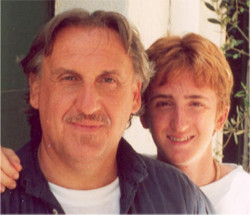
Moramarco with son Grazi-ano: living as a "visible” Zoroastrian
I had been waiting a long time for that moment, though I had stated my decision of petitioning for a navjote only one year before, in a letter to an Iranian-American acquaintance.
I never thought the investiture would suddenly or once and for all transform my inward life. I didn’t have any miraculous expectations (after all, European Enlightenment, the philosophy of reason, had played a major role in my spiritual growth). But I did think that it would "seal” the changes which had taken place in me during the previous 30 years. Plus, that it would add a strong push upwards. And all this has happened.
I asked to be initiated because, after professing the tenets of the Good Religion for some seven years, I was sure that the ritual reception of Mazdayasna would strengthen my will to carry on along this sublime path. Giving a clear form to my innermost yearnings seemed to me a bit like linking menog and getig, the two states of being which at the time of Frashkart, according to Zoroastrian eschatology, will be perfectly balanced and fused.
I was living — or at least endeavoring to live — as an "unseen” Zoroastrian. I decided that I wanted to keep on living and eventually to die as a "visible” one. I’ll be forever grateful to the learned and sensitive mobed who gave me this chance.
When we got out of the Patanjali Center, the mobed rejoiced in the rain that had started falling softly but insistently. I asked him why: after all there were four of us with only one umbrella within reach, and we had to walk a long way. "Ask the trees,” he replied quietly. Summer had been exceedingly hot and dry, and the simple wise words whispered by the mobed unveiled to my eyes the twin jubilation of Khordad and Amardad.
A long path leading to Daena
My name is Michele Moramarco. I was born in 1953 and raised as a Catholic. From the age of seven, I started having some sort of spiritual experience, like being moved to tears of joy, in a dark church aisle, by the light of a white candle which spoke of God to my tender mind.
At the age of 12 I began to question many of the Christian/Catholic dogmas: among others, I couldn’t accept the idea of an exclusive "incarnation” of God in history and, even less, that of an "eternal damnation.” A close schoolmate of mine, a nice and amusing kid named Dennis, had died of leukemia and I was upset — even outraged — by the commonly held, yet blasphemous idea that God had willed and created death. I could conceive deity only as the perpetual source of life and light.
In 1968, a year of social turmoil in the western world, I was a 15-year-old long-haired lad seeking for new meanings in life, so it was only natural for me to discard all religion and join the libertarian movements.
I was a high school student with a conspicuous interest in English, history, philosophy and music (in good music of all kinds I’ve always perceived the echoes of Garodman), but spent a lot of time as a political activist, and often went to Carrara, among marble-quarrymen, where the headquarters of the anarchist movement were located. Italian anarchism was mainly a humanistic movement; followers of Leo Tolstoy and Mahatma Gandhi also belonged to it, pursuing the utopian vision of a perfected mankind, able at last to govern itself peacefully without the need of any outward power. For a while I found an ideal haven in it; in the light of events, I can say it was a pre-religious experience.
At 17, I distinctly felt the call of the spirit, and after the years of denial I turned to the religious dimension with a new awareness. As an "angry” young freethinker, I was interested, above all, in eastern religions — the Beatles had just opened the doors of India to western teenagers — and in so-called heretical groups, such as the Christian Cathars and the Manichaeans. It was at this point that I first ran into Zoroastrianism, which many scholars described as the remote background for all those who refused to bow to a tyrannical "God.” From the very start I felt at ease with the friendly, just, pure and healthy image of Ohrmazd. I could only worship a Rayomand and Khoremand God who would have nothing to do with evil. The puzzling and discouraging problem of all the absurd ills which afflict nature and man, became the trembling focus of my reflections; the solutions offered by Catholic theology and language seemed unsuitable. But I was obviously rooted in the Christian tradition, and, being of a loyal disposition, I didn’t want to leave the fold. So I decided to explore those fringes of Christianity which could offer nobler, higher and more rational ideas of God and faith. I found something of this kind among Quakers, Unitarians, Universalists and Liberal Protestants. Ideas like the universality of revelation, the relevance of reason and conscience in religion, the presence of an "inner light” in all creatures, the prophethood of Jesus (instead of his being part of a baffling Trinity, devised and imposed by riotous church councils), the final salvation of all people, were current among them and appealed to me. At different times I was in communion with each of these minorities. In the late 1980s and early ’90s I was listed as the Italian contact in the directory of the Unitarian Universalist Association (UUA) of Boston, and on the Inquirer, a London unitarian periodical, a couple of articles appeared dealing with my religious activities. Now the UUA, I discovered quite soon, had become much too liberal: even atheism could be preached at their pulpits, and as far as lifestyles were concerned, absolute freedom was admitted. This really put me off and I quit belonging, though I kept holding the original Anglo-American free religious tradition in high esteem, for its intellectual soundness, theological richness (the English review Faith and Freedom, for instance, makes fascinating reading) and ethical commitment to peace, right sharing of world resources, etc — enough to make me decide that I still wanted to commune with them, albeit from a critical standpoint.
Meanwhile, I had continued to study Zoroastrianism with a sympathetic attitude, with the sources available in Italy at the time.
In 1975 I had been made a mason. Italian Freemasonry used to have strong philosophical connections; its symbolism of building and its enlightened universalism appealed to me. In 1977, the year I graduated in philosophy with a final dissertation on the great Hindu thinker Shri Aurobindo, I wrote my first book on the subject (in 1990 it was also translated in Russian and published by Progress publishers in Moscow). My best accomplishment in the field of masonic studies has been the authorship of the Nuova Enciclopedia Massonica (in three volumes, 1989-1995) favorably reviewed by the field magazines and the Press at large. A few inadequate pages of that work deal with the symbolical and historical relationships between Zoroastrianism and Freemasonry (the historical ones having to do mainly with the masonic membership of many Parsi philanthropists and scholars of the past two centuries). I think the masonic ethos which, for instance, emphasizes solar symbolism — Amadeus Mozart wrote a wonderful lodge hymn devoted to the sun as the "soul of the universe” — contributed to increase my interest in Zoroastrianism. To be continued
◆ ◆ ◆
From the archive