
Zoroastrians Abroad
FEZANA at the UN
An eight-member team from the Federation of Zoroastrian Associations of North America — United Nations/Non-Governmental Organizations (FEZANA-UN/NGO) led by management consultant Shahrokh Mehta of Syracuse, New York, participated in the 48th session of the Commission on the Status of Women at the United Nations headquarters in New York, March 1-12, 2004, notes a press release from Afreed Mistry of Toronto. The theme of the conference was the role of men and boys in achieving gender equality and women’s equal participation in the prevention, management and resolution of conflicts and in post-conflict peace building, writes Mistry.
The program included the celebration of International Women’s Day on March 8, the theme being "Women and HIV/AIDs.” UN secretary-general Kofi Annan inaugurated the event putting the global situation in perspective. The ensuing panel discussion focused on the impact of the disease on women, the spread of HIV due to migration and trafficking in persons and on activating community support for individuals and families and thereby restricting the spread of infection.
The afternoon of March 5 was reserved for a two-hour panel discussion on "Microfinancing — A Step Towards Uplifting Women” presented by four members of the FEZANA team. The session, which covered the basics of microfinancing, what works and what doesn’t, case studies, the Grameen Bank’s history and success factors, and an implementation plan, was held in the Boss Room, Church Building across from the UN on 44th Street. The aim was to prepare the over 900 participating NGOs (non-governmental organizations) for the forthcoming UN proclaimed International Year (2005) of Microfinancing.
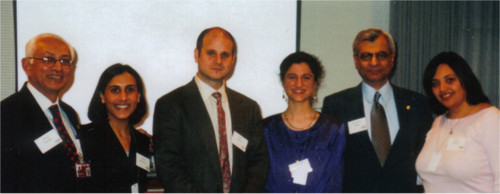
At the UN (L to R) Gandhi, Bilimoria, Karlan, Mirza, Mehta and Mistry
The 20-year-old concept evolved by Mohammed Yunus has changed the face of Bangladesh and inspired projects in more than 50 countries, notes the press release. The concept of lending money to the poor so that they can work their way out of poverty, change their lives for the better and pay it back, has inspired many microfinance projects in over 50 countries. About 90 percent of the people that are on microcredit are women. The reason being that women are more reliable in paying back the money, states the write-up, adding that the women in developing countries, normally not treated on par with men, feel empowered when trusted with the credit. These women have been known to not only transform their own lives, but that of their family and community. The goal of the Microcredit Summit Campaign is to reach 100 million of the world’s poorest families with credit for self-employment and other financial and business services by the year 2005, says the press release.
An active member of the North American Zoroastrian community, Mehta is president of Integrated Technologies, LLC, a management consultancy firm. He is said to have assisted over 200 businesses in building companies of world-class standards and has coached senior corporate executives in implementing value-driven strategies, as per his bio data forwarded by Mistry. Having lived and worked in several developing countries, Mehta was well able to present the positive impact of microfinancing in the eradication of poverty and the empowerment of citizens.
Prof Dean Karlan, assistant professor of economics and international affairs at Princeton University, whose work focuses on assessing the impact of microfinance programs in South Africa, Philippines, Peru and Brazil, has studied the impact of consumer responsiveness to interest rates, the integration of business and health training, the provision of loans in kind and better access to markets for farmers. Karlan shared with other participants his knowledge of the economics of microfinancing, its advantages and disadvantages.
Toronto based doctor of naturopathy Roxanna Mirza who has worked with homeopaths and naturopathic hospitals in India presented case studies from Poona and Pabal which she had experienced firsthand.
A senior at Stanford University majoring in international relations and economics, Nina Bilimoria presented an implementation plan for other NGOs to follow. Bilimoria is the 2003-04 chair for Stanford in Government, a non-partisan, public service organization committed to promoting political awareness and activism in society, notes the bio data.
Homi Gandhi of Glen Rock, New Jersey introduced FEZANA, which is dedicated to the task of promoting the study, understanding and practice of the Zoroastrian faith and the welfare of its followers and holds a consultative status with the UN’s ECOSOC (Economic and Social Council), to the audience.
Other members of FEZANA’s team were Ayesha Ghadiali of Baldwin, New York, Susan Karani of Manhattan and Mistry. Mirza, Gandhi and Mistry had a happy meet with the Canadian Ambassador to the UN when they attended a reception he hosted for the Canadian delegates at his suite at the Trump Tower.
◆ ◆ ◆
From the archive