
Zoroastrians Abroad
“A lot of good goes unnoticed”
Hutoxy Contractor and Freyaz Shroff discuss what it takes to provide critical assistance and welfare in North America
"The mindset of the community has changed,” says Hutoxy Contractor, president of the Zoroastrian Association of Pennsylvania. "Our elders never went to lectures or talks. They lived the life. Their value system was Zoroastrianism. It came naturally to them. Now it’s ‘What is there for me? Is my name going to be up there?’”
Contractor, along with Hosi Mehta, president of the Zoroastrian Association of Metropolitan Chicago and sociologist Freyaz Shroff constitute the Welfare and Critical Assistance Committees of the Federation of Zoroastrian Associations of North America (FEZANA) – three well meaning people living in different parts of North America who work by computer and telephone to alleviate the problems of domestic violence, enforced separation of families, economic and social deprivation that affect immigrant Zoroastrians. But their concerns don’t end there.
During their visit to Bombay recently Parsiana had the opportunity to chat with Contractor and Shroff, to learn more about what the committees have to reckon with and what propelled the two ladies to shoulder the task.
Critical or immediate need defines critical assistance: for example, a woman abused. But a poor Parsi who can’t meet the rent or faces eviction in six months falls in the category of general welfare, they help distinguish between the working of the two committees. Volunteers provide emotional support and they have a database of Zoroastrian volunteers in various parts of the continent. However, one must "ask people again and again whether they’d like such support. In 99 percent of cases they don’t want it,” says Shroff.
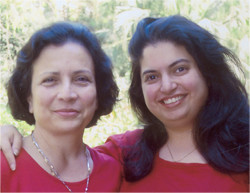
Hutoxy Contractor (L) and Freyaz Shroff: vibing together
"Critical assistance often gets a bad rap,” notes Shroff, who chairs the Critical Assistance Committee, adding, "People think it is only for battered women. It’s not, though it started out like that. It has now grown into family assistance…We are addressing education, housing, medical problems — doing much more than domestic violence.” She is cryptic in her description of their work: "There have to be boundaries, rules which we must follow.” Confidentiality is the keynote and cannot be violated at any price. She refers to a family separated by the Atlantic Ocean – the father and one child who had come pre 9/11, to the US; the mother and two other children stranded in the subcontinent because rules changed before they could make it to North America. "People are having problems surviving,” states Shroff tersely. Sexual abuse and its impact on teenaged children is corrosive. Also, "domestic violence is as common in highly educated, high income families, though it is generally less reported,” she adds.
"There is a shelter for Indian women in Chicago. When we tried to get a case in, we were told there was no space!” recounts Contractor adding, with a trace of incredulity, that people in the community had accused them of causing broken homes!
The ladies emphasize that it is not within the committees’ mandate to assist with immigration or legal issues. They say they are very careful that FEZANA, as an institution, is not involved in any matter that would jeopardize its standing in the country. So when such problems crop up, they help put the troubled party in touch with a good lawyer in Chicago or with other relevant agencies.
Helping people consumes time and money. Shroff is consistently at work on her computer or on the phone. A fundraiser in Chicago netted $ 30,000, says Contractor and two additional endowments have been established to enable them to continue with their work, one by Hoshedar and Anahita Tamboly of Tampa, the other by Firdosh and Yasmin Bhathena of Boston who have donated Cisco stock to create a 100,000 dollar endowment. "By nature we are hands-on people. That’s how we’ve gained people’s trust, confidence,” asserts Shroff, adding, "We can account for every penny.” Since 9/11 banks have become quite particular about how accounts are maintained, they tell us.
FEZANA treasurer Ketayun Kapadia maintains an escrow account for welfare/critical assistance which Contractor and Mehta operate. "Hosi uncle is an integral part of our work,” acknowledges Shroff who keeps count of the income and expenses on her excel sheet.
Contractor notes that the committee often sends money to local associations involved in relief work though they are free to do their own fundraising. For example, in the aftermath of the New Orleans floods they had sent a cheque of $ 5,000 to the Houston Association which had come to the rescue of the beleaguered Zarthoshtis of the devastated areas to further empower them. But they have also sent gifts to the librarian of the Meherjirana Library in Navsari, helped the family of a victim of the Bombay train blasts in 2006, sent $ 7,000 to the Surat Parsi Panchayat to help them deal with the victims of the floods last year. An update on the committee’s work in the FEZANA Journal (Spring 2007) urges the North American Zarathushtis to help the work of the Young Ratheshtar Group of Bombay that distributes essential supplies to destitute community members in Gujarat. In the same update Shroff also requests assistance to the S. P. J. Sadhana School for the mentally challenged. Noting that it supports autistic and mongoloid children, Shroff writes, "Over 50 percent of the children attending are Parsi Zara-thushtis.”
The Contractor tradition
Contractor has been involved in community social work for the past 25 years, attributing the inspiration to her Gandhian father-in-law, the late Dr Minochehr Contractor of Surat who with his wife Dinamai had been among the founders of the Parsi Pragati Mandal. His motto had been, "God, give me the opportunity to do good in life and the health to do it.” He would say "very few people are lucky enough to get the opportunity to do something (good) in life,” recalls Hutoxy, noting that 50 percent of his practice was charity work. "We used to be ‘chothias’ (tax collectors for the nawab) before we became ‘contractors’ to the British. Minochehr’s father Kaikhushroo was a civil servant who would help his jailed compatriots,” Hutoxy traces the family’s antecedents. Herself a daughter of bonesetter Darasha Randeria and Perin, Hutoxy’s maternal grandfather Edulji Kolah was the founder of E. F. Kolah whose pickles and chutneys have titillated generations of Parsi tastebuds. Her father too didn’t charge Parsi patients and served the poor free of charge in Ahmedabad. She grew up in a home where her parents, though not rich, worked within their income to provide anaj (food grains) and money to a couple of disabled persons every month. And no one who visited was allowed to leave without a meal.
Married to Dr Farhad Contractor, Hutoxy says her husband "didn’t want me to be in the kitchen or on the phone. He wanted me to do community work and never questioned my decisions.” An accountant by profession who had worked with Tata Consultancy Services, she has been involved with the Hindu community which raised half a million dollars to acquire a room in the Cathedral of Learning at the University of Pittsburg — one of 23 museum quality rooms used as classrooms reflecting the culture of various nationalities. The Indian room is modeled on the ancient University of Nalanda but there is also a copy of the Avesta and Parsi Zoroastrian artifacts "to spread awareness of who we are and where we come from,” notes Contractor. She has been involved in the Indian Physicians’ Auxiliary, an organization co-founded by her husband Farhad which is supported by the Swaminarayan Group. She has been involved in interfaith activities and worked with the Easter Seal Society which cares for mentally and physically challenged children, has served two terms as the first minority trustee of a school where participants included the CEOs of major corporations. "We raised 18 million dollars in two years. The American people give handsomely in the name of education. Their whole way of thinking is different. The Indian community wants to see their own names,” Contractor acknowledges the variance in approach.
The extent to which family tradition can affect young minds is reflected in the approach of her daughters Laila and Cyra. The fifth generation doctor in the Contractor family, Laila is a psychiatrist who gets a government grant for running a clinic in a poor black neighborhood of Pittsburg. Engaged to be married to IT businessman Homi Bodhanwala of South Africa (the wedding will have been solemnized while this issue is in the press) Laila has her fiancé’s full support in her social work, declares her mother.
The younger Cyra, who works for C. B. Richard Ellis, one of the largest commercial real estate firms in the world as notes Hutoxy, started by mentoring a poor lady while she was posted in Washington DC, where her bosses supported her community work. She has now begun a program to provide birthday cakes to the children of battered women with the support of her employers. "US companies really back you up (in social service commitments), have a 50-50 matching program for charities,” notes Shroff.
Contractor differentiates the FEZANA approach as "very positive …not interested in names but in the advancement of the community. It has been a pleasure to work with (former FEZANA president) Firdosh Mehta; he has really helped the youth. As for (current president) Rustom Kevala, you can’t say enough about him. He said ‘Just go ahead and do it’…He doesn’t want to be a micro-manager. (FEZANA vice president) Bomi Patel is also very good as is finance chair Dr Jerry Kheradi… They have given us free rein.” Sharing credit with coworkers Hosi Mehta ("we couldn’t have done it without him”) and "professional expert” Shroff, Contractor is also appreciative of Zoroastrians who man soup kitchens in their areas: "People come by bus and give of their time.”
Shroff’s experience
It was while doing her bachelor’s degree in sociology (followed by a masters in business administration) that Shroff got involved in domestic violence. Her thesis paper was on domestic violence in India and America. As a third year student she says she did an internship at a high risk shelter where battered women are brought in by the police. Located at an undisclosed address "because they don’t want the husbands to know,” the women in their early twenties came "in all kinds of conditions,” recalls Shroff and are sheltered there for a maximum 60 days. "You had to do everything in your power to get them back on their feet in 60 days. It meant finding a volunteer attorney who is ready to take your case, accompany the woman to court, get a temporary restraining order within a few days of her coming to the shelter, sometimes the same night. They were high risk cases, hence the urgency.” When the counselor there quit, Shroff became a case worker but couldn’t be counselor as she was not a qualified therapist.
"I am a business minded person; I do all my work with that mentality. Work flow must be logical even in a non-profit organization!” Shroff is emphatic. The daughter of businessman Kurush and Nivi (née Nivi Jamshedji Shroff – "a unique case where they are totally unrelated!” as declares Freyaz) of South Carolina, she has a younger sister Nazneen who works with the parents. Freyaz describes herself as "not a politically correct person. I will say and do what I have to say and do, go with my values. I know I can’t be bought.” Americanization has not eliminated Freyaz’ religiosity. She says she always lights a diva and prays, believes in old age wisdom, the need for guidance and that good souls attract other good souls. "Freyaz doesn’t need to do all this work. She could be sitting on the beach, sunbathing!” avers Contractor.
When one is brought up in a different country, one grows up differently, feels Contractor. Though they are a generation apart, Contractor (as also Mehta, they are quick to point out) and Shroff vibe well together because "our upbringing is very similar. The family instilled values, but we had to learn about the religion on our own.” For Shroff to answer questions at college; for the others, to answer their children.
Imbibing Zoroastrian values leads to other spinoffs: Hutoxy and Farhad Contractor’s anniversary gifts were encashed and the proceeds went to the welfare fund. These people often gift each other by sponsoring a child on World Vision, as notes Shroff.
During her trip to Bombay Shroff had shown a desire to work for a non governmental organization here to widen her ambit of experience. The Parsi Resource Group (PRG) wanted her on board and the ladies, much "impressed by PRG transparency” were thinking in terms of a symbiosis between the FEZANA Welfare Committee and the body floated by builder Jimmy Mistry. "Younger Zarathushtis want to help, but they want accountability. We tried to start a project like World Vision with a Parsi orphanage in India but the director didn’t cooperate. If there was transparency, I know the North American youth would participate. If they could come and meet the children, they would even do mentoring. I have an optimistic view of the Zoroastrian community. People do a lot of good that goes unnoticed because there are some who don’t want to live the Zoroastrian way of living,” says Contractor.
"The incoming ZYNA (Zoroastrian Youth of North America – a body under FEZANA) is starting to develop a leadership academy for youths... If you go to a youth congress and an ordinary congress, you will see the difference,” Shroff told us, adding, "I bet you a million to one that even here the youth would have the same mentality. The mental divide between the old and the young is incredible…The awareness created by the motorcycle rally (organized by PRG) was big time. The PRG has got 200 volunteers who go from door to door to collect funds for their goals. I like his (Mistry’s) philosophy. I like his attempt to mobilize the grassroots. People can pledge Rs 50-100 per month…(The idea is) see how much money we have — we don’t need gifts!”
"He is trying to run it as a business and has the foresight,” concurs Contractor. However she does feel pretty strongly that "if Zoroastrianism survives anywhere, it’ll be in North America because of FEZANA leadership which has given the youth autonomy…”
◆ ◆ ◆
From the archive