
Zoroastrians Abroad
FEZANA at the UN
"Thousands of non-governmental organization (NGO) representatives from over 80 countries joined together with United Nations Secretary General Ban Ki-moon in blowing their whistles to mark the launch of the global campaign ‘UNITE: To End Violence against Women’ which will continue till 2015; and to officially open the 52nd Commission on the Status of Women (CSW) event that was held at the United Nations headquarters in New York from February 25-March 7, 2008,” writes Mantreh Atashband in an e-mail to Parsiana. Atashband, who has been involved in the HIV and AIDS movement for over a decade and has been advocating for people living with HIV (especially women and girls) locally, nationally and internationally, is part of the executive board of directors for a local Sexual Assault/Rape Crisis Centre, where she works towards the eradication of sexual violence against women and girls. She along with Afreed Mistry, Shekoufeh Zonji, Gautam Ivatury and Farah Minwalla formed the FEZANA (Federation of Zoroastrian Associations of North America) team led by ZAGNY (Zoroastrian Association of Greater New York) president Homi Gandhi that participated in the event.
The Zoroastrian delegates conducted a well received panel discussion on "Technology and the private sector bringing solutions in financing to impoverished communities.” The panel presented the different facets of development work, illustrating how NGOs, the private sector and innovative tools like microfinancing and technology such as cell phones play a crucial role in poverty alleviation, states Atashband.
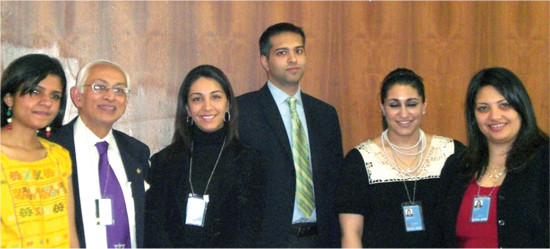
L to R: Shekoufeh Zonji, Homi Gandhi, Mantreh Atashband, Gautam Ivatury, Farah Minwalla and Afreed Mistry at the UN headquarters
"Mistry from Toronto spoke about India’s largest private sector bank, ICICI, who has contributed to alleviating poverty by providing small loans to rural women, empowering them to lift themselves out of poverty. Zonji from Toronto provided vivid examples from her internship with an NGO, Walking Together for Health and Development (WT) in the rural indigenous village of Tlamacazapa, Mexico, and showcased the multiple struggles women face living in acute poverty and the importance of holistic approaches to financing,” Atashband documents the part played by her teammates. Atashband writes that in her speech she used a case study from South Africa that has resulted in a decrease in gender based violence, and hence incidence of HIV, to emphasize the urgency of synergistic partnerships between NGOs and the private sector.
Other key issues discussed at the 52nd CSW event included the importance of gender perspective on climate change, and increased participation of women in conflict resolution. The CSW event was brought to a close with the celebration of International Women’s Day on March 8, 2008 with the theme of "Investing in women and girls” when Ban Ki-moon stated that "investing in women was not only the right thing to do, it was the smart thing to do,” reports Atashband. He also pledged to work to strengthen the UN Secretariat’s own gender machinery and concluded by announcing plans to significantly increase the resources of the UN’s Division for the Advancement of Women, writes Atashband who had been the communications chair for the 2007 North American Zoroastrian Congress-IMPACT.
◆ ◆ ◆
From the archive