
In Memoriam
Anklesaria's administration
Died: Rustom Kaikobad Anklesaria, 82, former municipal commissioner of Ahmedabad and erstwhile chief executive of the Bombay Parsi Punchayet (BPP) on December 31, 2003 following cardiac complications.
"He was such a wonderful asset when I was chairman of the Punchayet,” conveyed Dr Aspi Golwalla in his condolence message to the family. During his "long and meritorious service” of 14 years as chief executive, "a post first ever created in the Parsi Punchayet Bombay,” Anklesaria had impressed those around him with his "tremendous energetic, forceful personality, social demeanor...sense of humor...zeal for perfection...dedication to the service of the community...” as noted the scroll presented to him when he retired on August 12, 1995.
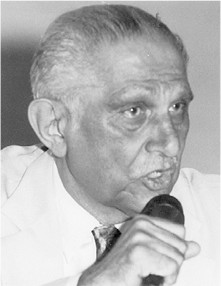
Anklesaria: admi-rable conviction
"I had always admired his placid temperament, mature judgment...(and) can honestly say that as the chief executive he was responsible for the efficient functioning of the BPP. The community owes (him) a great debt...” acknowledged erstwhile BPP trustee and former municipal commissioner of Bombay Jamsheed Kanga.
Although known for his "helpfulness and friendliness — he did so much for so many,” his "role in the Ahmedabad municipal life and in the management of Punchayet affairs in general and the establishment of the Holiday Programme for Youth have never been sufficiently recognized,” regretted solicitor Nadir Modi whose involvement in community affairs gave him many occasions to interact with Anklesaria. The scroll though did give him credit for initiating welfare projects such as amelioration of priestly class, school counselling, Holiday Programme for Youth, day care center, family and marriage counselling, housing, defunct anjumans, coaching classes for excellence and entry to medical and engineering studies, all India defence and civil services.
With his own experience in the defence and administrative services Anklesaria was able to guide and inspire many aspiring youth. During World War II he had fought for India and its British rulers. At the age of 21 he joined the Indian Army as a King’s commissioned officer and within six months got an opportunity to serve the Royal Indian Navy which was his first preference. After the War was over he took a discharge from the Navy as a lieutenant. "I had given him an ultimatum to choose between ‘Sheri’ (his pet name for his wife Sheroo) or Navy,” recalls his wife.
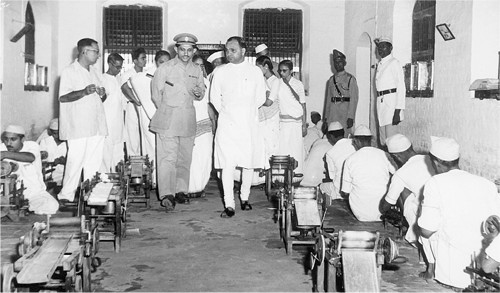
Anklesaria, as jail supe-rintendent, familiarizing minister Ratubhai Adani with the new reforms
At the time of India’s independence he took up work as income-tax officer with the Government of India. But disillusioned with the nature of his job he opted to work as jail superintendent — Class I with the then Bombay State’s Yerawada, Baroda, Bombay, Sabarmati and Nasik prisons. Jail superintendents then used to be recruited from amongst army officers from the Indian Medical Service (IMS), holding the rank of colonel or major. On a rare occasion senior departmental jailors were appointed superintendents just prior to their retirement. Anklesaria was the first ever non-IMS jail superintendent, class I, in the history of the jail department of Bombay State to have been so appointed through open examination and selection by the Public Service Commission in 1947, reiterates his younger son Jimmy. At the end of 12 years he had risen as inspector general of Prisons, State of Gujarat, the first non-IAS (Indian Administrative Service) officer to be given this rank, according to his bio data.
For six months he got a chance to study criminology and social sciences at a course conducted by the Government of India and the United Nations at the Tata Institute of Social Sciences. For a year he was selected as a US Fellow to study social defence, prevention of crime and treatment of offenders in the United Kingdom and seven other European countries. After these courses the once hard taskmaster became a soft, gentle, lovable man, mentions Jimmy. Whenever a prisoner was given the death sentence he would feel sad and try and give solace to the prisoner in his final hours, recounts Sheroo.
He had successfully introduced and implemented a number of humanitarian measures and jail reforms in Yeravada, Baroda and Sabarmati Central Prisons, the most noteworthy being "open prison” whereby select prisoners were given an opportunity to work in the prison farms. Although he was advised against this move on the grounds of it being a risk to his and their safety, he dared to proceed. He also encouraged the senior prisoners to supervise the langar (common kitchen) to motivate others to improve their behavior. With occupational training offered to the prisoners, their furniture and linen stores became popular as did their band which was given permission to play at public places. With his team’s support Anklesaria succeeded in converting the Sabarmati Central Prison into a sort of a cooperative society or a vocational training institution where inmates willingly gave up their vices for virtues. "If you want to visit a Gandhi ashram visit the Sabarmati jail,” Sheroo remembers the comment of one of the many visiting dignitaries.
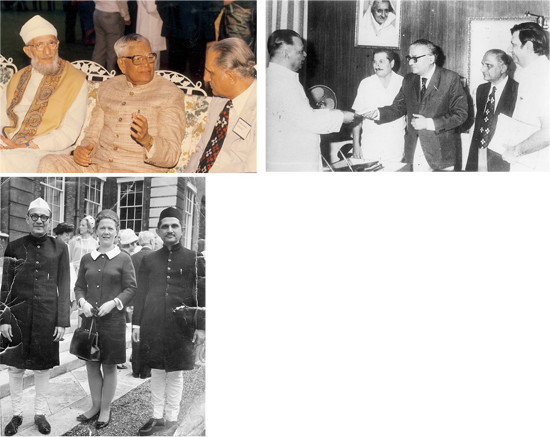
Anklesaria in the company of religious, community and national leaders: with R. Venkat-raman (left), S. B. Chavan (right) and Hitendra Desai (center)
"My work is my mission,” was the credo of Anklesaria who was a stickler for time. When his wife would tell him to relax he would say, "Maaru kaam bolsé, maaru naam nahi (I will be remembered by my work, not my name).” At other times when he was faulted for placing untold trust in the prisoners he would say "Kaidioni doova kaam laagé (the blessings of the prisoners help us).”
In 1961 on the recommendation of the Government of India, Union Public Service Commission and Government of Gujarat Anklesaria was absorbed in the IAS cadre without his having to appear for any competitive examination, a rare honor in recognition of his meritorious service to the state. Over the next two decades he served the Gujarat state as collector of Baroda and Surat districts, deputy secretary in the industries and revenue department as also the home department, principal secretary to chief minister Hitendra Desai, commissioner of sales tax, vice chairman and general manager, Gujarat State Road Transport Corporation with a staff of 45,000 persons working under him, director of transport, area development commissioner, principal secretary to government of Gujarat in the home and food and civil supplies department, administrator and finally municipal commissioner, Ahmedabad Municipal Corporation.
During the 1971 Indo-Pak War Anklesaria was called upon to act as the state liaison officer with the Army Command Operational Headquarters and conferred the rank of major general. As noted a commendatory letter by N. D. Buch, then additional chief secretary, home department, Government of Gujarat, "The Government is...aware that the task allotted to you was unprecedented but due to your untiring efforts and mature experience you could achieve complete coordination between the Army command and the State government throughout.”
Beginning 1981 Anklesaria’s varied experience was used in the service of the community. "The Punchayet was like his adopted child,” reveals his wife who was happy that he had a fulfilling career. On the expiry of his first seven-year contract with the BPP he chose to renew it twice more. Thereafter he opted to work as consultant/advisor to Cowasjee Dinshaw who is the chairman and trustee of different trusts which own vast properties. He retained his ties with the Punchayet as honorary advisor (projects) and continued to lend his expertise to the Federation of Parsi Zoroastrian Anjumans of India. To salvage the properties of defunct anjumans, the Federation frequently relied on him. As acknowledged honorary secretary of the Federation Keki Gandhi, "He was of immense help...”
Ankleshwar born Anklesaria was fond of reading since his early days at the R. C. High School in Ahmedabad, and subsequently during his years at the Wilson College and St Xavier’s College from where he completed his postgraduation with French honors. It was only in later years that he got a chance to read his collection of books acquired over the years. Five percent of his earnings went into purchase of books, mentions the family. Primarily books on Zoroastrianism, Sufi books and Vivekananda’s philosophy interested him towards the end. His interest in music too which started with western classical under the British influence had metamorphosed to Indian classical and spiritual bhajans. He had even learnt the sitar for a while.
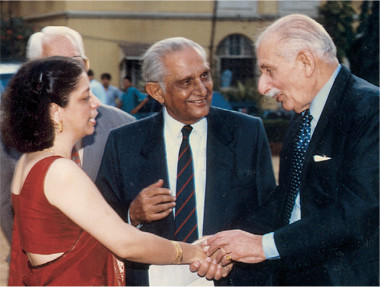
Anklesaira (center) with Diana Marfatia (left) and Sam Manekshaw
To write his life’s memoirs he was hoping to find time but had not got round to doing it, stated Jimmy. He enjoyed editing the BPP Quarterly Review and subsequently, the Newsletter of the Parsi Punchayet as he foresaw the need to keep the community informed of developments within the Punchayet to minimize confrontations. As he had then conveyed to Parsiana (see "A Punchayet that communicates,” April 1988) his role was that of an architect "building bri-dges between the trustees and the community... When a person is in a seat of power, one must not say things knowingly or unknowingly which could affect the well-being of the community.”
The scroll presented to him by the BPP management confirmed that he faced controversies with a "cool and unruffled mind and determination, showing admirable courage and guidance and conviction whenever occasion arose.”
The ace administrator is survived by his wife Sheroo, and sons Shehriar and Jimmy.
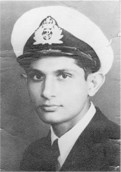
Anklesaria, as a young lieutenant
Marfatia on the move
Died: Dara Tehmurasp Marfatia, 76, joint honorary secretary of The World Zoroastrian Organisation (WZO), India and erstwhile company secretary and general manager of Crompton Greaves Limited, on November 4, 2003 after he suddenly collapsed on the dance floor at the Il Palazzo Hotel in Panchgani.
"Darakaka, true to his tireless energy...dances the cha cha cha with full abandon! Without getting out of step he now sits down on the floor...losing no time he lies prone with open arms on the floor...the music continues...we all laugh and think it is a big joke, dance around him...but Darakaka lies there, never to get up — only (the soul) to rise up! I experience people dying almost every two to three weeks at my cancer clinic, but so easily? How is it possible from one moment of dancing to the next of silence?” questioned Dilnawaz Bana who had accompanied the group of WZO members on the three-day picnic to Panchgani and recounted the last few happy hours they had spent when he had impressed her with his optimism, patience and jovial nature.
"The extremely popular joint honorary secretary of WZO India...not only dedicated his last several years offering sincere and meritorious service to the Organisation but left this world while on duty, entertaining the WZO members who were taken by him on a trip to Panchgani,” noted the condolence resolution signed by the WZO, India president Dadi Engineer. The resolution further recorded "the valuable and selfless service rendered” by him "for nearly 15 years...with his friendly disposition (which) had earned the love and respect of all our members.”
At the condolence meeting convened by the WZO on November 15, 2003 at the Sethna Agiary Hall, the same venue where Marfatia had organized innumerable programs for the WZO, Engineer stated how Marfatia with his dedicated band of WZO committee members had collected over Rs 21 lakhs in the course of their fund collection drives at different baugs in Bombay for causes as diverse as Doongerwadi, the B. D. Petit Parsee General Hospital, computer training and the education fund. The fact that there were no lifts in the different baug buildings was no deterrent to Marfatia and his helpers who would climb up umpteen flights of steps.
Recalling how Marfatia would go out of his way to help others, joint secretary Rusi Bhumgara noted that perhaps his greatest fault was his inability to say no to anybody. "He would always remain in the background letting others take the credit for all the good work he did,” as noted Prof Khurshed Sheriar.
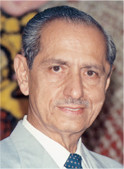
Marfatia: selfless service
Sympathetic to the cause of the poor, the soft-spoken, unassuming Marfatia would invariably start his working day by distributing food to the poor. He had an understanding with Bake House whereby the leftovers of the previous day would be personally distributed by him to deserving Parsis in different locales, recalled a close confidante. Several are the people to whom he extended aid, by sharing his financial, legal or business acumen. "He was the best role model anyone can have and we learnt great lessons in humility and selflessness from him,” attests his youngest daughter Diana, principal of the Byramjee Jeejeebhoy Parsee Charitable Institution. In spite of his very busy schedule he always made time for his wife Bacha and family. "We saw him working tirelessly and selflessly for everyone, rich or poor, known or strangers,” adds Diana.
Having worked in senior executive positions with companies like ICI, Cadbury’s India Limited he ultimately retired as the company secretary and general manager of Crompton Greaves Limited. After retirement he practised law and fought cases for clients. Innumerable clients, associates, colleagues and juniors have attested to his humane and sypathetic approach towards all. "We will always remember his simplicity, good nature, intelligence, wisdom and modest lifestyle,” wrote Naresh Mody of Anil Electric Company.
After completing his schooling from St Mary’s and his graduation from St Xavier’s College, Marfatia studied law at the Government Law College. Subsequently he completed his solicitor’s examination and qualified as a company secretary.
There was a time when he tried his hand at poultry farming and even catering, mentioned close family friend Sarosh Bana who gave Marfatia credit for encouraging him to take up the presidentship of the WZO Youth Wing. He enjoyed western music concerts and even expressed a desire to study Urdu literature, time permitting.
Religion, for him, meant leading a good life. In the last few years he did make it a point to pray for an hour every morning, recalls Diana. "It was always a joy to be in his presence and we all have vivid memories of his goodness,” summed up Dr Gulrukh Bala.
The gracious Marfatia is survived by his wife Bacha, son Shahrukh, daughters Deenaz Hoshang Jhabvala and Diana, brother Minoo and sister Shirin Navroze Kanga.
P. M. G.
◆ ◆ ◆
From the archive