
Readers' Forum
“To safeguard the survival...”
The recent decision by the High Priests debarring priests from performing the ashirwad for interfaith marriages or navjotes of children of intercommunity marriages has created a furore
"The High Priests hereby declare...” The seven proclamations made public by the six High Priests of the community on March 23, 2003 aroused the ire of the liberal members of the Zoroastrian faith. Wont to exercising their freedom of choice in personal/religious matters they were not prepared for the directives issued by the High Priests who sought "to safeguard the survival of the community and prevent further damage to the Parsi Zoroastrian identity.”
Under the new edict (see box for Resolution in its entirety) any intercommunity marriage (irrespective of whether the man or the woman opts for a non-Zoroastrian spouse) "cannot be considered as a religiously valid marriage under the Parsi Zoroastrian faith...cannot be considered lawful from a religious point of view.” Further, no issue of intercommunity marriages will now be permitted to be initiated into the faith to claim "religious rights of the Parsi Zoroastrian faith.”
Contradicting the opening sentence of their missive which refers to the "increasing number of intermarriages within the community,” the six High Priests claim in their seventh edict, "There have been stray instances in the past of mixed marriages in the community and ‘navjote’ of children of Parsi fathers and mothers belonging to other communities and faith. However this was never accepted by the priests or the community at large. In fact, the community, at Samast Anjuman Meetings, has from time to time condemned such acts. The High Priests reaffirm the resolutions passed at these meetings.” The intercommunity marriage figures published annually in Parsiana show that nearly 30 percent of the Zoroastrian population marries outside the community. Hitherto, according to the law of the land, as prevailing since the judgement given by Justices Dinshaw Daver and Frank C. O. Beaman in 1908 (Petit vs Jeejeebhoy) children of Parsi Zoroastrian fathers and non-Parsi mothers have been openly navjoted while the children of Zoroastrian mothers and non-Parsi fathers have confessed their faith covertly.
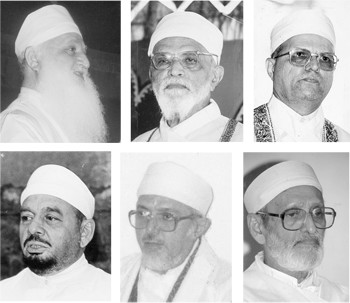
From left (top row): Kotwal, Mirza and JamaspAsa; (second row): MeherjiRana, N. Dastur and Unvalla
Of the seven High Priests in India, the six who have signed the resolution are Dasturs (Dr) Hormazdyar K. Mirza, (Dr) Firoze M. Kotwal, (Dr) Kaikhusroo M. JamaspAsa, Meherji K. MeherjiRana, Noshirvan Dastur Manchershaw Dastur and Nadirshah P. Unvalla. Dastur Khur-shed Kaikobad Dastoor of Udvada, the last to join the ranks of the High Priests following the demise of his father Kaikobad last year, is the only one who abstained from signing the resolution. (Khurshed Dastoor’s name had erroneously appeared in the Jamé weekly of March 23 as one of the signatories to the proclamations. The Jamé carried a retraction in its next issue.) "I definitely do not support intercommunity marriages nor am I in favor of juddin navjotes,” declared Khurshed Dastoor, the new president of the Athornan Mandal, when Parsiana asked him his reasons for not signing the resolution. The issues raised by the High Priests are "nothing new. It is just old wine in a new bottle,” he stated. "The way certain points had been elaborated” was not acceptable to Dastoor who opted not to support the document, disregarding the pressures brought on him. The salahnamu (advisory document) signed by 14 dasturs of yore had similar contents, mentioned Dastoor who is trying to procure a copy of that whilst he is deliberating on issuing an individual statement.

K. Dastoor
"The edict is misleading,” declared Meher Amersey, president of the Association of Inter-Married Zoroastrians (AIMZ) which convened a meeting to pass a counter resolution condemning the High Priests’ strictures which have "caused a great deal of pain and confusion in the collective minds of the Parsi community. Parsi Zoroastrians married out of the community are safeguarded by the Special Marriage Act, 1952, granting them the right to practise their religion in the same manner as other Parsi Zoroastrians... We also feel that this re-solution is retrograde and is in no way going to deter Parsis from marrying out of the community... We are aware the Gathas are the original teachings of the Prophet and nowhere in them are there any such strictures — explicit or implicit. Zoroastrianism is a religion of rationality and all attempts to interpret it otherwise go against the tenets and spirit of the religion.”
"Who gives these priests the right to be spokesmen and watchdogs for an entire community and to say what the group accepts and what it doesn’t?” AIMZ legal advisor, advocate Darius Shroff’s query was reported in the Mumbai Newsline of April 1. Many members of the community had mouthed similar openly defiant statements which were carried in the general media: "It appears that now the Talibanisation of Zoroastrianism is complete. Is this not the persecution that our forefathers fled from in ancient Persia?” Daulat’s statement was carried in the Mid Day of March 31. Nekzaad N. Vakil blatantly countered in the same day’s paper: "This new rule would not deter me from marrying outside my community.” "Does the Zoroastrian religion indeed preach that one must be false to one’s heart in order to be true to the faith?” asked columnist Armin Wandrewala in the Bombay Times of April 1. Musician Farhad Wadia countered in the Afternoon Despatch and Courier of March 29: "They are nothing but religious bigots who are not concerned about the dying Parsi race. It is discrimination at its worst and is legally wrong.” "The priests are not the only protectors of our identity...I feel that the community is educated and liberated enough to decide what is right or wrong for it. In fact, some of the priests who have passed this resolution have themselves in the past performed navjotes for children of mixed marriages,” stated Nawaz Mody, head of Mumbai University’s politics and civics department (The Times of India, March 30). Ophthalmologist Dr Rusi Dastoor (Afternoon Despatch and Courier, March 29) declared: "This is only aimed to mitigate our already small community and in years to come there will be more harm done.” According to liberal priest Ervad Framroze Mirza who was quoted in the Mumbai Newsline of March 28, "The High Priests are insecure and just want to display their power...There are priests fighting for power, dragging the whole community down in the process.”
The High Priests have found supporters in the community too: Calling on "all true Zarathushtis (as also)... all morally upright and righteous non-Zoroastrians” to support the High Priests’ stand, the resolution of the Traditional Zarathushtris Mailing List (TZML) signed by its 11 board members notes: "The pillars of our religion are neither up for debate nor are we authorized to tamper with them... These religious laws are in place to protect the religion, and the High Priests are the custodians of the religion therefore they have the moral right and the moral authority to reinforce the religious laws. The High Priests have done their religious duty, and we fully endorse and support their stand.” "Academic studies have shown that only one out of 100 offspring of interfaith marriages weds a Zoroastrian. If we allow interfaith marriages, within a few generations our unique Parsi identity will be wiped out completely. Our priests are the keepers of this faith and ethnicity. It’s because of them that we have maintained our traditions and values for a thousand years. They are concerned about the future of the community. Let us understand what they are trying to say and follow their guidance instead of castigating them,” Zoroastrian Studies founder Khojeste Mistree was quoted in The Times of India, March 30. Trustee of the Traditional Zarathushtrian Trust (TZT) Karl Sahukar told the Times of March 28, "This should have been done much earlier. I think it is a positive step in the right direction.” Supporting him was TZT president Noshir Dadrawala, "We are not saying we are racially superior. But intermarriages will dilute our identity...The edict should be a deterrent to such marriages (Mid Day, March 27).” Principal of the Dadar Athornan Boarding Madressa Ervad Ramiyar Karanjia told the same newspaper, "The latest resolution is a reminder to the community, especially youngsters, that the community faces the danger of extinction if the trend of such marriages continues.”
The voices of moderation declared: "The High Priests, by limiting its access in this manner are doing a great disservice,” pointed out script writer Sooni Taraporevala (The Times of India, March 30). "The Parsi racial stock has ethnologically been relatively pure. But now that the survival of this stock itself is under threat we should compromise and allow some dilution,” opined artist Jehangir Sabavala (Times, March 30). "Intelligent and free-thinking people cannot allow themselves to be restricted by resolutions passed by the keepers of the faith. The hope of continuity of our small community can only lie in expanding it rather than strangling it,” businessman Byram Jeejeebhoy stated in Afternoon Despatch and Courier (March 29). "Some of the most progressive Indians have been Parsis. It’s ironic that the community’s future is at peril because of some Dasturjis,” regretted Rahul Anand, an engineer with a Parsi mother, in the Mumbai Newsline of March 28.
The community publications, Jam-e-Jamshed and The Bombay Samachar had voiced their apprehensions on the futility of such a resolution. As noted an editorial in the Jam-e-Jamshed of March 30, "In such sensitive matters the High Priests should not rush in where the community fears to tread...We are afraid that the High Priests, by passing these resolutions, may have hurt the very cause (they) have espoused...” "This so-called resolution binds none,” it was written in bold in noted solicitor Berjis Desai’s "Parsi tari Arsi” column in The Bombay Samachar of April 6. He added, "These gentlemen have no authority, legal, moral or ecclesiastical to issue any edict or diktat or fatwa. The so-called resolution are the views of these gentlemen. We must respect their right in a democracy to hold their views. They must respect our right to dub their views as high nonsense...This will go down as the starting point when the orthodox began to commit mass suicide of their cause...”
Many Parsi Zoroastrians (born of a Zoroastrian father and non-Zoroastrian mother) cannot come to terms with this new verdict. As wrote journalist Kimi Dangor in the Sunday Mid Day (March 30), "To all the men who got together one morning and decided that I wouldn’t have been a Parsi if I’d been born 20 years later, I defy you every morning when I say my prayers. So what if you will excommunicate me for marrying outside the faith and won’t let my children into a fire-temple. I still have my prayers. Zarathushtra still remains my prophet and I still wear my sudreh kusti. So sue me.” Adi Pocha, in a letter addressed to his predeceased father Jimmy Pocha in the Mumbai Newsline of March 29, enquired: "A few days ago, seven learned men decided that all things considered I should no longer be called a Parsi. Because this lady you met on Tableland (wife Uma), this lady who loved us and all Parsis, this lady who grew us proud to be Parsi, who nursed you through every second of your cancer, this lady who still takes care of me when I am ill and talks to my sister when she is lonely — this lady is not a Parsi. Dear daddy, please tell me: What should I do? Postscript: Should I change my name to Adolf?”
"Half-Parsi” Namrata Bangera conveyed the pathos of the exclusive attitude of the community in her letter in Mid Day (April 1): "I will forget those moments of hurt confusion when I was not allowed to eat the chasni (consecrated offerings) at the school jashan... Those moments of endless wait outside a fire-temple while my Parsi friends and relatives finished their prayers. The deep yearning to experience just once the sight of the sacred fire in all its glory, to smell the sandalwood as I bow my head at the threshold to chant Ashem Vohu loudly because I am allowed to. And finally, the most difficult, I will give up the hope that one day I would be accepted...”
"If a Zoroastrian should have a clandestine and perhaps illicit affair with a non-Zoroastrian, such a person cannot only remain within the community but can continue to visit agiaries and atash behrams and follow his/her religion. However God help him/her if he or she sanctify that relationship into a legal marriage...Is this true Zoroastrianism?” asked activist Phiroze Amroliwalla in the Jamé of April 6. Anil Thakraney’s bottom line in his column in the Sunday Mid Day of April 6 stated: "Better to have...‘half bawas’ than to have none at all.” Morparia’s cartoon referred to the sparring nature of this sparse community as "Sparsees.”
"The potential threat to the very survival of the Parsi Zoroastrian community” and the fear that "the unique Parsi Zoroastrian identity which the community has zealously preserved since centuries will be diluted and subsequently wiped out” are the reasons cited by the religious savants for coming out with a new verdict. The loss of numbers is not their concern, actress Tanaaz Currim conveyed her experience to the Bombay Times of March 29, "I would love to bring up my daughter Zianne as a Parsi but that’s not possible. And that’s merely because I was excommunicated when I married outside. Aren’t they losing out on numbers with such rules?... Now even my brother who’s married outside the community stands to be excommunicated. What about his children who are Parsis?” (There is no excommunication in the community — Editor)
But she is not the only one facing uncertainties. There are many grey areas which will have to be addressed. Barely a decade ago most of the signatories to the present resolution had consented to the navjote of Neville Wadia when the octogenarian industrialist had chosen to embrace the faith of his ancestors. What counsel would they now offer to the scions of the Wadia family?
What about the funeral rites when a Parsi Zoroastrian marries outside the faith? Hitherto all facilities at the Doon-gerwadi were available to men who had married out and in the wake of the Roxan Shah tragedy, even to women if an affidavit was given that the woman married out had continued to profess her faith.
In 2001 the Jeejeebhoy Dadabhoy Agiary had announced that their spacious premises would be available for celebrations if any one of the parties to the marriage is a Zoroastrian. Do they have to reconsider their decision?
The High Priests have requested the "panthakies, priests and the trustees of all the atash behrams, agiaries and all other institutions of all the anjumans in India to take note of these resolutions.” Those residing abroad are free to follow their own conscience? What happens to Parsi Zoroastrians of Indian origin who have settled abroad? And what happens to athornans and behdins who choose to ignore the new resolution?
As eminent solicitor and former chairman of the Bombay Parsi Punchayet Eruch Desai declared in the Jamé of April 13, "How can they (the trustees and other priests) be compelled to take an action which would not be in consonance with the correct legal position?... Nothing can be hostile to religion which is agreeable to justice... It would therefore be an act of statesmanship on the part of the concerned High Priests if they were to rethink on this aspect and issue an appropriate clarification...”
Since more questions are raised than answered by the High Priests’ resolution, the community can hope that more constructive decisions will emerge after substantial rethinking. After all, some of the High Priests did not first recognize Unvalla as Dastur when he was conferred this distinction by the Bangalore Anjuman in 1996 but joint deliberations over contentious issues did apparently get them to reconcile to the new situation. As the High Priests had then forewarned: "Faith runs into all spheres of life but in religious matters faith without knowledge and understanding degenerates into fanaticism and even threats of violence as it happens on some occasions. This is detrimental to the very existence of our community.”
Resolution Passed By The High Priests
We, the undersigned Parsi Zoroastrian High Priests, are pained to observe the potential threat to the very survival of the Parsi Zoroastrian community due to increasing number of intermarriages within the community and the so-called initiation of the progeny of such intermarried couples into the Parsi Zoroastrian faith. This is against the tenets of the religion. If this trend continues, the day is not far when the unique ‘Parsi Zoroastrian’ identity which the community has zealously preserved since centuries will be diluted and subsequently wiped out. We are also pained to observe that certain priests are performing the "ashirwad” ceremony of couples where only one partner to the marriage is a Parsi Zoroastrian and the other is not. Subsequently these renegade priests also perform the "navjote” of children born of such intermarriages. Taking a serious view of the above stated circumstances and with a view to safeguard the survival of the community and prevent further damage to the Parsi Zoroastrian identity, we the undersigned High Priests hereby resolve as under:
1. The High Priests are strongly of the view that our religious scriptures disapprove the marriage of Zoroastrians with members of other communities and faith and consider it to be a transgression of the tenets of the religion. The Parsi community recognizes only the marriage between two Parsi Zoroastrians where both the marrying individuals are born of Parsi Zoroastrian parents, and where the "ashirwad” ceremony which includes the "Nahn,” Holy Sacrament, and prayers specific to the ceremony are duly and properly performed.
2. The High Priests hereby declare that marriage of a Parsi Zoroastrian man or woman with a person of another faith cannot be considered as religiously valid marriage under the Parsi Zoroastrian faith.
3. The High Priests hereby declare that the marriage of a Parsi Zoroastrian, male or female, with a member of another community or faith under any civil law of the country, is a civil contract. However, marriage from the Zoroastrian point of view is a sacrament and, therefore, such civil marriages may be valid from the point of view of civil law, but such marriages cannot be considered lawful from a religious point of view.
4. The High Priests hereby declare that the performance of "navjote” of children where only one of the parent is a Parsi Zoroastrian, cannot give religious rights of the Parsi Zoroastrian faith to such children.
5. The High Priests hereby declare that the children born of Parsi Zoroastrian father with the mother belonging to another community or faith are not accepted in the community as per the Religious tenets of the Zoroastrian Faith.
6. The High Priests hereby declare that no Parsi Zoroastrian priest should perform the marriage ceremony where only one of the marrying partner is a Parsi Zoroastrian and the other is not. Also, no Parsi Zoroastrian priest should perform the ‘navjote’ ceremony of children of such mixed marriages.
7. There have been stray instances in the past of mixed marriages in the community and ‘navjote’ of children of Parsi fathers and mothers belonging to other communities and faith. However, this was never accepted by the priests or the community at large. In fact, the community at Samast Anjuman Meetings has, from time to time, condemned such acts. The High Priests reaffirm the resolutions passed at these meetings.
The High Priests request the Panthakies, Priests and the Trustees of all the Atashbehrams, Agiaries and all other institutions of all the Anjumans in India to take note of these Resolutions. The High Priests have, by hand, forwarded a copy of this Resolution to the Office of the Trustees of the Bombay Parsi Punchayet with a request to safeguard the interests of the Parsi Zoroastrian Community, as they are the custodians of the Funds and Properties of the community.
Dasturji (Dr) Hormazdyar K. Mirza (Udwada), Dasturji (Dr) Firoze Meherji Kotwal (Mumbai), Dasturji (Dr) Kaikhusroo M. JamaspAsa (Mumbai), Dasturji Meherji K. MeherjiRana (Navsari), Dasturji Noshirvan Dastur Manchershaw Dastur (Surat), Dasturji Nadirshah P. Unvalla (Bangalore)
◆ ◆ ◆
From the archive