
Seminar
Tea with the President
One of the highlights of the 16th Youth Conference in New Delhi was a meeting with the President of India Dr Abdul Kalam
While youth meets are mainly about masti-majaa (fun and frolic), making friends and exchanging ideas, there should be a serious content too, and issues relevant to the community should be discussed, it had been decided. To further this trend of thought the 16th annual Zoroastrian Youth Conference was held in Delhi from January 24 to 27, 2003. News of inclement weather in the preceding week when Delhi experienced one of its worst cold, windy, foggy and cloudy spells, and the consequent delays and cancellations of incoming rail and air traffic, did result in a disappointing turnout of youth, especially from Bombay and South India. In all 35 youth attended, the maximum representatives from Gujarat.
The four-day proceedings started with a jashan followed by a short opening address by Lt Gen (Retd) Adi Sethna, president of the Delhi Parsi Anjuman, welcoming the delegates. In his talk on the relevance of the Zoroastrian religion in modern times, Noshir Dadrawala, an orthodox columnist and speaker, elaborated on the value system and ethics of the universal faith. Advocating reverence to all of God’s creations, he noted that if Zarathushtra’s teachings were to be summed up in one word, it would be Asha which could be variously interpreted as truth or righteous conduct or divine order and man’s duty to live in harmony with that order. It also stands for purity in thought, word and deed and behoves every Zoroastrian to fight for the good at the physical (cleanliness, etc), social (alleviating poverty and human suffering) and ethical (overcoming greed, anger, envy, etc) levels, he reiterated. The ensuing question and answer session had to be interrupted as the youth had an appointment with the President of India at 1.30 p.m.
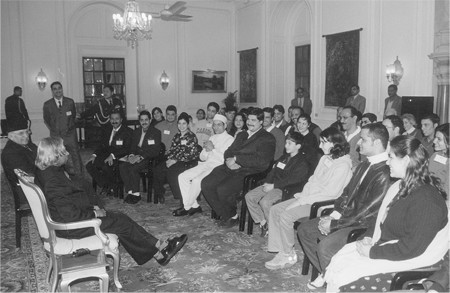
Youth delegates chat with Kalam
An enthusiastic group boarded the bus heading for Rashtrapati Bhavan. Dr Abdul Kalam, known for his fondness for the young, was a little surprised that among the Parsis those up to 35 years of age are considered to be youths! Chatting informally with some of the youngest in the group he referred to the influence of teachers in an age where both working parents were unable to devote adequate time to their children. He also impressed on the group the need for a strong self-reliant Indian nation and the role the youth would be required to play to make this possible. The audience was followed by tea and snacks and a guided tour of Rashtrapati Bhavan and the Mughal Gardens.
The afternoon session was devoted to a talk on marriage and fertility practices among the Parsis by Ava Khullar who explained how extreme modernization, urbanization, higher education among men and women and expectations of a high standard of living had brought about a pattern of late marriages or no marriages among a large segment of the community leading to a serious demographic decline. Unless remedial measures are taken by the youth who are the future of the community it could lead to the eventual extinction of the Parsis, she warned.
Dr Lata Narayan of Bombay’s Tata Institute of Social Sciences who will be conducting a study of Parsi youth under the UNESCO sponsored PARZOR project then discussed community issues with those present. When interacting with the youth she tried to understand their concerns to see how those could be best addressed in the proposed study. During the first two days when the panel of Khullar, Narayan and Dr Shernaz Cama of PARZOR guided the deliberations, the topics of life, marriage, the often differing expectations of partners, the role of parents and the expectations from their children were openly discussed. The males who outnumbered the females denigrated the high expectations of females as well as their unwillingness to move to smaller towns outside Bombay. The reluctance to change and to be more realistic, as also the passive and negative role of the parents in influencing their children’s decisions were viewed as the other deterrents.
A message from Dinshaw Tamboly, managing trustee of the World Zoroastrian Organisation (India) Trust and Bombay Parsi Punchayet trustee was read in his absence on the morning of January 25. Urging the youth to fight complacency and strive for excellence in a highly competitive environment, Tamboly referred to the various crises — urban family life-style, personal health, leadership, dwindling population, erosion of human values — facing the present-day Parsis.
A feast of four films was organized for the delegates on the second day: Glimpses which gave an insight into the PARZOR project, Asha: the Law of Harmony, a study of environmental consciousness in Zoroastrian rituals which was submitted for UNESCO’s awards for "Masterpieces of Oral and Intangible Heritage of Humanity,” a film by Ashdeen Lilaonwala explaining the art of kusti weaving based on her study "Threads of Continuity, A study of the Textiles used in Rituals and Customs of the Zoroastrian community,” and an excerpt from a film on the life of Field Marshal Sam Manekshaw which was released on April 3, 2003.
To encourage Parsis to join the defence services, the afternoon session on the second day saw Air Marshal Adi Ghandhi and Air Marshal Fali Major share their experiences in the air force, demonstrating how exciting and fulfilling a career it can be. This was followed by a promotional film on the Indian Air Force. Opportunities in the hospitality sector were laid bare by Ravi Bhoothalingam, former president of the Oberoi Hotels who referred to the different sectors like administration and food and beverages and the openings in the wine industry. He stated that the main objective of the hospitality and hotel business was to give a memorable experience to the customer which required human skills in dealing with people, communication skills, a genial temperament and a trustworthy personality. Appealing to the youth to be bold enough to start their own independent enterprise as did their forefathers, Adil Nargolwala, youth trustee of the DPA, said that the reward of creating your own empire (maybe a very small one) and then nurturing it is very close to creating a family by getting married, having children and watching them grow. Therefore in all of us there is something of an entrepreneur. The freedom to work at one’s own pace, the financial rewards and the ability to be one’s own boss are the added perks, he revealed. The growing need for creative thinking which plays a crucial role in any venture in this competitive age was stressed by Navroze Dhondy who related his own experiences in the field of advertising and the opportunities available.
At the valedictory function Porus Karanjawalla of Ahmedabad was presented a silver plate in recognition of his leadership in steering the Federation of Zoroastrian Youth Associations of India for several years.
The intellectual discourses on the first two days of the Conference were followed by outdoor trips on the last two days. Attending the Republic Day Parade, visiting the Delhi Haat Complex which has on display handicrafts from around the country and a full-day excursion to Agra were the other highlights of the youth meet.
The four-day meet was meant to enthuse the youth. As Tamboly had noted in his message, the youth had the capacity to think rationally, analyze objectively and execute decisively to lead the community to a glorious future.
◆ ◆ ◆
From the archive