
Cover Story
"We need to run faster"
The current economic scenario in India was assessed by experts at the launch of the World Zarathushti Chamber of Commerce's Bombay Chapter
"When the entire Indian economy is opening up except for the core sector... it’s a shame to influence our youngsters to take a job. If they can earn as entrepreneurs, the sky is the limit.” Cyrus Guzder, chairman and managing director of Airfreight and DHL, was participating in a seminar convened by Bombay Parsi Pun-chayet (BPP) trustee and incumbent chairman Minoo Shroff to launch the Bombay chapter of the World Zara-thushti Chamber of Commerce (WZCC) on January 18 and 19, 2003 at the West End Hotel. The dearth of young entrepreneurs in the community (as also reflected in the audience) has been a source of grave concern to community elders.
Such had once been the Parsis’ spirit of enterprise that when the Bombay Chamber of Commerce was established in 1836 its managing committee had comprised three Englishmen and three Parsis. The members included 15 English and 10 Parsi firms recounted WZCC president Rohinton Rivetna of Chicago. "Our history was that when business flourished, the community flourished,” he added.
Whereas the Tatas, Wadias and Godrej had pioneered Indian industry with nationalist fervor the post Independence generations, with a few notable exceptions, had developed in the words of Shroff "a horror of failure” opting for safe 9-5 jobs, provident fund and managerial perks, content to hang up their boots at the end of the day.
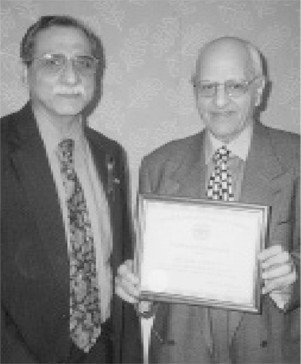
Rivetna and Shroff: Pulling out all stops to revive entrepreneurship
A supplement on local Zarathushti businesses in the FEZANA (Federation of Zoroastrian Associations of North America) Journal had resulted in two conferences in Las Vegas in 1997 and 1998 where the idea of a chamber of commerce to link Zarathushti businesses throughout the globe was developed. By 1999 it had been registered and the first business meet was held in Houston at the time of the Seventh World Zoroastrian Congress, recounted Rivetna. Since then chapters have been established in Los Angeles, San Francisco, Houston, New York, Chicago, Toronto, Iran and Delhi, added Rivetna. The WZCC website (www.wzcc.net) features the list of members. The body’s email address is zchamber-subscribe@yahoogroups.com
Outstanding entrepreneur, outstanding professional and young entrepreneur/professional are three annual awards by which the body hopes to recognize talent. On the cards is an economic and cultural delegation to Iran. Zarathushtis in Iran are in urgent need of capital and business opportunities because of lack of employment open to the younger generation, Rivetna noted. The WZCC will work towards providing small loans to business, establish a business advisory board and provide for exchange of educational material.
In her inaugural address Anu Aga, chairperson of the Poona based Thermax Group, recounted how her Cambridge educated husband, the late Rohinton Aga, had traded the financial security of well paid jobs for the satisfaction of transforming a small family owned business into a Rs 650 crore multi-divisional, multi products company involved in pollution control, water and waste management, speciality chemicals, etc. Aga suggested that talented school students be selected and groomed as winners with imaginative teaching techniques and mentoring to inculcate in them a love of learning, for "knowledge is power.” She described the "Incubation Park” she had visited in Israel where the best talent is selected and encouraged into entrepreneurship. During a year’s break after the youth’s studies the budding entrepreneur "had access to the best libraries and brains and was expected to come up with a viable project” with ensured export of 90 percent of the product. He was helped to create a project report, get bank finance and provided a small area wherein he could fructify his idea. After two or three years, when his project was successful, he moved out of the Incubation Park and was on his own.
Aga also referred to the prevailing opportunities for non-conventional businesses like cafeteria and beauty parlours and agricultural adjuncts in rural areas like food processing and refrigeration. She emphasized the value of a joy of living and a sense of humor along with such time honored virtues as integrity and charity — all of which have been traditional attributes of the Parsi community — in overcoming odds en route to fruition. She also stressed the need to learn the art of conflict resolution, "stand up by our own achievements and not by pushing someone down.”
Guzder addressed the issue historically by asking and answering the question, "Why has the spirit of enterprise died out even among other successful entrepreneurial communities?” While ancient India had a robust trade history spanning two millennia ("Our global diamond industry, global spice industry brought Europeans to India... We imported wine from Rome 2,500 years ago... Indian coins and pottery have been found in other parts of the world”) Jawaharlal Nehru’s central planning model emphasized infrastructural investments like the Bhakhra Nangal Dam, Hindustan Steel, etc. "Infrastructure is not something that entrepreneurs get into because of its long gestation period.” The planning priorities made "intelligent Indians feel they should become managers or professionals. Our community went into the professions.” The 1970s saw the stranglehold of government shackling corporates with tax, licensing and other red tape. The last 10 years however have witnessed "fundamental changes in the economic and social situation.” Whereas the lower middle class had invested in two-wheelers because the manufacture of motor cars had not opened up and people were trapped in a poor educational system, today every family aspires to send its children abroad. Whereas it had taken a long time to get the single telephone at home, now children have mobiles, clothes off the shelf at will instead of once a year.
"But how are families going to meet these aspirations as jobs disappear?... Companies are shedding jobs and becoming larger by outsourcing their requirements.. The services sector is creating jobs but not enough. Where will the income come from? There is no option but for the majority of our children to become entrepreneurs,” declared Guzder. He provided the example of his own companies where housekeeping, canteen, xeroxing, etc are outsourced. Whereas DHL once had its fleet of cars and 30 drivers on the payroll with large overtime payments, since they persuaded the drivers to form a cooperative and run their own vehicles, they are paid for the deliveries they do. It has increased productivity, noted Guzder.
Knowledge is a key ingredient in running any business successfully, said Guzder adding that the Internet had brought all fields of knowledge to one’s doorstep. No longer do niche activities remain small: by video conferencing and networking one can access and brainstorm with others in the field wherever they may be.
Guzder spoke of the increasing need for independent insurance agents with the entry of private foreign insurance companies in India. Health care and pharma companies are moving into the delivery of health services which has to be reached finally to the patient. Manufacturers’ after-sales services are being farmed out. For Mahindras to sell more tractors they want franchisees to educate farmers on why they should use tractors and help group them together to enable them to do so.
Hindustan Lever’s race for cosmetics is spawning beauty parlours around the country. "There are opportunities everywhere. The choice is between a management job and starting one’s own business. If a youth is able to do anything better than the guy next door, he should take a shot at it.”
When a member of the audience referred to the cost of administrative delays "because files don’t move,” Guzder admitted that "transaction costs,” a euphemism for corruption, were relatively high but reckoned they will come down as the central and state governments phase themselves out of economic activities.
Management consultant Sharu Rangnekar adopted the anthropological approach. "Whats happened to the Parsis has happened to others. As people become prosperous they avoid risks.” The Parsis started as shipbuilders, then went into trading, then into professions, then into service, each stage marking a reduction in the acceptable level of risk. The thinking being "you may not succeed but the savings of the past will not go down the drain.” Earlier complaints about corruption reminded Rangnekar of the public statement made by J. R. D. Tata and G. L. Birla in 1970 that no industry in India can really expand. "But in the same period Dhirubhai Ambani expanded despite labor productivity problems and corruption. There is no situation that hurts only one person in an industry. The entrepreneur enjoys difficult situations. There was never a complaint from Ambani...Once an industry became successful, his interest waned. He sought something else.”
According to Rangnekar, autonomy and creativity are the only ideas an entrepreneur values. "What are we teaching the next generation? Money? Status? Power? They’ll never be entrepreneurs. This is where you are stuck,” he declared. "Parsis are a community killed by welfare because all sense of insecurity was lost.” It has increased longevity at the expense of the "fire in the belly” that makes an entrepreneur tick.
"A minority which is harassed by the majority becomes stronger. If not, it vanishes. For example, Jews are harassed all over the world but not in India and they are vanishing here!” Rangnekar demonstrated the link between diminishing enterprise and diminishing population: "The average Parsi knows that he will get educated, will get a degree even if he fails a couple of times; that he will get a job though not a high-flying job. He is used to a high standard of living but has not the income to maintain it for the whole family so he will remain unmarried or marry late. Therefore if security and procreation are ranged against each other, people don’t produce children. People with high economic status (practice) family planning. Hence the negative growth rate in some developed countries of the Anglo-Saxon world.”
Who are these entrepreneurs who have a way of "smelling opportunities?” It is the reasonably well educated individuals who do not belong to a high economic strata who will take advantage of the current opportunities, feels Rangnekar. Their "fire in the belly” will make them work long hours not only for money but because they want to do something. He cites the example of the Marwaris ("0.6 percent of the population who control more than 25 percent of private sector assets”) who are not the most popular community in India yet have this fire, making up 30 percent of those who attend sessions organized by the Maharashtra Enterprise Development Association. However even among them an increasing number have started going into law and medicine. Generally "family concerns vanish because by the third generation they are looking at benefits to the person who runs the industry and begin to sell off the business. Pedder Road was full of Parsi bungalows. They are all sold because the latter generations do not want to stay and fight and live on Pedder Road.”
The speaker urged the assembled gathering: "Go for the battle. Ask, ‘Can we create for our children?’... (Grab) the opportunities of the new technology, software. The organizer keeps crores, the workers only manage to keep lakhs... A change in culture is required... Teach them that whatever autonomy, creativity you have must be preserved...”
ICICI Bank’s joint managing director Hosi Sinor provided a few statistics: 95 percent of industrial units in India are small or medium enterprises; they account for 45 percent of output and employment, 35 percent of exports. But they also account for 50 percent of failures and 30 percent of non performing assets.
A banker of 37 years’ standing, Sinor noted that the way banks do business has changed radically in the last decade. Of its three parts — marketing, servicing and transaction processing — the first and third are now outsourced, offering opportunities for young entrepreneurs to register as marketing agents or as data entry subagents.
As for starting a business, "only money will get you nowhere.” Sinor provided a glimpse of the "awkward questions” any potential financier will ask: How will you manage? Who are your customers? What is the geography of the market? What is the demand-supply position? What is the element of profit? While there is no entry barrier one must assess the external factors which would affect the profitability of the business for the next four or five years and beyond. Only after one has these answers worked out should one approach for finance. "You must be risking your own contribution before the financier will support you.” Thereafter there are the statutory requirements one needs to meet, the administrative and legal hurdles where corruption pervades. One needs to learn to cope with these aspects and to remember that in all areas there are also good people.
Creation, start-up, break even, maturity and expansion mark the lifecycle of business of which the first three stages are critical, noted Sinor.
Founder of Mazdayasnie Monasterie Meher Master-Moos who has been in touch with the nascent Zoroastrians in Central Asia, spoke of entrepreneurial opportunities in Tajikistan, especially in the mining industry. The Tajiks’ memory of their early Zoroastrian ancestry prejudiced them in favor of Parsi enterprises, she noted. Delhi Parsi Anjuman (DPA) president Lt Gen (retd) Adi Sethna agreed that Tajiks, Kazaks, Uzbeks, Afghans have a background of Zoroastrian culture and are looking for help. "We should look at ourselves as part of the Indian ethos and as part of world ethos. We need to have a wider perspective, work with others without getting swamped,” he noted.
For those who may find the membership fees high (Rs 500 per individual member; Rs 1,000 per corporate) Zareen Karani Araoz suggested they link up through cyberspace for services they may need to hire or for advice or new ideas. "The Zoroastrian Chamber will succeed only if senior established members give time and reach out to aspiring youths and mentor them,” she added.
Noting that candidates are not forthcoming despite the Punchayet mentoring, counseling and funding courses to enable youths to make a career in the police and civil services, Shroff wondered, "Will there be enough takers for what we can give?” He suggested a target of 1,000 members for the WZCC by end 2003 or mid 2004, 50 percent of which should be from India. "We are one of 11 or 12 faiths recognized in the world. This brand equity will not remain forever. We must produce. We need to run faster because others are running faster; see if the next generation can fare better.”
When Rivetna spoke of job openings in Dubai, Homai Mehta, principal of the J. J. College of Commerce volunteered to be the Bombay contact.
Pheroze Patel, chief executive officer of the Zoroastrian Investment Corporation (ZIC), enlightened the audience on the BPP initiative to provide venture capital on softer terms to community enterprises: Structured on venture capital norms, the ZIC with an initial authorized capital of five crore rupees, will invest in the share capital of applicant companies, provide professional guidance in the gestation period and exit from them as they reach maturity. Its focus is said to be on skill oriented small scale industries such as light manufactures, software, etc. Its sister concern is the non-profit tax exempt Centre for Promotion of Entrepreneurship open to donations from charitable trusts. These monies would then be transferred to ZIC as a gift with the stipulation to use in the share capital of Zarathushti concerns, informed Patel.
So far the ZIC has received 34 applications of which about 26 did not fulfill the venture capital norm as they were not open to equity participation. Additional information is awaited from three of the five applicants who discussed their projects with the ZIC. Only one was prepared with all the answers: The project is a tented tourist resort near the Kanha wildlife sanctuary, 280 km from Nagpur. The initial investment of Rs 19 lakh (for the first stage of four tents) may rise to 30 lakhs for the second stage of six tents. The land stands in his name and he has built a rapport with the local government, noted Patel who had visited the site last November. This applicant is determined that the venture goes through even if the BPP does not provide the finance he needs, added Patel.
Shroff added that they had worked out a list of questions which the applicant was required to answer: "We are soft bankers but we are responsible for the community’s money... We warn them about the negative sides, point out various contingencies. But we are not going to reinvent the social background of India. What happens if he runs out of funds? The Punchayet will provide an umbrella but he can’t keep running back to us.”
Supporting an initiative by Meher Guzder of the J. J. College of Commerce, the Punchayet is moving to establish a management college, noted Shroff. Explaining the raison d’être of the proposed institution Guzder noted that of the 22 management institutions in Bombay several were run by various communities, each of whom had 50 percent reservation for their own students. In 2002 there were 47,000 applicants of whome 3,700 were eligible for admission, among them 127 Zoroastrians. Of these barely four or five will find a place including paid up seats which cost between three and four lakh rupees. Diploma courses have a lower market value. Guzder reasoned that if the Zorostrian College of Management begins with 20 students, the figure can rise in the future and an increasing number of Parsi youths can avail of the postgraduate course which is mandatory to move up the corporate ladder. Currently, fewer and fewer Zoroastrians are moving up, noted Guzder.
Guzder subsequently informed Parsiana that while the site of the Management College remains to be finalized, Sir J. J. College of Commerce — Management Division offers Pitman’s Qualification Certificate in Business Studies from London, along with a variety of other management courses.
FEZANA president Firdosh Mehta suggested that some provision be made to include Iranian Zoroastrians. Guzder noted that the University of Bombay stipulates three reserved seats for non-resident Indians. While BPP trustee Dinshaw Tamboly suggested that they be clubbed with the 50 percent open category, Shroff felt that the canvas could be enlarged if there were not enough takers from the community.
Zoroastrian Trust Funds of Europe president Dorab Mistry didn’t share the pessimism of some of the day’s speakers. Tata Consultancy and Godrej’s new businesses had grown in the past two decades, he pointed out, adding "our best people are in the US, in Australia... The UK chapter of the WZCC is scheduled for launching in March and the annual general meeting of the WZCC is to be held in London in October.
Most successful business enterprises are in India, Pakistan and Hong Kong, Dorab Mistry noted, adding that the success of Karan Bilimoria’s Cobra Beer made him an exception amid the largely professional community landscape in UK and US. He hoped to enfold the approximately 50 Zoroastrian entrepreneurs in the UK in the WZCC and invited the community from India and Iran to opt for business migration schemes in Britain where "the culture is based on entrepreneurship, merit and talent.” He also added a fervent plea to keep the WZCC independent of the anjuman and its political hassles of power sharing.
Dadi Mistry, vice president of the DPA and convener of the WZCC’s India chapter in Delhi, noted that 50 members had signed up there at the end of the one-day conference. Vera Mawalwala, Brig Pervez Cowasji, Adil Nargolwala and Farokh Rustomji constitute the WZCC core group in Delhi. Among a number of non-Zoroastrian speakers chief guest Dr L. M. Singhvi, former ambassador and currently member of the Rajya Sabha, had spoken about Zoroastrians here and in the diaspora and their contributions past and present. Dadi Mistry read out congratulatory messages from various dignitaries starting with the President of India Dr A. P. J. Abdul Kalam. Others who spoke in Delhi included A. K. Bhargava of the Punjab National Bank, Karan Bilimoria, Lt Gen A. Natarajan and Air Vice Marshal Fali Major. The gathering was privy to a screening of In War and Peace, the life story of Field Marshal Sam Manekshaw.
Dadi Mistry told the Bombay gathering that no collateral need be provided for loan a of Rs 25 lakh from the Punjab National Bank if it has approved of the scheme. In Bombay, he felt that the Zoroastrian Co-operative Bank would be most suitable for a link with the WZCC.
Discussion on the nitty-gritty of setting up the Bombay chapter led to a cross ventilation of ideas. Solicitor Merzi Chenoy suggested that the WZCC constitution should be circulated only after it was complete. Shroff felt that whoever joins should be able to give his time and some of his money initially. According to Rivetna, each chapter is autonomous and retains the major portion of its membership dues to support expenses. Rusi Gandhy, chair of the New York chapter, related his experience: four or five interested people bring in a new friend at each meet to get him/her interested. A specialized authority is also invited to speak to the members viz on the legalities of partnerships, insurance, etc. He suggested the creation of a website and e-mail address to build on the initial interest. "Activate the commercial side of the community. Stick to making this body tick,” Shroff advised the evolving core group of chartered accountants Kersi Limathwalla and Kersi Commissariat, (the latter’s live-wire wife Zarin has opted to be secretary), Chenoy, buildings restorer Viraf Chiniwala, builder Zarir Bhathena, author publisher Marzban Giara and Thana Anjuman president Rustom Cursetji who offered to house the chapter in a community property in Thana. (Since then Parsiana has learnt that it will operate from a rent free accommodation at the BPP’s polyclinic at Gamadia Colony, Tardeo.) Heavy weights Shroff, Tam-boly, BPP trustee Dinshaw Mehta and former Tata Sons director Minoo Mody have also been inducted.
BPP Public Relations Officer Godrej Dotivala suggested that the All India Directory of Zoroastrian Punchayets, Anjumans, Associations and Local Bodies be used to seek out entrepreneurs at each location. Giara suggested the tapping of various souvenirs and the Navroz and Pateti issues of the Parsi Press and noted that a Parsi business directory is already on the web. Parsiana volunteered to categorize the large all-India list and publish it in the magazine if there was an underwriter for the costs incurred.
Limathwalla noted that while Bombay Parsis take a lot for granted it was noteworthy that "the world body has fructified abroad though its beneficiaries will be largely in India.” Information technology professional Hoshedar Mehta was enthusiastic that the WZCC website would be able to conjunct buyers and sellers, help travelers locate bed and breakfast stays. Once the web page gets going, "every browser is automatically a member,” he added.
Imbibing the "latent entrepreneurship feeling,” and the gist of the messages from the main speakers, Shroff noted the need for the Punchayet "to provide a helping hand, not a prop” to the community. "We have to have guts and staying capacity,” he noted. He recommended Cyrus Guzder’s suggestions for growth and Thermax’s heavy investment in its employees that created bonds of love and admiration for the organization. Reassured by the membership response (approximately 100), Shroff pledged the BPP’s moral and administrative support to the nascent body.
FEZANA Journal’s editor-in-chief Roshan Rivetna from Chicago found "the enthusiasm here far beyond any other chapter formed in the US cities... Projects have developed in the diaspora because we feel the need for networking.” A couple of months earlier 26 prominent Zarathushtis in Dubai including Kersey Bhesania, Oofrish Contractor, Baji Bajan and Cyrus Magol under chairperson Meher Bhesania had celebrated the establishment of the WZCC.
Rohinton Rivetna who heads the international board of directors of the WZCC — Kobad Zarolia of Toronto, Homi Davier of Houston, Meherwan Boyce of California, Fali Shroff, Sarosh Collector of Houston, Edul Daver, Ness Lakdawala of Quebec, Dorab Mistry of London, Dadi Mistry of Delhi — said he was intensely gratified: "We did not dream that we’d be so successful in germinating this thought in India,” and thanked Shroff and Tamboly for "pulling out all stops.”
"It would not have been possible without the support and hard work of the BPP staff,” Shroff conveyed his appreciation to BPP Chief Executive Officer Behram Dastur, senior executives Sheroo Master, Mehli Colah and Homi Mulla. Noting that January 9, the day Mahatma Gandhi returned to India from South Africa, has been designated annual Pravasi Day in India, Shroff ended the proceesings with the suggestion that January 11, the day the WZCC’s India chapter was launched, be observed each year as Zarathushti Pravasi Divas.
Subsequent developments
Within a month of the launch, the non-funding Bombay chapter was in the process of setting up different cells to advise new entrepreneurs on the legal, taxation, business advisory and start up aspects of their work, convener Limathwalla told Parsiana. Aware of the worrisome crumbling of established businesses because of family feuds, they are also keen to establish an arbitration cell comprised of a few well respected individuals with commercial knowhow to help "sort out the simmering issues before they ignite, before they reach the point of no return,” he added. A placement cell comprising a couple of human resource and development people along with Homai Mehta is also under active consideration so that community members can know and avail of job opportunities here and abroad, because the ultimate "intention is to make the community economically strong.”
Inviting groups of 20-25 potential members with whom to interact and explain the purpose of the WZCC, the Bombay chapter will also address and incorporate groups in Thana, Dahanu, Daman, Sanjan, Silvasa, etc, Limathwalla outlines their plan. "People in the community should get used to participating in the organization and looking at it as a business chamber as distinct from political and welfare work; maintain the focus.”
A simple questionnaire has been accompanying the membership application forms distributed by the Chamber. It seeks to know what the applicant expects from the WZCC, what he/she would and would not be able to contribute, delineating the field and manner of contribution. All correspondence will be on e-mail to save time and expense. Encouraged by "forms from people I haven’t heard of,” Limathwalla estimates they have acquired 100 members so far. The core group is contemplating life-membership at a 10-15 multiple of ordinary membership, as also associate membership (without voting rights) for the non-Zoroastrian partners of Zoroastrian businesses as their presence will provide Zoroastrian members with a different dimension of business thinking. A coordinating committee comprising the WZCC, the Zoroastrian Co-operative Bank, now a scheduled bank, and the ZIC is on the cards "because everyone is working for the same goals.”
According to an email to Parsiana a WZCC economic and cultural delegation has been scheduled to visit six Iranian cites — Tehran, Shiraz, Kerman, Bam, Yazd and Isfahan — between June 14-25, 2003. Also included in the itinerary are a few historical and religious sites. Those desirous of joining the group may email Rivetna (RRRivetna@ aol.com) or call him in Chicago 630-325-5383/630-734-1579.
◆ ◆ ◆
From the archive