
Drama/Cinema/Theatre
“Theater is a great medium”
Tanaaz Currim’s acting career started with the theater and moved on to television and films
"Theater has helped me hone my skills and kept my feet firmly on the ground, year after year. It has kept me a good soul. Television has kept me in the public mind; it has given me a chance to enact roles for longer periods of time. I can bite into the roles and help the characters become famous. Besides, it’s a family atmosphere on the sets. On the other hand, nothing can touch the silver screen. My work remains for life and goes into the film archive.” Having worked in theater, television and Hindi cinema, Tanaaz Currim talks about her enriching experiences in the different media.
"In theater you are your own workman. You have to be totally zeroed in on your role. You can’t let the mask fall and mind wander even for a minute! Theater grinds you like a diamond.” Television, on the other hand, is a lot of fast and technical effort: "You get about 10 scenes a day, you have to learn your dialogs immediately, enact immediately. If you have done theater, it helps you. I don’t just follow what is in the script; I transform the role into a really interesting character. Mind you, it looks easy on screen, but it is very difficult to actually do it. To make people laugh is not easy.” Currim had the "greed” to want to be the best. Even as a newcomer, she wanted to look "suave and sophisticated.” She was fortunate to work with talented and experienced actors like Pankaj Kapoor, Tom Alter, Viju Khote, Keith Stevenson, Vivek Vaswani and director Sanjeev Sharma.

Cinema is totally different. Currim had to unlearn all she had learnt in theater and television: "Cinema is more stylized, there is more craft involved. There has to be a USP (unique selling point) in you, either your acting or your dancing or your hair or your delivery of dialogs.” Apart from her naturally curly hair, Currim’s USP is that she is a thinking actress. But she has other strengths as well: "I am in this career for the right reasons. I love acting. I just don’t act for money or fame. These are to be considered as perks in this profession, which even mediocre actors get. The important thing is that fame shouldn’t go to your head. Do your work as your job. I am good at what I do because I am passionate about it and because I take even my comedy seriously. Besides, I never step out of my limits. I am open to suggestions, keep a comfortable atmosphere on the sets by not getting very personal with people and running anybody down.”
She also has a weakness: "Sometimes I do get lazy. I have bundles of energy, but if the atmosphere does not charge me, my battery automatically goes low.” But God had better plans to charge up Currim’s "batteries.”
Currim has worked in about 10 theater productions. The last play she worked in was Ek Se Bhale Do, which ran for 13 shows in Los Angeles in August 2003. She is presently working in the play, Yeh Dil Maange More, shows of which are running across India.
The actress’s unplanned career took a turn when television actor Vivek Vaswani noticed her in the play, Bottoms Up, directed by Bharat Dabholkar: "Vivek suggested my name to producer-director Rajeev Mehra of Eagle Films, for the serial Zabaan Sambhaal Ke. This was my first television serial. At that time I was already married to Farid Currim, who runs a PR firm, Red Pepper Communications, and had a daughter, Zianne. I didn’t understand the gravity at that time, but I was happy to act in a television serial.”
Word spread about Currim’s acting talent. She got another role in the serial, V3 Plus. "Its director Rakesh Sarang taught me a lot of technicalities, how to think on my feet and understand the television medium better,” says Currim with gratitude. Some of the television serials she has worked in are Swabhimaan, Tanha, Battle of Bollywood (for which she, was nominated Best Anchor for the Screen Awards), Do Aur Do Paanch, Kya Scene Hai (she was co-compere), Meri Biwi Wonderful, Kahani Ghar Ghar Ki, Shhh...Koi Hai, Achaanak, Gudgudi...
Once, when attending a friend’s wedding, well-known director Rakesh Roshan noticed her: "He said, why don’t you work in movies? At that time I was busy working in television serials. He offered me Kaho Na Pyaar Hai in which I played the role of Amisha Patel’s cousin.” The movie was a hit and put Currim on the international map. More films came her way: Hamara Dil Aap Ke Paas Hai, Rehna Hai Tere Dil Mein, Diwangee, Mere Yaar Ki Shaadi Hai, Had Kar Di Aapne...
Currim is now awaiting some good roles: "I would now like to work in parallel cinema, movies which are not big-budgeted, but are good films.” Her dream story would be something that is close to her heart: "If I am in the main lead, I’d like to work in a movie like Chicago. At the moment, I’m working in a film, Bevdadaas, a spoof on Devdaas, the first of its kind in Bollywood.” Currim plays Aishwarya Rai’s role of Paro. Her name in the movie is Maro: "I am having a wonderful time playing this role.” Johnny Lever plays the role of Bevdadaas, a take off on Devdaas played by Shah Rukh Khan. The film is due for release this year.
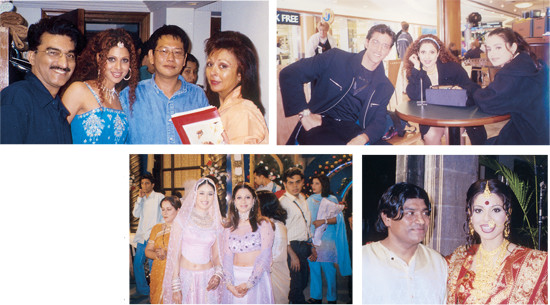
Clockwise from top left (L to R): Currim at the Mrs India contest with make-up artiste Bharat Godambe, photographer Chien Wien Lee and Maureen Wadia; shooting for Kaho Na Pyaar Hai in New Zealand with Hrithik Roshan and Amisha Patel; with Johnny Lever in Bevdadaas and on the sets of Main Prem Ki Deewani Hoon with Kareena Kapoor
Being a good artiste, Currim accepts only interesting and challenging roles, and reinvents herself in every character she plays: "It does hurt when I have to reject roles which are either of a best friend or of a sister. But, as long as I know I’ve made the right decision and it’s beneficial to me in the long run, it’s okay. Ultimately, my fans should be proud of the product I present on screen... I believe that there’s nothing like a small actress; there can be a small role. I do not mind playing the smallest of roles, but it has to have some substance, something related to the main story. There should be some challenge to me as an actress.” Paresh Rawal, Pankaj Kapoor and Naseeruddin Shah are the ones she admires "who had never been heroes, but have always stolen the show.”
The actress is proud and happy of the fact that despite being a Parsi who has never known Hindi properly she has got juicy roles. Currim is not a prude: "If I am convinced about wearing something that fits the role well, I’ll wear it. Television cannot capture exposing so well. So it’s not really necessary to wear short clothes, whereas, in cinema, if you have a good figure and wear a short dress, it looks elegant on the big screen.”
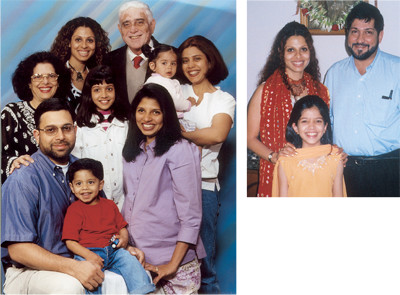
(Above, back row: from left) Daulet, Tanaaz, Russy and Vispi with Zoe in arms and amshid, Sharukh, Zianne and Perin ; Alongside Tanaaz with Farid and Zianne
"A lot goes into becoming an ‘A’ Grade actor. You should know how to interact with the director, say the right thing at the right time. You can’t throw tantrums and look for how to get the better of the producer. You are walking on a tight rope.”
One day, producer Sandeep Sikhand of Ek Se Bhale Do approached her to direct a play, Ask What Father Says. She liked the script and felt that she could handle direction: "It’s a knack to get the best out of an actor, within his/her limits. You are considered a good director, if you can assess the actor’s limits, his/her strengths, his/her weaknesses, and motivate him/her.” As a good director, Currim lets the creativity flow in all her actors, and allows them to enhance the character’s personality. She finds directing the toughest: "I find directing more time-consuming as I have to direct all the actors, whereas, when it comes to acting, I have to do only my part to the best of my ability and not worry about the rest.”
With such a diverse acting experience, having scaled the heights of professionalism and success, Currim laments: "Theater is a great medium, but it has been abused recently. We are taking the audience for granted. People are dishing out more sex comedies for the sake of doing comedies. Theater is not a medium to earn money from. You should go in for theater only if you have a good script, a good character. Only then people will appreciate your good work.” About the medium of television, she is of the opinion: "Television, surprisingly, is getting interesting. Apart from the normal saas-bahu (mother-in-law/daughter-in-law) soaps, there’s action and a new kind of comedy that is more realistic like the Jassi Jaisi Koi Nahin serial; television is ‘happening’ because the channels are competing with each other. The viewer has the last laugh.” Currim doesn’t leave cinema far behind: "Hindi cinema is also going through a lovely change. Scripts are now considered more important than the actors. Acting has become more natural, packaging more interesting, comedy more palatable rather than embarrassing. The actors have started taking their work more seriously, coming on time...”
Like most actors, Currim slogs it out: "I leave at eight in the morning and return home at 11 in the night, absolutely fagged out. Compared to theater, you have to work much harder on the television sets. You are on your feet all the time, there’s no escaping even for a minute, as you have to clock in a certain amount of work in a few hours. So many lives are connected to your timings; you can’t have too many retakes.”
The only thing Currim doesn’t like about this profession is the timing: "I want to have a personal life as well. I want my life to be well-rounded. So, at times, I let good work go.”
With such tremendous work pressures, 11-year-old Zianne, who is a sixth standard student of J. B. Petit High School for Girls is "well taken care of by her father.” Does Currim see her childhood in her daughter? "No. I was a typical Aries — carefree, with a big ego, full of temper, calmed down equally fast. There just had to be a rule to be broken! I was a rebel without a cause, always a little jungli (waif). My daughter is a typical Virgo. She wants everything on time, is neat and clean, never disobeys, is very sensitive, gets bullied all the time, and is a gem of a girl at heart. I find it interesting dealing with her because she is different from me. She has fallen on my sister Vispi.” When was Currim born? "I was born on April 8th.” The year? "Revealing my age doesn’t help me in the profession in which I am.”
A happy-go-lucky child, all Currim wanted was to be well fed and to be a grown-up fast, as she is "very young compared to my siblings” — brother Jamshid Lal (40), an I.T. consultant in Los Angeles, and sister Vispi Lal Oberoi (37), who used to help her husband in producing films for Lock Stock and Barrel. She is now a housewife.
Currim was a smart little girl: "I could easily put two and two together. I was much more intelligent than people gave me credit for. And, I liked it that way as I didn’t want to shoulder many responsibilities!” She was a clever student: "I used to hardly study, and yet got nothing less than a first class. My mother wasn’t very strict about studies and was quite open-minded.” Currim’s mother, Daulet Lal (62), is a gemologist. She makes gold and diamond jewellery and runs the business, Lavaan, from her residence. Currim’s father, Russy Lal (72), retired from the German company, Winter Halter Gastronon, supplying kitchen equipment to the Taj and President Hotels in India.
Currim always possessed leadership qualities: "I loved my freedom when it came to acting in or directing a play. All I needed was a bit of direction. I hated following instructions, otherwise I wouldn’t like to do that part!” Currim’s acting talent was inborn. She never found the need to join an acting school. Besides, stars like Rekha and Sridevi greatly influenced her: "They made me feel like entering this profession.”
When Currim was studying in Standard VIII at the Cathedral and John Connon School, she worked in her first commercial play, Boeing, Boeing with Dinyar Contractor. Knowing that Currim was a good imitator, Contractor’s niece Persis Irani who was in the same school recommended her name to Contractor. Once she was clearly explained how she had to enact the role of an airhostess, Currim performed up to his immense satisfaction and landed the "small but substantial” part.
Currim got another chance to act in a play, Mischief Mania, directed by the late Pearl Padamsee, when studying in first year junior college at the H. R. College of Commerce: "Rehearsals took a lot of time, especially a month before the play would commence. I had to take my college notes from my friends. Of course, in the library, I chatted more than taking notes! Somewhere, my heart was always in theater.” Not many may be aware that, when in college, Currim used to occasionally hand-model for commercials such as Johnson and Johnson, Lux and Surf: "Hand-modeling hardly took a couple of hours, and I would get the cash immediately and return home. It was good pocket money.” More importantly, this made her understand the value of money.
God being her biggest source of inspiration, she lights the divo and prays everyday at home. "I try to believe nothing of what you hear and half of what you say. I feel so right at the end of the day, that I haven’t harmed a soul, neither verbally nor physically. I believe in the policy of ‘live and let live,’ an easy expression, but not many people understand the meaning of it.” She believes, "Parsis are known for their stability, honesty, cleanliness, friendliness. I don’t need to sell myself any more as a friend. Some of the best friends and the best bosses that people have are Parsis. It has always been an asset to be Parsi. Parsis are open-minded, we laugh at ourselves so willingly and happily!”
Currim is upset that the Parsi law does not allow a person to convert to the Zoroastrian faith: "My brother Jamshid is married to a Bohri, Perin Lokmanji. Their children, Sharukh and Shiraz are Parsis, but Perin is not allowed to convert (to Zoroastrianism). My sister, Vispi, is married to a Punjabi, Vikram Oberoi. Their daughter Zoe cannot follow the Zoroastrian faith. My husband is an Ismaili Khoja. I couldn’t do Zianne’s navjote... A Parsi was not born from a fruit; he was converted. Zarathushtra himself converted the first human being into a Parsi. Similarly, the first Christian followed Christianity because Christ himself converted him.” Currim believes in moving with the times: "Religion is a very scientific way of making a group follow a proper and systematic way of thinking. If our Prophet had been alive today, he would have told our High Priests to move with the times. We need leaders who can assess the situation around them for the benefit of the group.”
Her views on the religion may not win the warm and friendly Currim encomiums from the community as would her "free and natural acting.” She is not a winner of any awards, except being the first runner-up in the "Gladrags Mrs India 2002” contest. But for Currim, "more work and challenging scripts would be my best accolade.”
◆ ◆ ◆
From the archive