
Life-Style
A force to reckon with
His commendable feats of strength have earned Edul Palamkote a mention in the Limca Book of World Records
When a student in Standard IV at Bombay’s Sir J. J. School, Edul Palamkote was slapped by a senior boy who thought the junior had hurled a stone at him. Palamkote went home with a red mark on his cheek and showed it to his father Pirojshaw who gave him another slap for taking a beating from another boy. Today, an 84-year-old great-grandfather, Palamkote still remembers the first lesson that made him toughen up. Practising freehand exercises and yoga from the age of nine he grew to be "One of the Strongest Boys of Bombay” with a strong, lean and symmetrical physique. For three years consecutively from 1938 to 1940 he won the "Mr Bombay” title.
As time passed, Palamkote became stronger. He relates how he could lift with his teeth a weight of 200 lbs, break thick buffalo chains, cut a thick iron bar into two on his chest while lying on a bed of nails, tear a big copper plate apart, tear apart two telephone directories... He could even pull a heavy fire engine (with full crew) over a distance of 100 yards by his teeth when he was only 18. The latter record is still unbroken as per the Limca Book of World Records first edition in 1990.
Prof Tehmurasp Sarkari, the Father of Physical Culture in India, once introduced Palamkote to two well-known pahelvans (strong men), Gamma and Himambux. Edul played handgrip with both. When he was testing his strength against Gamma’s neither of them could outdo the other, making Gamma compliment the young Palamkote, who was barely 20 at the time, for his strength and give him the titles "Fauladi Purush” and "Man with the Iron Grip.” He offered Palamkote a fistful of almonds and pistachios which was politely refused: "Instead of almonds I eat grams, and peanuts are pistachios for me.” Palamkote’s name was splashed all over the papers. Making headlines is in his genes.
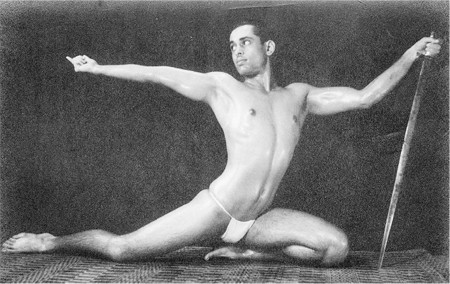
27-year-old Palamkote’s Pose of Challenge during the Mr Bombay competition
Palamkote has a very illustrious family background. From the carefully preserved news clippings we learn that his father, Lt Pirojshaw Dinsha Palamkote was a member of the Poona and Bombay Volunteers Rifles, Auxiliary Force (India), Indian Defence Force and Indian Territorial Force. He served in World War I and was Prisoner of War in Turkey for three years. His mother, Cooverbai, was a distinguished swimmer and cyclist. His brother Rustom was with the Bombay Fire Brigade and died in the line of duty during the 1944 Bombay Dock explosion. He had two other brothers: Burjor was in the Royal Indian Airforce and served in World War II; and Homi was in the Arsenal as Edul’s assistant in the Bombay Fire Brigade before he joined Tata Hydro in charge of automobile workshops. Edul’s fui (paternal aunt) Bhikaiji was a life academic member of the Trinity College of Music, London. Another fui Bai was a Parsi lady journalist running a Hindi graphic paper. His uncle Sorab Limjibhoy Palamkote was a poet and journalist.
In the throes of World War II, an announcement was made that volunteers were needed in the Auxiliary Fire Service. Palamkote joined immediately. Part of his training he attributes to his elder brother, Rustom. In 1941 Tatas took over the Service. Explains Palamkote: "Tatas wanted to depute an officer who knew ARP (Air Raid Precaution), fire-fighting and could train their staff. They had approached Norman Coombs, the then fire chief, who recommended my name.” Palam-kote reported to the directors of Tata Industries.
In 1942 Coombs appointed Palamkote as the first Indian section leader, says the veteran. He had to train new recruits in discipline, fire-fighting and drilling. But life was not a bed of roses. Palamkote went through rough times, he narrates: "Once there was a big fire in the Fort area. Rustom and I entered one of the rooms to fight the fire. We suddenly got locked from outside. We tried hard to push open the door, but couldn’t. My brother broke open the window and leaped outside to catch hold of the open window of the opposite building. I followed him. Later, we got to know that someone from within the Fire Brigade had locked us from outside. Today, I’m surprised how we managed to save ourselves.” Duty was for 24 hours. In Palamkote’s words: "It was like niché dukaan, ooper makaan (shop below, residence above). We could not even have a proper bath lest the bell ring, calling us on duty!”
Major Snalling, the fire chief of the armed forces in Khadki, Poona, came for a visit to the Auxiliary Fire Service. Amongst the 250 officers he selected Palamkote to work as fire chief, in charge of arsenal and explosive factories. Palamkote became the first and the youngest Indian to be appointed as fire chief of the armed forces (army, navy and air force) in March 1943 at the age of 24, he happily reports. Palamkote recollects an incident vividly: "One day, two European sergeants were walking towards me. They noticed me and, instead of saluting me, started tying their shoelaces. The commanding officer, a Britisher, watched that from a distance. He told me: ‘Son, did you notice anything? The two sergeants didn’t salute you!’ Both were called in to salute me and were warned against any future misbehavior. The commanding officer continued: ‘They don’t salute you. They salute the King and the Queen. Next time if anybody breaks the discipline, please tell me immediately.’ Sadly, today things are exactly the opposite.”
When India gained Independence, Edul was proud that now he would fight for his motherland. But, to his dismay, most of the allowances and perquisites he enjoyed were discontinued by the Indian government. Also, injustices started prevailing ["maama, maasi nu raaj (favoritism and nepotism superceded merit)”].
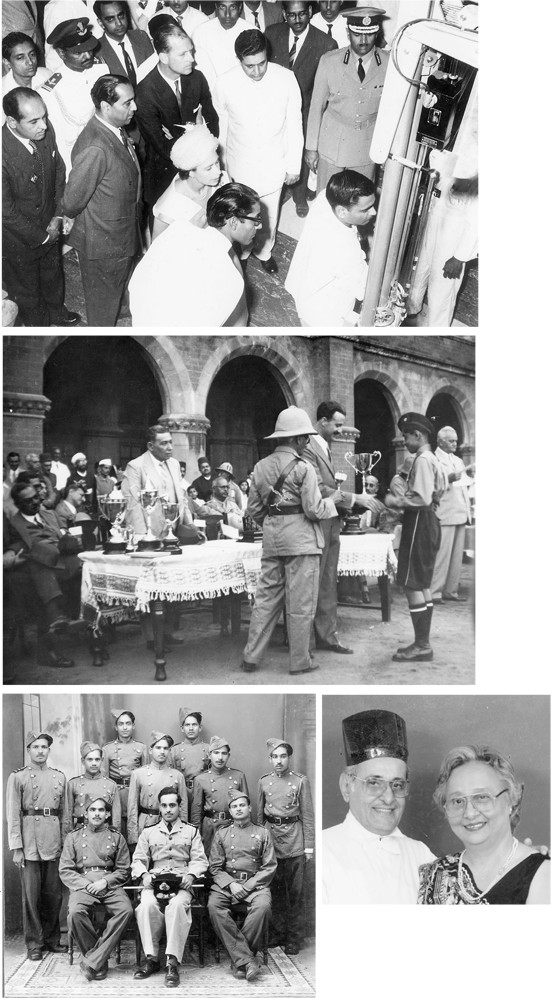
Top (L to R): Palamkote, Bhabha, Prince Philip, Dr Homi Sethna and Queen Elizabeth at the Atomic Energy plant Center: A young Palamkote receiving a cup from Bombay Governor Lord Brabourne Alongside: Palamkote (seated center) as fire chief of armed forces and (far right) with wife Sheroo
Palamkote resigned as fire chief of the armed forces and joined corporate bodies, he says. In 1950 he started with Tata Sons as fire and security in-charge of the Tata concerns. In 1953-54 he became fire chief and advisor to Stanvok. From 1956-58 he was with Atul Attic and Ladderlee as fire and security chief.
In 1958 it was an honor for Palamkote
when Dr Homi Bhabha offered him service at the Atomic Energy as fire and security officer. He was given the responsibility of organizing their fire brigade. He came across several dignitaries such as Prime Minister Indira Gandhi, Queen Elizabeth, Prince Philip... In 1960 he was appointed Scout and Guide examiner by the State Government. He retired in 1977 from the Atomic Energy as Central Government gazetted officer.
The good-looking Palamkote had unknowingly pull-ed the heartstrings of many a girl during his younger days. He received several offers for marriage, for dates at hotels and cinema halls. But the good boy "would show all the letters to my mother and she would warn me, ‘Muvaa maari naakhas; ai lafraa maa padto naa (I’ll kill you if you have clandestine affairs).’” But soon he fell in love with a reserved, sober and active Sheroo Behramsha Khergam-walla, whose family in Bulsar was known as the Jagirdars. The two met in a Parsi Youths Rally and later took part in several charity physical/cultural shows together, showing feats of strength. Edul and Sheroo got married in 1950.
For the last several years Palamkote has been preoccupied with doing social work for the Parsi community. While his eldest daughter Roshni Cyrus Palamkote is in Bombay, the other two children are abroad. Son Behram, a master chef with Lufthansa, is in Germany and daughter Hutoxi Minoo Driver is in the UK. A devout Zoroastrian, he believes in the dakhmenashini tradition and is against inter-caste marriages: "If you cannot be faithful to your own religion, how will you be faithful to your spouse’s religion?” He is particularly unhappy with the Parsi youth: "All they want is a cushy job in a bank. They don’t want to work hard as we did.” He would like to share the secret of his good health: "Keep well, live well, be hygienic.”
◆ ◆ ◆
From the archive