
Zoroastrians Abroad
Mody and the HK Varsity
The Incorporated Trustees of the Zoroastrian Charity Funds of Hongkong Canton and Macao (ZCF) celebrated the 90th anniversary of the founding of Hong Kong University by installing a new bronze bust of Sir Hormusjee Nowrojee Mody, the university’s principal donor. The joint unveiling by ZCF president Jal Shroff and vice chancellor of the University, Prof Ian Davis on June 17, 2002 was attended by distinguished members of Hong Kong academia and members of the community, informs a missive from the ZCF. The bust replaces an earlier one which for some reason had been removed and misplaced.
"The University had decorated the entire staircase with lights and set up enlarged photos of Sir Hormusjee taken at the original foundation stone laying ceremony in 1910,” notes the write-up by Yazdi Parekh. Refreshments and champagne organized by the University followed the ceremony which took place a few steps up from the front entrance of the main building, he notes.
The 60 cm high bust cast in bronze is set on a polished wooden plinth with a base of solid black stone. The plaque on the plinth — which states, "Sir Hormusjee N. Mody (1838-1911), major donor towards the founding of the University of Hong Kong, a distinguished Parsi businessman, renowned philanthropist and benefactor of Hong Kong for over fifty years. This bust is presented to the University of Hong Kong on 17th June, 2002 by the Incorporated Trustees of the Zoroastrian Charity Funds of Hong Kong, Canton, and Macao to commemorate the 90th anniversary of the University of Hong Kong” — will ensure that generations of students, professors and visitors will be aware of Mody’s contribution to the institution.
When the ZCF trustees found that the original statue was missing and sought to replace it, they realized that a long and complex liaison with the University was required. It was former president Noshir Pavri MBE, JP who undertook and completed the task. Together with his son Kawas, now a ZCF trustee, Pavri worked with a master sculptor to design and construct Mody’s likeness, even supervising the placing and lighting of the bust for optimum effect. "Thanks to the hard work of the Pavris, the trustees prevailed and donated a stunning new bust of Sir Hormusjee to the University,” notes Parekh. Shroff concluded his opening speech honoring Mody and describing the time-consuming process that ended so happily, recalling Mody’s words: "providing for others what I myself was denied.”
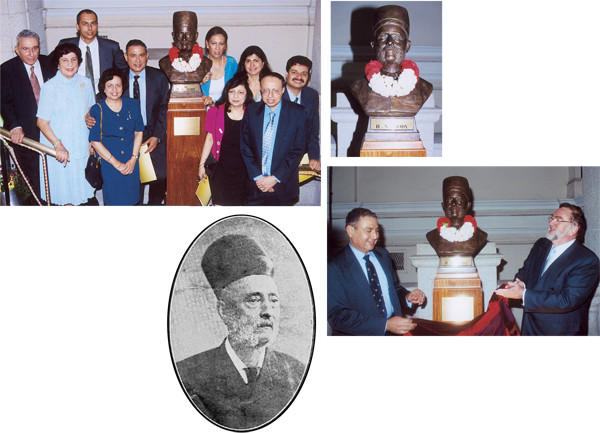
Clockwise from top left: ZCF trustees and their spouses stand around the bust of Mody; the new bust installed at the University; Shroff (left) and Davis at the unveiling ceremony; benefactor Mody
A major artery in the heart of the bustling Tsim Sha Tsui district is named Mody Road after the man who activated the Hong Kong Gold Bullion market (today Asia’s largest) and the Hong Kong Stock Exchange (Asia’s second largest), founded the Kowloon Cricket Club and owned a famous horse-racing stable, notes Parekh. The 20-year-old youth who had arrived in Hong Kong in 1858 was responsible for reclaiming and developing much of urban Kowloon and Hong Kong and became the president of the ZCF in the 1890s. "He made a considerable fortune from his business but returned much of it to the area and the people that made him successful,” writes Parekh.
What was particularly gratifying to Shroff and the community was that the next day the Chinese language Press featured substantial reports and pictures of the event which "served to educate the local population on the vast contributions made to Hong Kong by past generations of Parsis and to raise the profile of the current Parsi community and Zoroastrianism in general,” states Parekh. He further notes that the Sun Daily devoted a full page to Parsis and Zoroastrianism tracing the community’s history from Zarathushtra to the modern 23-storey Zoroastrian Building in Hong Kong.
"The newspaper even had a small article on the ancient Zoroastrians who had come to China over a thousand years ago and helped the Chinese develop a better style of Kung Fu. The local Chinese population was extremely surprised to find out how much Parsis had contributed to the development of Hong Kong and the betterment of their way of life. Most were completely unaware of the existence of Parsis and Zoroastrianism at all. Truly, these were special days of recognition, not only for the Parsis of Hong Kong, but for Parsis around the world,” Parekh concluded his report.
◆ ◆ ◆
From the archive