
Observation
Genesis of the fire
As per maritime rules, any ship carrying gunpowder and ammunition has to fly a certain type of flag signifying the explosive nature of its cargo when it enters the docks. The captain of the Fort Stikene never flew this flag and so nobody except the crew knew of the danger that the lethal cargo posed. Why the flag was not flown can be anybody’s guess. Possibly, the British feared that there were plenty of spies in the dock area who would report the arrival of the ship with the ammunition (and also the gold) and hence decided to keep it a secret and the captain may have had specific orders not to fly the danger flag that day.
Perhaps, the captain made another fatal error. Due to the heat, the smell from the dry fish loaded from Karachi may have been so overpowering to the captain and his crew that they decided to unload the fish first instead of the dangerous cargo of ammunition and gunpowder!
The first sign of fire was reportedly noticed by a sailor of another ship close by who saw the white smoke and sounded the alarm. As Fort Stikene was not flying the flag signifying the explosive nature of its cargo, the fire’s danger to the ship and the city was grossly underestimated and a small fire tender with about half a dozen men was sent out. Had the nature of the cargo been made known at the outset and a much larger force been called, perhaps under Palamkote, the fire could have been put out in time (before it got to the gunpowder) and the explosion avoided altogether. But as it happened, the same sailor who had first reported seeing smoke, was horrified to see the smoke change color from white to greenish-brown! From his training he at once knew the significance of this color change. It meant gunpowder was on fire! He shouted a warning and at the same time dove into the water! Minutes later the first explosion was witnessed. That is when Palamkote and his men came on the scene of utter chaos. As per official records, 1,376 lives were lost. The real number could be much more. The cause of the start of the fire was never determined. It could have been a lighted cigarette carelessly discarded into the hold where the cargo of cotton bales was kept, or it could have been a case of sabotage! Those who may have known the answers were never heard of again. April 14, 1944 will always be remembered as the day when the horrors of war came to Bombay.
•••
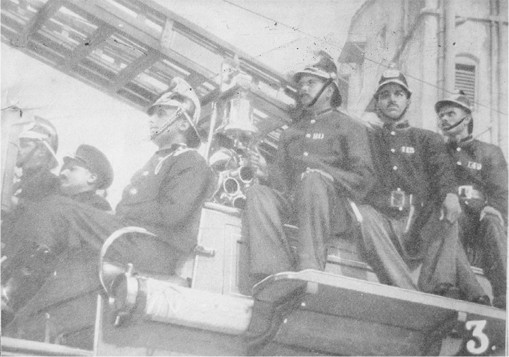
Palamkote and his fire fighters
For the information of our readers and on the suggestion of the author Parsiana accessed the website http://www. merchantnavyofficers.com/bomEx.html to gather more information on the catastrophe.
Deep in the holds were 1, 395 tons of explosives including shells, torpedoes, mine signal rockets, magnesium flares and incendiary bombs, and these were for discharge at Bombay. Above these lay 12 crated Spitfires and more explosives for discharge at Karachi and finally gliders were stacked on the upper decks. More specifically in the tween decks of Number Two hold 238 tons of highly sensitive Category A explosives had been stacked on three sides, on the fourth side a steel container measured 5’x4’ x 4’ had been lashed. Within the container were 31 wooden crates, each crate contained four gold ingots measuring 15”x3”x1.5”, each bar weighed two stone and was a part instalment to a bank in Bombay which was to be used to cancel out the adverse effect that the British War economy was having on the exchange rates in India. The estimated value of the gold varied from a low of £ 1,000,000 to a high of £ 2,000,000.
The vacant space created by the discharged crated gliders and Spitfires was filled with 8,700 bales of raw cotton, drums of lube oil, timber, scrap iron, sulphur, fish manure, rice and resin. (The ship’s officers) were more than a little alarmed at what they were expected to carry... So much so that when Captain Naismith complained to the shippers, their response was in effect, ‘Didn’t he know that there was a War on?’ The last straw was on April 7 when 750 drums of turpentine turned up with the shippers proposing that the highly inflammable concoctions be placed on top of the ship’s coal bunkers, Naismith turned them down flat. All the deck officers voiced their concerns over the stowage of cotton with lube oil in the same hold as explosives but couldn’t find any reference books on the ship or ashore and so it was with a great deal of misgivings that the cargo was loaded.
"Prior to sailing the chief officer Harris gathered his deck crew together and tested all the ship’s fire fighting equipment and Naismith declared he was to hold an extra fire drill once the ship had left Karachi. With five civilian watchmen, a crew member on the gangway and two Dems Gunners patrolling the deck, an officer on watch and two Pakistani policemen on or near the ship it’s fair to say that sabotage was not a factor in events which were to follow. The cotton was stowed in the lower hold, wood and then scrap iron were placed on top and then the lower hatch covers were put into place. Before the lube oil could be stowed it was discovered that one of the drums was definitely leaking with others suspect, so Harris laid tarpaulin and nailed it down himself over the lower hold covers. The American regulations stipulated that no more than 250 barrels of oil should be carried in the same hold as raw cotton and then separated by the length of the hold. Fort Stikene loaded 1,000 barrels and it was stacked immediately above the cotton. Naismith declared, "We are carrying just about everything that will either burn or blow up... The least we can do is to have extra fire drills.”
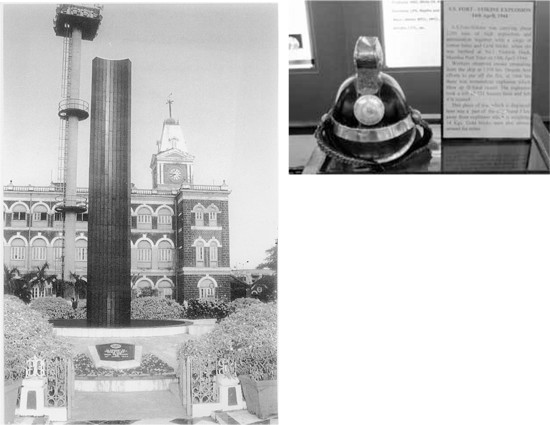
Memorials to honor those killed in the explosions: At Princess Dock (left) and a fireman’s helmet and plaque recording in brief the events of April 14 at Victoria Dock (above)
"The ship then made her way towards Bombay’s Victoria Dock... No-one within the dock area was aware of her dangerous cargo because the flying of the ‘Red Flag’ had been discontinued for the duration as the ships flying the flag were quite well aware of being ‘The Target Ship’ in the event of an air raid. Under normal conditions ships carrying explosives were not allowed alongside and were discharged into lighters. Because of the war this prohibition had been lifted. Explosions fall into three categories, A, B and C, the least dangerous ‘C’ could be loaded into warehouses and await transport, ‘B’ had to be loaded into waiting wagons for immediate carriage and the highly sensitive ‘A’ could only be off-loaded into lighters moored alongside the ship and never on the quay. Fort Stikene was immediately granted ‘A’ certificate of grave urgency by Major R. C. R. Hawkes on behalf of the Embarkation Commandant and work commenced a short while later when all five hold hatches covers were lifted. No lighters arrived to unload the category ‘A’ explosives until the following afternoon despite the grave urgency certificate issued by Hawkes.
"Work commenced however on discharging other cargo including the drummed lube oil onto the jetty. The foreman stevedore Shapoorjee Desai noticed that after discharging the drums from both Number One and Two holds quite a few of the drums were leaking and that the tarpaulins nailed down by Harris has a slick of oil covering them. It was at this juncture that an extra gang was employed to work on the Number One hold to facilitate the rapid discharge of the fish manure which by now was causing distress to all onboard. The gang worked all night and it was this action which created much discussion at the later commission of enquiry. Could for instance one of the labor force have climbed the ladder out of Number One hold into the forward mast house, gone through the bulkhead door should it have been unlocked and descended into Number Two hold for a cigarette unseen?
"Alerted that something was terribly wrong by the stampede to get off Stikene the section leader gave the order to get onboard with their hoses and remembering that the ship contained explosives ordered his sub leader to contact the Fire Brigade control room and give them a ‘Number Two’ message.
"Unfortuantely the sub leader, unable to get through to the control room on the telephone, broke the glass on the fire alarm out of sheer desperation. All this effectively did was to alert the Fire Brigade to the existence of a fire, not that it involved explosives! Consequently only two engines were dispatched.
"Onboard the ship were three conflicting points of view as to how best to cope with the problem and who, if any, had the authority to make a decision. Naismith wanted to save his ship, the dock’s general manager Colonel J. R. Sadler his docks and Bombay Fire Brigade chief Norman Coombs wanted Stikene to stay where she was so his crew could concentrate on extinguishing the fire. Captain Brinley Thomas Oberst, a British Army officer attached to the Indian Army Ordinance Corps, however doubted that any of the men could comprehend what was about to happen when Stikene blew up as she was sure to do in his opinion.
"The clock in the Dock Yard Tower had stopped at 1606 hrs when the first explosion occurred and remained so for many months. Oberst was flung up in the air by the blast and landed on a pile of dunnage. As he surveyed the scene around him in the gloom he observed bodies lying all around, most with their skin burnt off. Of the firemen in the immediate vicinity 40 were killed outright. Fort Stikene was blown in two and her boiler, still intact was found a half mile away from Number One berth. A huge tidal wave swept across the dock and ripped ships from their moorings. One ship finished astride a warehouse and Jalapadma finished up alongside what was left of Stikene. At 1633 hrs as Coombs stared across the dock surveying the scene of destruction the second explosion occurred throwing debris 2,000 ft into the air. Jalapadma’s poop deck along with her 12 pounder gun was blown clear over the warehouse to land some 200 yards distant. British India’s Baroda which had been set on fire by the first explosion when parts of Number Four shed fell onboard was blown across the end of the adjacent berth when the second explosion occurred.”
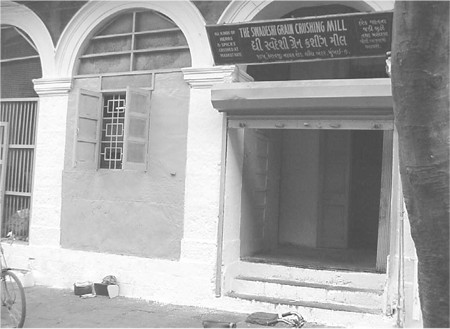
Entrance to the Swadeshi Grain Crushing Mill owned by Behramji Damania
The effect of the devastation was conveyed in an account, written in 1969, by Derek P. Ings who had joined H. M. T. Chantilly as assistant purser in October 1943.
"An hour after the first explosion all the shops, stalls and eating places had closed. Many of the windows of offices and shops had been blown out and glass and roof tiles were strewn everywhere. There were some people in the streets, mostly office or shop workers, but there was no sign of the sweeper class.
"I reached the (St George’s) Hospital at about 5.30 p.m.; passing a dead gharry horse lying at the entrance. My friend had been put out of his bed to make room for the injured that were arriving by ambulance in very dirty and bedraggled condition. Mattresses were (laid) all over the ground floor to treat the casualties...
"There were now 30 burning dhows in the stream and, as they sank, their cargoes of cotton still smoldered on the surface... Next morning... I walked towards the scene of the explosion and, whilst still in Alexandra Dock, saw several large steel plates, all twisted and torn, too heavy for one person to lift...
The fire continued to burn for all of that day and for the following night; by this time dead bodies were to be seen floating in the water off the ship. In all 27 ships were destroyed in the Victoria and Princess Docks. Many people were killed outside the dock area by falling shrapnel and shells which exploded on impact, many buildings collapsed and others were set on fire.
Amongst the debris falling from the sky were the 28 lb ingots of gold. One of the first to be found was picked up by Burjorji Motiwala, a retired Parsi civil engineer. The ingot had crashed through the building’s corrugated roof, penetrated the floor of the balcony above and come to rest on his balcony in the corner. The bar was stamped Z13256 and was worth Rs 90,000. Motiwala received a reward of Rs 999 which he donated to the relief fund...
The area of fire extended out from the epicentre by approximately 900 yards and included all of Victoria and Princess Docks, the godown estate to the west, the Burmah Oil installation to the north and the rice market to the south. On the western side it had gone beyond the godowns and had set fire to many of the dwellings of the poorer natives who lived on the fringes of the city proper. It took four more days to extinguish the main fire and for a further two weeks smaller fires continued to smolder in the ruins.
Two hundred and thirty-one people, attached to the various services which included the fire brigade and dock employees, were killed, another 476 were injured. Outside the docks over 500 civilians were killed and a further 2,408 were injured... In all some 50,000 tons of shipping was destroyed with a further 50,000 tons severely damaged. Of the Stikene’s officers and crew, Naismith, chief officer Henderson and Alexander Jopp, the second cook lost their lives, the remainder miraculously survived.
Within seven months the docks in Bombay were back in operation and it was estimated that up to 8,000 men had been involved in the clean up project including troops from Britain, West Africa and India itself.
On October 28, 1944 the authorities began to flood the basin at a rate of three feet for each tide, this allowed the salvageable ships to re-float at a gradual rate and also allowed the repair crew to repair leaks as and when they were located. It took 48 hours to complete the operation and four days later the docks were back in normal use. Three hundred acres around the docks had been cleared using bulldozers, grabs, cranes and bare hands. Three hundred and fifty lorries a day made four round trips to Sewree carrying 3,500 tons of debris, the total amount transported exceeded 800,000 tons...
◆ ◆ ◆
From the archive