
Observation
The lethal cargo
An overload of ammunition and combustible articles aboard Fort Stikene in 1944 led to an unprecedented explosion in the Bombay docks
Friday April 14, 1944 was a very hot day in Bombay. The ship Fort Stikene (7,420 tons) had arrived on April 12 and was moored at Victoria Dock undergoing unloading like several other ships next to her. At the time of the explosion, the ship was carrying a lethal combination of cargo of dried fish, cotton bales (loaded from Karachi), timber, 1,400 tons of ammunition including gunpowder and gold bars (loaded from Berkinhead, England). The gold was to stabilize the rupee which was sagging due to World War II and fear of invasion from Japan and would allow the government to print more currency notes for paying salaries and other war expenses. The gold bullion was valued at approximately two million pounds sterling at that time.
Nobody is certain as to how the fire started but the two explosions which followed one after another were so loud that windows rattled and/or shattered as far away as Dadar, a distance of eight miles. The destruction in the docks and surrounding area was immense and several hundred lives of dock workers and firemen were lost in an instance. After the first explosion went off, the Bombay Fire Brigade led by chief fire officer Rustom Palamkote answered the call to duty within minutes. Palamkote himself courageously entered the hold of the burning ship to inspect the cause of the explosion when there was a second, more devastating blast. All of the 66 brave fire fighters, including Palamkote, lost their lives (a monument has been erected in the Victoria Dock in their honor). Some of the ships that were docked alongside the Fort Stikene were blown right out of the water and lay along the dock on their sides!
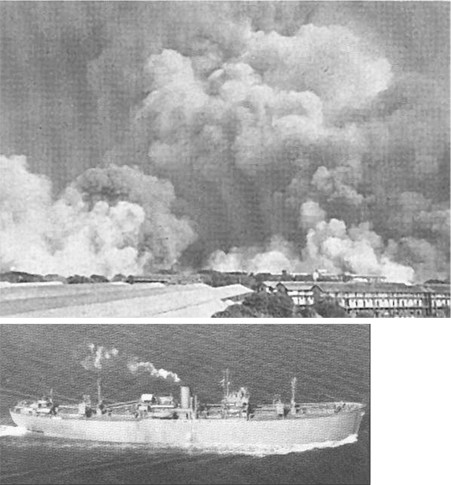
Above: A view of the harbor after the first explosion and the ill-fated Fort Stikene (alongside)
The population of the city was panic stricken as wild rumors spread rapidly that the explosions signaled the commencement of hostilities by the Japanese on the same style as the surprise attack on Pearl Harbor in the Hawaiian islands in December 1941. Totally unfounded tales from Surat, where the Tapti river meets the sea, had mentioned several sightings of periscopes of supposedly Japanese submarines! As it turned out, the Japanese were nowhere near Bombay since they were engaged in fighting a losing battle with the British army in Burma at that time. Nevertheless, the Bombay Central (BB&CI) railway terminus was packed to capacity with terrorized citizens fleeing the city in whichever train they could board with all belongings they could possibly carry. It was impossible to get any train from the Victoria Terminus as both the harbor and main lines of the Great Indian Peninsula Railway were also affected by the blast and were unoperational due to the large amount of debris fallen on them.
At the time of the explosion, one of the red-hot gold bars crashed through the roof of the third floor apartment of a Parsi gentleman named Burjorji Motiwala, more than a mile from the docks as he sat in his lehenga (pyjama) and sudreh reading a newspaper! He promptly and honestly returned the gold bar to the authorities for which he was commended. A substantial number of gold bars were subsequently recovered from different parts of the city; the last ones to be found were hauled up from the bottom of the sea in the docks. During normal dredging operations, carried out periodically by the Bombay Port Trust to maintain the depth of the docking bays, gold bars were found intact sporadically as late as the 1970s and returned by the port authorities to the British government. But a considerable number of bars still remain missing.
My father, Behramji M. Damania, was in his office at the Tata Power Company’s receiving station at Dharavi when the first explosion occurred. He went outside to see a plume of dark smoke rising that he cleverly deduced came from the dock area. Since he owned a spices and herbs grinding mill (chakki) at Chinch Bunder very close to the docks, he immediately got into his car and drove towards the area at top speed. As he neared the J. J. Hospital he saw crowds running away from the area with their most precious belongings on their heads and/or in their hands. He worriedly made his way towards the mill to find my cousin Rusi Medhora, who used to manage the day-to-day operations of the mill, standing at the corner on the Dana Bunder bridge in a complete daze. Rusi was very glad to see my father and they both cautiously went towards the mill on foot.
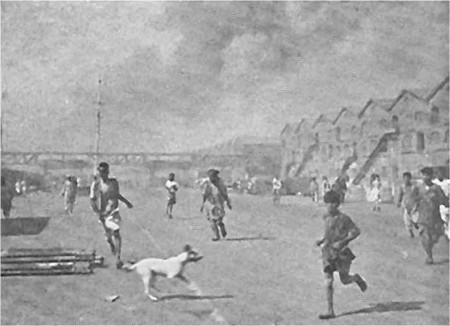
Workers fleeing the scene after the second explosion
The wooden doors of the mill, about a quarter of a mile from the docks, had been blown off their hinges and all the workers had fled for their lives, leaving all the machines still running! Together he and Rusi shut the machines one by one and managed to put the doors back at the entrances as best as they could. People were fleeing everywhere. Some of the residential buildings were on fire. My father saw one old man on the second floor balcony refusing to come down from his burning building! His relatives and friends were pleading with him to abandon his home and flee. From his perch the old man shouted, "Pun aanoo shu karoo (but what shall I do with this)?” He was holding a sack full of currency notes! Later my daddy and Rusi drove home through the throngs of crowds heading towards the Bombay Central railway terminus. The British administration at the time of the explosion, under the governorship of John Colville, took full responsibility for the disaster and adequate monetary compensation was promptly paid out to citizens who made a verifiable claim for loss or damage to property. The damage to the mill too was in time set right, but my father always talked about that fateful "dhadako (explosion)” day "when Bombay blew up” with great enthusiasm. Rusi on the other hand, who had been close to the explosion and must have been very badly shaken, rarely talked about it. A curved piece of solid steel from one of the several ships that were destroyed that day lay where it fell for several decades alongside the railway tracks just before the down platform of the Sandhurst Road (upper level) station. When I looked for it the last time I was there it had disappeared.
◆ ◆ ◆
From the archive