
Events & Personalities
Memorial duty
April 14 each year is observed as Fire Service Day in India when 2,023 fire stations across the country pay tribute to their fellow firemen who died in action, mentions Fire Safety Chronicle (FSC) in its issue of January-March 2002. The significance of April 14 is known to Lovejoy Secil Dadee Mehervanjee who, according to the FSC, is perhaps the only surviving fire officer who physically participated in fire fighting operations in the infamous Bombay dock explosion of 1944. Each year he is among the fire officers who dutifully attend the memorial service held annually to commemorate the gallant efforts of the 66 firemen, including the first Parsi station officer Rustom Palam-kote, who lost their lives.
"It is a day I cannot forget. The fire, the flames and the loss of lives and property,” recalls Mehervanjee who had joined the War time Auxiliary Fire Service (AFS) as sub leader just two years earlier. The ship Fort Stikene, laden with lethal ammunition caught fire and within a few hours slipped onto its side and exploded. Mehervanjee reported, "I was by my trailer pump near the ship organizing further strategy when the ground rumbled... Then at 4.05 p.m. the ship exploded (and) the searing heat and vicious flames leapt high into the air...” After 31 minutes there was a second explosion, causing further devastation but by then 19-year-old Mehervanjee along with other injured firemen had been rushed to hospital for medical treatment.
Mehervanjee quotes Lt Edward F. Oliver of the U.S. Coast Guard who wrote: "Few have ever heard of the greatest dynamite gunpowder explosion of World War II — a blow to the allied war machine beyond the wildest dreams of a potential saboteur. The explosion nearly wiped out the Gateway of India and destroyed or damaged nearly 1,00,000 tons of allied shipping. The cost of the disaster has been put at more than a billion dollars. In terms of human lives, the figure is more difficult to arrive at.”
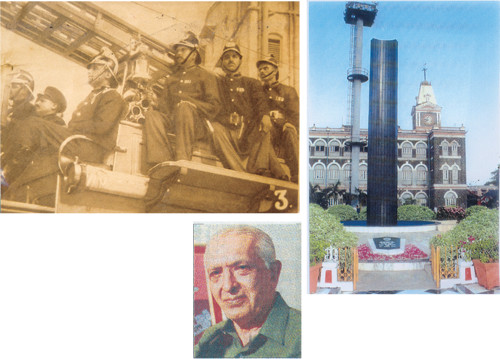
Above: Palamkote and his crew; Right: Survivor Mehervanjee and the memorial at Princess Dock to honor those killed in the Bombay dock explosion
The Stikene laden with RAF planes and general stores, explosives and ammunition left Birkinhead (UK) on February 24 and reached Karachi on March 30 where a part of the cargo was offloaded and substituted with cotton, timber, lubricating oil, resin, sulphur and other combustibles, reports Mehervanjee. Sailing from Karachi on April 9, she reached Bombay’s Victoria Dock on April 12, 1944. "Outwardly there was little to distinguish the 7,000 ton merchant ship from the other freighters discharging cargoes of allied war supplies. The only unusual thing about the ship being... a little known item, a cargo of gold ingots worth millions,” writes Mehervanjee in FSC.
When the War was over and the AFS disbanded, Mehervanjee and some "of the luckiest persons” were absorbed in the regular Fire Brigade of Bombay. Originally a good robust physique and completion of matriculation were sufficient qualifications for recruitment while presently one must be a science graduate and additionally have technical experience, points out Mehervanjee who retired in 1983 as chief fire officer.
There have never been many Parsis in employment in the fire brigade, points out Mehervanjee. Following the demise of Palamkote who was station officer at Motor Pump 13, the British rulers chose another Parsi, Shiavak Pavri, to succeed him, mentions Mehervanjee. Impressing upon the community "the need to be enthusiastic,” he would like to see Parsis join the Fire Brigade.
Mehervanjee states his mother, who was pregnant when proceeding to China by the ship Secil, was keen to name her baby Lovji but his father Dadee wanted to name the boy after the ship. They reached a compromise and gave the baby, born in China, a double-barrel name Lovji Secil. Unfamiliar with Parsi names, his British employers transformed Lovji into Lovejoy which has stuck since then, reveals Mehervanjee. And since Love-joy translated into Hindi means Prem-anand, his Maharashtrian friends now tease him saying he could consider a name adaptation yet again!
◆ ◆ ◆
From the archive