
Comment
Adventures in Aden
Parsis in that strategically located port city bonded well as a community until uprooted from there because of political upheavals
After completing my schooling in Navsari in 1950 I went to Bombay. Like many a youngster, my heart was set on joining the Indian film industry, but it was not to be. I spent a couple of years looking for jobs, trying my hand at shorthand, typing, bookkeeping and accountancy, even training as a motor mechanic.
My father who had settled in Aden since 1910 eventually called me there after a brief training in marine insurance as requested by my prospective employer.
I was provided deck class passage with cabin food on a Moghul liner called Jehangir. Of the many journeys I undertook from Aden to Bombay and vice versa this was the most memorable. Due to limited refrigeration facilities, live goats and chicken were carried on board. I was not very happy with cabin class food. I had never tasted such rubbery steak and boiled potatoes and preferred the fresh fish and chicken cooked by the crew, eaten with warm rotlis. Rookie that I was, I was given to understand that I should dress up for dinner, so I went wearing a necktie, only to see half a dozen Parsis sitting down to eat clad in their sudrehs and lenghas.
Initially I was very unhappy in Aden. The rocks would absorb heat during the day and radiate it at night. The air churned by the fan would be warm and humid. The office was dusty and there was no real work as the company had more or less closed its business. Fortunately, I was allowed by my boss to leave his company and join The National Bank of India. The hours were long and work very boring. Luckily, of the several Parsi boys working in the Bank I was selected to go to Little Aden where a BP refinery was being constructed. We had to travel 20 miles through the desert to reach Little Aden. There I ran a one-man bank for several years and gained much experience in banking.
Immigration laws demanded that we did not leave the colony for seven years in order to qualify for permanent stay. So the first time I went to India on holiday was after seven long years. The vacation lasted nine months during which time I hoped to get married. Many of the girls I had known earlier were already married, with a child holding on to a finger, one on the hips and one in the oven! It was a job finding a suitable wife, and we went as far as Hyderabad looking for a bride. With my mother believing in "Ras and dorda” i.e. astrological compatibility, the task became even more difficult. One prospect even asked me: "Jim, why don’t you smoke? It is so manly to smoke!”
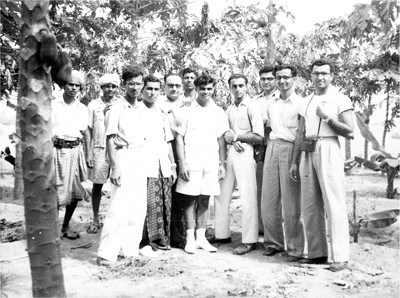
Employees of The National Bank on a picnic to Lahej
After seven futile months I finally found a suitable girl in Prochi Engineer, who lived just two doors away from us! After a very hurried wedding we set sail for Aden in a P&O liner where a job as chief cashier was awaiting my arrival. With the passage of time life in Aden gradually began to improve. The Bank installed air-conditioning. But life in Aden remained static; one met the same people everywhere.
Aden being a free port, all the ships passing through the Suez Canal called there for bunkering of oil. The shops in Steamer Point would remain open even in the middle of the night on account of the flourishing trade with tourists and people migrating to Australia.
Parsi ship chandlers would make it a point to invite any Parsi traveling to or from Europe to their staff mess and show them around Aden. Not that there was much to see. There were Tavilla Tanks built years back by the Turks to store scarce rain water. These were located close to our fire temple in Crater, Aden. A friend of ours was once whisked off the ship by a staff member of Cowasjee Dinshaw and Brothers and taken around Aden before we could get there. When we met up with him later, he jovially mentioned that the gentleman had showed him the dakhma on the hill from various angles and locations!
A Parsi funeral was a dreaded experience. About 15 to 20 of us had to carry the ravan up the hill, an exercise which was killing in the fierce heat. At one time there were about 2,000 Parsis in Aden and the occasional weddings, navjotes and Gatha gahanbars were very welcome. All the Parsi sethias would contribute towards the five gahanbars: first by Cowasjee Dinshaw, the second by Pallonji Dinshaw, the third by Keki Muncherjee, the fourth by the Motiwalla family and the fifth by the Anjuman.
An old gentleman living in the agiary compound would clap and shout out for: "Sorab, Rustom, Najoo, Naval, Soli, Temul,” and I wondered how the Parsi community was dwindling with so many children. Until I learned that he was calling all the Merwan Baug dogs for dinner! We formed a musical group which performed in Merwan Baug on joyous occasions.
At least once or twice a year we would enact a comic drama. Attending the rehearsals was most enjoyable as there wasn’t much by way of entertainment after work, except to go to the Parsi Club and play cards or billiards.
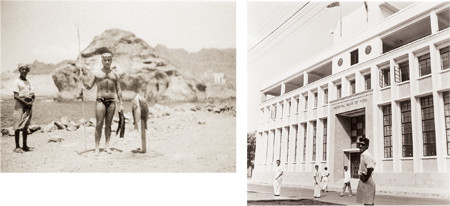
Above: Jamshed Tamboly with his day’s catch. Right: The National Bank of India in Aden
The blue sea around Aden was very inviting. There being not much rainfall, and the tide rising a foot to two, there was not much turbulence in the water. I developed a passion for harpooning fish in Aden’s waters. The other boys in the bank dubbed me a "mad Parsi” for fishing in shark infested waters. For me it was a real joy to spend hours in the warm clear waters, with fish in abundance. Our fridge would always contain fish and the surplus would be sent to friends who sometimes jokingly told me, "We were waiting with oil boiling on the choola (stove) but the fish never came.”
In 1964 political trouble started with bullets and bombs. I was on holiday in Bombay when Crater, Aden, was placed under siege. The British Army clamped down on the locals and cut general water supply to citizens for two days. Gun-toting British Army soldiers would go around in jeeps, harassing all and sundry. In those days Indians were deemed second class citizens and the locals treated even worse. Foreigners in Aden realized that their days in the colony were numbered. My wife and I acquired a flat in Colaba in case we had to leave Aden in a hurry. Our children were sent to our family in Bombay.
About 400 good cars belonging to Indians and Europeans were stolen, including mine. I had gone fishing, leaving my car parked on a hilltop near a European club at Gold Mohor. When I emerged from the water with the fish my car was gone — along with my clothes, shoes, house keys and money. The hot rocks and sand seared the soles of my feet. I rested and cooled my burning feet by placing them on the cold fish before going to a nearby European swimming pool/club. There I managed a lift from one of my managers who dropped me off at the Steamer Point taxi stand and gave me some money to enable me to proceed to Crater. I must have looked a real specimen traveling naked but for my swimming trunks, carrying gun, snorkel and fins, not to mention the catch of fish!
Young Arab boys began to keep revolvers and hand grenades in their bank safety vault drawers. I used to hold the keys of the Bank’s safe and I realized it was time to leave for good. About 30 Parsi men decided to resign and leave Aden. Indians leaving the colony were harassed by the locals. The fridges and goods of Indian merchants leaving Aden were deliberately dropped from the cranes into the ships’ holds to damage them. Immigration officials would demand money and gold if anyone leaving the country had either item on their person.
My wife worked for Aden Airways, a subsidiary of British Airways. We shipped our goods to Bombay and decided to holiday in Nairobi and London before returning to Bombay. Fortunately I managed to find a job in the Bank of India in London and settled down there in 1967. With God’s grace my wife and I have had a good and happy life, with many friends in London.
◆ ◆ ◆
From the archive