
Events & Personalities
Unity in variety
"To perpetuate the memory of a great son of the soil it is our foremost duty and responsibility to strive to achieve the ideals that were dear to his heart,” remarked M. M. Rajendran, governor of Orissa, in the course of his speech as chief guest at the meet organized by the Dadabhai Naoroji International Society (DNIS) on March 30, 2002 in memory of the political activist, one of the founders of the Indian National Congress and the first Asian Member of Parliament in the British Parliament. Describing Naoroji as "one of our tallest leaders of the freedom movement, tall not in physical stature but in his deep insight into Indian psyche, his integrity, undisputed qualities of leadership and his remarkable ability to anticipate the course of events,” Rajendran added, "he became a legend in his own lifetime.”
The function at the Indian Merchants’ Chamber was honoring 12 awardees with the Dadabhai Naoroji Millennium Award-2002 in the presence of the Society’s president and secretary-general Dr L. M. Singhvi and Dr S. S. Mohapatra respectively, chairman of the Bombay Parsi Punchayet Jamshed Guzder, member of the Government of India’s National Commission on Labour Arvind R. Doshi, economist Y. P. Trivedi and Samajwadi Party member Amar Singh.
Referring to the antecedents of DNIS, general secretary Homai Modi stated that it was set up 10 years ago to celebrate Dadabhai’s parliamentary centenary when at a function in Bombay’s Raj Bhavan, the then governor C. Subramaniam presided and J. R. D. Tata was the chief guest. The motivating force behind a corresponding celebration in London was Singhvi, then the Indian consul in UK, noted Modi. Presently "the live wire of our International Society (with branches in Delhi, Calcutta, Madras and Bangalore) is former Member of Parliament Mohapatra while the London branch is under the leadership of Lord Swaraj Paul,” stated Modi.
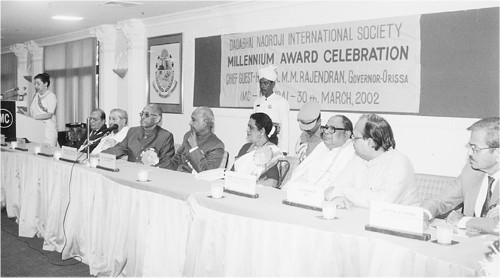
From left: Modi, Trivedi, Guzder, Singhvi, Rajendran, Ms Rajendran, Mohapatra, Singh and Doshi
Of the 12 awardees selected this year, three were Zoroastrians: Dr Aban Mistry, Jehangir Sabavala and Jehangir Nicholson. Tabla maestro, musicologist and scholar Mistry "has performed all over the world and is affiliated to over 15 universities as a visiting professor and examiner.” Senior artist Sabavala has the distinction of holding 30 one-man exhibitions and participating in over 100 group shows. "He is a remarkable example of a cultural bridge that links the past with the present and the east with the west,” introduced Modi. The posthumous award for former sheriff, art collector and rallyist Nicholson was accepted by his close friend Guzder.
The others who had come in person to receive their awards were cinestar Amitabh Bachchan, producer-director G. P. Sippy, managing director of Mukand Limited Niraj Bajaj, beauty therapist Minati Das, social activist Sampat Raj Jain and educationist R. P. Kathuria. Film producer Dr B. R. Chopra, secretary-general of the Minorities Commission Sarita Das and Indian Administrative Service officer Ujjagar Singh received their awards in absentia.
For the awardees and the audience from different religious and social backgrounds, Rajendran’s views on the subject of "National unity and secularism” were of significance in a communally torn India, especially his words, "Beneath all the manifold variety there is an underlying fundamental unity of the people...If we consciously preserve and promote this deeper unity in the lives of our people without emphasizing the differences born out of politics, there will be further growth in our understanding of the people’s way of life and their values.”
◆ ◆ ◆
From the archive