
Institutions
Lambent in Lonavla
The Aden fire’s sanctuary in India completes 25 years
Twenty-five years ago the fire had wended its way up the Bhor Ghat from Bombay to Lonavla in a cavalcade of cars, following its long flight from Aden. On the occasion of its silver jubilee on November 8, 2001, the window of the railway carriage trundling steadily up afforded Parsiana a glimpse of the Ghat road. It was clogged with bumper to bumper trucks, buses and cars, engines and tempers heating with the unexpected delay on the stretches-still-to-be-completed hill section, following the smooth drive to Khopoli along the ribbon of the new, multi lane expressway. While the lucky ones sneaked past the snarl of traffic, a number of devotees, anxious to arrive on time for the jashan, finally trooped into the tranquility of the Bai Jerbai Cowasjee Dinshaw Dar-e-meher (Adenwalla agiary) in Lonavla, over an hour-and-a-half later than scheduled, the incandescence of faith however undimmed.
The agiary houses two flames — a dadgah fire consecrated 102 years ago on June 3, 1899 and another of adarian grade consecrated in Aden in 1883 and flown in and installed in the agiary on November 14, 1976, roz Behram mah Khordad, AY 1346 (see "Lonavla’s legacy” Parsiana, July-August 1999). To commemorate the Aden fire’s silver jubilee in this picturesque hill retreat, the agiary wore a new look, with fresh paint, new tiles and a gumbaz (dome) constructed over the Aden fire.
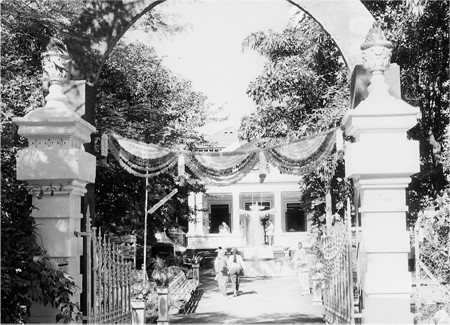
Arched portal of the agiary
High Priest (Dr) Firoze Kotwal’s unexpectedly delayed arrival saw Ervad Asphandiar Dadachanji and other mobeds commence the jashan amidst a packed hall of faithfuls, who included the members of the Lonavla-Khandala Parsi Zarthosti Anjuman and their families. The felicitation function following the jashan was held in the shady surroundings of the garden, beneath the verdure and spread of ancient foliage. Expressing his appreciation, Kotwal complimented Cowasjee Nusserwanji Dinshaw (Adenwalla), the chairman of the agiary trust, on the building of the gumbaz and other renovations. A jashan, Kotwal informed the gathering, is more than just a routine recitation of prayers. The Amesha Spentas are believed to be present at the place where the ceremony is performed. As long as the people’s faith in the atash, the Atash Nyaish, the sudreh-kusti, the dakhma and other prerequisites of the religion is strong, the community will survive, he asserted.
Tracing the over 100-year history of the Aden fire, Dinshaw told the audience that the firm of Cowasjee Dinshaw and Brothers, into shipping and a variety of businesses, was founded in Aden (now renamed Yemen) in 1850. Aden was a port booming with business, situated on the vital sea route between the East and West in Southern Arabia. Though a fire-temple had been built earlier and consecrated on September 20, 1854 (see "The Flight of the Fire,” Parsiana, December 1976-January 1977), in 1883 the Adenwalla family consecrated an adarian grade fire in the township, and built a mosque known as Masjid-E-Cowasjee for the locals as well. Aden and the Parsis prospered till 1967 when South Yemen turned communist. The British trooped out, so did the Parsis who reportedly numbered over 1,000 at that time. The adarian faced the flak of civil war, yet no bomb, exploding all around, or splinter touched the agiary, stated Dinshaw.
It was imperative that the fire be taken out of a country whose government did not believe in God. The dakhma, agiary and their funds became nationalized state properties. "We were not worried about the carpets or the silverware,” asserted Dinshaw, but only about the mission of shifting the fire to a safe haven. But the Indian government did not wish to antagonize the Arabs, the Queen of England gave no satisfactory reply to entreaties, neither the United Nations nor the World Bank extended help. Finally, it was Congress stalwart Y. B. Chavan, then the foreign minister, who prevailed upon the south Yemenese head at a non-aligned meet in Colombo to let the fire be moved out, with Prime Minister Indira Gandhi lending her support.
There followed a succession of quandaries — should the fire be taken west to London or east to Iran or India? London as an option was ruled out — an adarian fire had to be tended continuously and London did not have facilities for this. Iranian Zoroastrians followed the Fasli calendar — Aden’s was a Shahenshahi agiary. India was considered the best option. Field Marshal Sam Manekshaw was approached for help, but the overland route meant traversing Mecca and Medina, out of bounds for non-Muslims. The final decision — the fire would be flown out in a special container in a chartered Air India Boeing 707 with an all-Parsi crew.
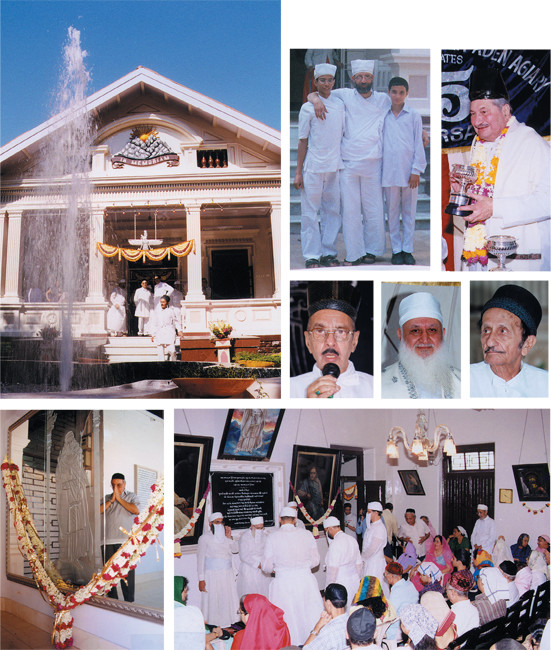
From left (first row): The fountain and the flowers, Zarir Tata (center) with Jamas (left) and Cyrus (Photo: Hilla Guzder) and uzder; (second row) Cowasjee Dinshaw, Kotwal and Gotla; (third row) embellished mirror and the agiary hall Photos by Homyar J. Mistry, Homz Prints
But problems persisted — the pilot scheduled to command the flight took ill, no replacement was to be found. Finally, it was Air India pilot Capt Sam Peddar, who had a license to fly the Boeing 747 and not the 707, who saved the situation. "My role was accidental on this historic occasion,” wrote Peddar in his letter of good wishes to the trustees, read out at the silver jubilee function. Learning of the heroic efforts to save the fire and the Yemen government’s stringent conditions and deadline, Peddar put in extra flying hours to obtain his license for the 707. On the eve of the midnight hour of departure, a message was said to have arrived from the head of the Yemenese police that he wished to inspect the contents of the container. More torment and tension followed, but the final knock on the agiary door brought not the chief of police, but a messenger to say the chief had reportedly passed away! "There is a lot of power in this holy fire,” stated Dinshaw, "and those who serve it will not go empty-handed.”
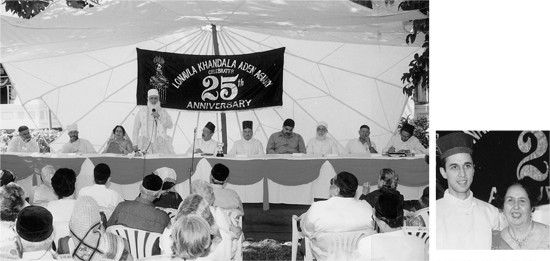
At the felicitation (from left): Tirandaz, Zarir Tata, Khodaparast Dinshaw, Kotwal, Cowasjee Dinshaw, Guzder, Dadrawala, Dadachanji, Maneck Shroff and Gotla; Khodaparast with son Sarosh
Present at the function were Dinshaw’s wife Khodaparast, also a trustee of the agiary, Bombay Parsi Punchayet (BPP) chairman Jamshed Guzder who was the chief guest, BPP trustees Dinshaw Mehta and Rustom Tirandaz, columnist Noshir Dadrawala, Lonavla-Khandala Anjuman vice president Maneck Shroff, secretary Darius Gotla and a host of others. Pledging a donation of a lakh of rupees, Guzder reiterated his oft-repeated message of teaching children the importance of prayer. "Fire is an animator, the symbol of light, the symbol of life,” stressed Dadrawala. "We have fire energies in us. When we die we go cold — the fire energies have left us.” Dadrawala exhorted his coreligionists to keep, if not a fire, at least a divo burning in their homes. Dadachanji informed the gathering that the two fires, which had been shifted due to the ongoing repairs, had been reinstalled the previous night in their respective keblas after due ritual purification. While Mehta did not speak, Tirandaz in his usual flamboyant style touched upon the "crystallized DNA of the Parsis” and the need to marry within the community, adding that the decision of the trustees of the Jeejeebhoy Dadabhoy Agiary at Colaba to allow the use of the baug for marriage receptions even where the groom is a non-Parsi had "greatly pained my heart.”
With a table full of mementos glinting in the noon sun, the organizers acknowledged with shawls, flowers and silver cups the assistance and benefactions of numerous individuals — the priests, including the agiary’s panthaky Zarir Tata, well-wishers like Maneck and Rashida Shroff, Jal Engineer, Adi Banajee, Khorshed Cooper, Sheramai Jussawalla, Sam Choksi, Capt Percy and Erene Master and a long line of others too numerous to name, as well as the Air India crew, some of whom had made it a point to be present. Fortifying energies after the felicitation was a lunch of Hyderabadi delicacies, organized and supervised by Rashida Shroff.
"People say that if you build a gumbaz, you die. But if I die in bhalai na kaam (good deeds), I do not mind,” stated Gotla who was the master of ceremonies. Elaborating, at Parsiana’s request later, on the repairs, Gotla said the agiary now has a more spacious look, as the Aden fire which many devotees in the past did not even notice because of the wall separating it from the original (dadgah) fire, is now easily visible as the wall has been demolished. The large etched mirror donated by Dali Mistry of Mistry Motors enhances the space and light effect, a beautifully framed Persian carpet donated by Tehmtan Davar adds luster to the wall at the entrance of the kebla.
The renovations included the building of a new kathi room at the rear and a new archway at the entrance to the compound. With Rusi Khambatta the architect in charge of the project and contractor/coordinator Cyrus Unwalla carrying out the work at cost in deference to the sanctity of a fire-temple, the task was completed within six months.
Gotla expresses appreciation of the role played by Kotwal and Dadachanji and their guidance and visits to Lonavla regarding the shifting of the fires. The present panthaky’s son Jamas is also a navar and plans are afoot to make younger son Cyrus a navar at the Lonavla agiary itself, once the facilities are put in place. He particularly commends the young boys and girls who came from Poona to help in readying the agiary for the reinstallation — scrubbing and cleaning, putting the shine back into the chandeliers with fine brushes, etc.
The 12-member Anjuman committee consists of Dinshaw as president, Maneck Shroff as vice president, Gotla as secretary, Soli Toddywalla as joint secretary, treasurer Keki Meherji, joint treasurer Jal Engineer and members Pesi Taraporewala, Adi Banajee, Behram Dhabhar, Nergish Balaporia, Dinshah Irani and the agiary’s panthaky inducted as member as well. "There is a lot of samp (togetherness) within our Anjuman, trustees support each other. That is the way it should be,” asserted Gotla, adding that only with togetherness can the fire and the faith be cherished, taking the agiary (in Guzder’s words) "from posterity to posterity.”
◆ ◆ ◆
From the archive