
Engaging with the environment
Reverence for nature is enjoined in the Zoroastrian religion, reminded the panelists at the 12th World Zoroastrian Congress
To inspire community members to play a proactive role in the preservation and restoration of their natural habitat, the panelists highlighted the work they were immersed in: Dr Daniel Sheffield explored the theology relating to the earth and the environment from ancient Zoroastrian liturgical texts, medieval and early modern literature. Dr Rashneh Pardiwala referred to her successful models of environmental sustainability in the fields of solar electrification, rainwater harvesting and urban afforestation. Verahrami attempted to augment scientific comprehension of the world and our capacity to preserve it.
Moderating the session was Aban Marker Kabraji. Working as a senior advisor on climate change and biodiversity to the United Nations Development Coordination Office in the Asia Pacific and to the Asian Infrastructure Investment Bank, Kabraji alluded to the "Triple Planetary Crisis,” as termed by the UN, to encompass climate change, biodiversity loss, and pollution. A board member of Traffic, a nongovernmental organization that seeks to curb trade in wild animals and plants, she was very clear that the planetary crisis is actually a crisis of life on earth. The planet will continue to exist, it is the life thereon that would be impacted. "How can one respond to crises?” she asked rhetorically before proceeding to answer: "understand the origins of crisis, understand how to protect it; look at what’s damaged and how to restore it.”
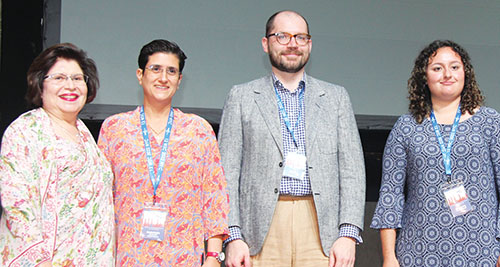
From l: Aban Marker Kabraji, Dr Rashneh Pardiwala, Dr Daniel Sheffield and Anahita Verahrami
Reinterpreting the religion
Assistant professor in the Department of Near Eastern Studies at Princeton University, Sheffield is considered a specialist in the social and intellectual history of Zoroastrians during the late medieval and early modern periods. "As a scholar what I find so inspiring about Zoroastrianism is… the repeated injunctions for renewal,” said Sheffield, the author of two forthcoming books: 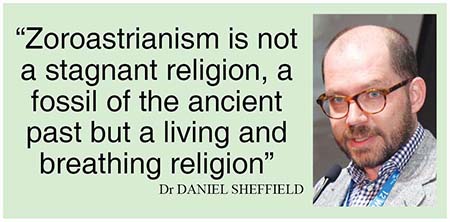 Wizikard I Denig: The Pahlavi Book of Religious Decrees and Cosmospolitan Zarathustras: Translating Religion in Iran and India.
According to him, "Zoroastrianism is not a stagnant religion, a fossil of the ancient past but a living and breathing religion which has been interpreted and reinterpreted across generations and geographies by its followers.” He cited the instance of the first small pox vaccine reaching the shores of western India in 1802. Within three years a Surat priest Dastur Burjorji Darab Pahalana issued a fatwa announcing that vaccination is forbidden in the Zoroastrian religion because a vaccine contains ritually polluting matter. However, even creatures like snakes that are considered "polluting” serve a dual purpose because not only are they capable of venom but also anti-venom. Likewise bees that can sting also serve an agricultural purpose. "Mankind cannot really understand the cosmos as it really is…” continued Sheffield.
Pahalana’s view was repudiated by a Bombay priest Mulla Firoze who said Ahura Mazda had intended the good of the vaccine and the polluting content was nullified by the bodily fire. "It is due to such progressive theological reasoning that Parsis became pioneers of medicine in the 19th century,” stated Sheffield.
"Heal the earth”
An ecologist specializing in climate change, Pardiwala who studied at the University of Edinburgh, is a pioneer in developing carbon management and environmental sustainability programs. To induce the audience to adopt environmentally friendly, socially equitable and financially viable strategies to "heal the earth,” she referred to her work under the auspices of the Centre for Environmental Research and Education (CERE) of which she is the founder-director.
"Environment/development cannot be a situation of either/or. We have to walk the middle path of sustainable development by conserving natural resources and generating less pollution and waste. Water is going to be the next major issue facing this world. It is not only the surface water, it is the groundwater table that we are sucking out without pumping any water in,” she mentioned.
 At the Bombay Doongerwadi, her team’s efforts to improve ecology started with five acres. After removing the termite load on the plot, 7,092 native tree saplings were planted, 52 being unique plant species, as a result of which 1,560 metric tonnes of carbon dioxide were sequestered (captured). "I truly believe that nature has an amazing ability to bounce back if we only give it that one opportunity. Communities need to come together to start greening their concrete jungles, to start reviving their forests. Biodiversity is required for our survival. We are Zoroastrians. We are very closely connected to nature. It’s so easy to plant a tree. We don’t need to make excuses,” she urged.
Her rooftop solar electrification efforts have benefitted the Bai R. F. D. Panday Girls’ High and Bai Avabai F. Petit Girls’ High Schools as also the Sanjeevani Children’s Cardiac Care Hospital, 80% of whose operations work on solar energy. Working with 35 institutions, CERE has managed to generate 4.02 crore units of clean energy, sequester 87,913 metric tons of carbon dioxide and save Rs 45.21 crore (USD 5.46 million).
For rainwater harvesting the team has worked with different establishments including H. D. Saher Agiary in Bombay and the Dr K. N. Bahadurji Sanatorium in Deolali. The six institutions with which they are working has resulted in savings worth Rs 129.5 crore (USD 15.64 million). Further, they were able to annually harvest 26.1 crore liters of water in Bombay, Poona and Nasik. She referred to her recent efforts to bring water to Jalna when she learnt that nearly 135 years ago, it was a Parsi from Surat who, at the behest of the British, had built the reservoir that is now running dry.
"It isn’t rocket science to create percolation pits. Our survival depends on our ability to live in sync with nature and within its carrying capacity. It is time we recalibrate our aspirational lifestyles and development models so that each one of us can truly become custodians of Zamyad (the spirit of the earth),” she recommended. "As a community we need to assume stewardship for environmental sustainability.”
Respect all life
Completing her Master’s in ecology with a focus on conservation biology from the Colorado State University, Verahrami believes that for Zoroastrians, "Good deeds involve cherishing and respecting the source of life that has allowed us as a species to survive…” She has spent the last six years working with the Elephant Listening Project, a research group at Cornell University that is using acoustic monitoring to study and protect forest elephants in Africa, and address issues connected with their habitat, 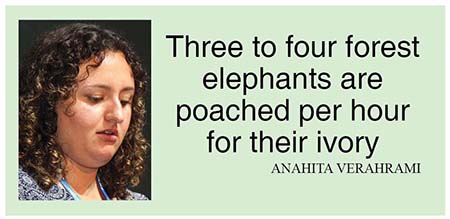 communication, movement and response to human disturbance. Giving them credit for their role in the maintenance of the ecosystem "as architects and mega gardeners” she referred to their movements that result in distribution of tree species.
Three to four forest elephants are poached per hour for their ivory. The strategically placed sound recorders that can register elephant rumbles as also gun shots, registered the lowest number of gunshots on Fridays, the day of the market, when poachers go and sell their loot. The audience was given an experience of disturbing sound recordings — a jarring gunshot in a rainforest, a movement of a ship amidst marine life — to enable them to empathize with the creatures in their natural habitat. She considers herself fortunate that "I could choose a path that would allow me to engage daily with earth and its protection.”
Introduced in the Congress brochure as "a Zoroastrian woman, a member and ally of the LGBTQ + community, and as a person who grapples with mental illness,” she is a firm believer that "diversity of theories, perspectives and identities will significantly augment scientific comprehension of our world and our capacity to preserve it.”
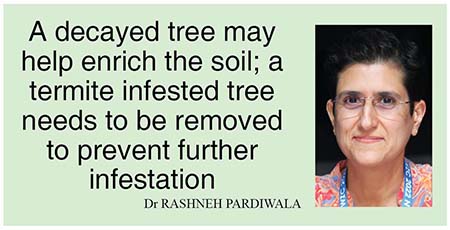
When audience participation was invited, one delegate suggested that each Covid frontline worker should be honored with the planting of a tree while another felt every Zarathushti should celebrate his/her birthday by planting a tree. Should a decayed tree be allowed to stand or be uprooted? queried another delegate. While generally a decayed tree may help enrich the soil, a termite infested tree needs to be removed to prevent further infestation. Could sandalwood trees be planted at Bombay’s Doongerwadi? Pardiwala mentioned that while usually sandalwood does not grow well in high rainfall areas, a few saplings planted some years ago have survived; planting more could result in a security threat, she feared.
Encourage Zarathushti youth to travel to other countries to assist in environmental work, recommended one delegate, making Verahrami allude to Zarathushti Youth Without Borders that promotes such volunteer work. Ultimately, the panelists were requested and agreed to create a document with their recommendations that could be adopted by Zarathushtis keen to save the environment.
As noted the introduction to the panel discussion in the Congress brochure, "Zoroastrians have committed to an ideal of maintaining the purity of the earth and its elements, succinctly enshrined in the statement (from Yasna 16.6) ‘We worship the earth which gives good gifts.’”