
Cross-collaboration at the Congress
The 7WZYC offered an opportunity to the youth to introspect and interact
 Angeles from July 1 to 6, 2019 (see "We cannot stand still,” Parsiana, August 21-September 6, 2019) included a panel titled, "Can Zoroastrians Solve Climate Change?” on the first day.
 Panelists included Farzad Sunavala, a petroleum engineer who wants to make changes from within the oil and gas industry, Dr Hanoz Santoke, a chemistry professor and environmental engineer, and Reanna Unwalla, an environmental science student and aspiring marine biologist. The session was moderated by Karl Desai, a sustainable development architect, contributing to the efforts of The Paris Climate Agreement. This impressive panel discussed Zoroastrians’ links with the environment, why they chose their career paths and practical tips to lessen one’s carbon footprint on the earth. They reiterated the need to carry reusable water bottles and grocery bags, opt for a carpool or public transport whenever possible, reduce the amount of meat consumption, starting with ‘Meatless Mondays,’ plant trees, and understand the importance of amending wrong habits for ultimately small changes can make a huge impact on problems created by humans.
Another panel, "Zoroastrians in Media,” focused on the importance of representation in the media. This panel was moderated by Bita Kavoosi, a university senior and included special guests, Hollywood actress Nazneen Contractor, actor, producer and activist, Behzad Dabu, and director of the Hollywood Bureau, from the Muslim Public Affairs Council, Sue Obeidi. Contractor and Dabu spoke about their career trajectory, the pressure to conform, and the roles they have turned down because they were one-dimensional caricatures of certain ethnic communities. Everyone agreed that while this is a golden age of increased on-screen representation, it does not reflect in a percentage increase behind the camera. An audience question concerning the pressure to select a westernized stage name, resulted in Dabu stating that if Hollywood can learn to pronounce Ansel Elgort or Benedict Cumberbatch, then surely they can learn to pronounce Behzad Dabu. Currently working on a story on his family, he wants to involve as many Zoroastrians both on and off the screen. Contractor remembered feeling self-conscious about looking and sounding different in her youth but now appreciated that those same differences are a huge advantage in this industry.
In a similar domain was the panel on "The Power of Film to Connect Zoroastrians around the World” moderated by Roxanne Unwalla, youth coordinator for the Zoroastrian Association of California. Joining her in the discussion were Tanya Hoshi, a film and web series producer/director based in Toronto, Canada and Simran Jehani, an aspiring filmmaker and actress from Bombay.
The Zoroastrian diaspora should not seclude itself but rather contribute positively to the community at large and be a voice that stands up against injustice for all, reiterated panelists participating in "Zoroastrianism and Advocacy.” The panel included Congress chair Parshan Khosravi, a government relations director, Niousha Farhangi, a public affairs student and member of the Interfaith Youth Council in Orange County, Nigel Shroff, a council member of the Royal Commonwealth Society and an advocate for Hong Kong ethnic minority groups, Arta Khosravi, a high school student and a FEZANA representative at the United Nations, and Pablo Vazquez, an academic and activist.
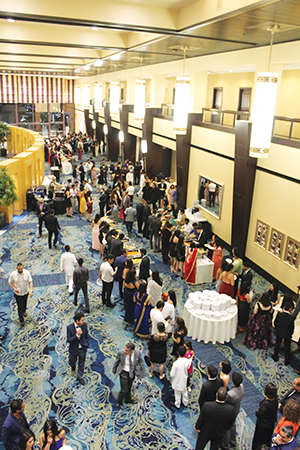
Congress photos: Parenda Foroghi, Shayda Sales, Ana Verahrami
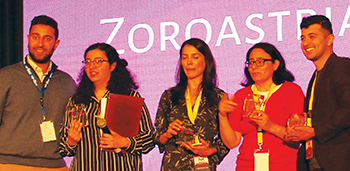
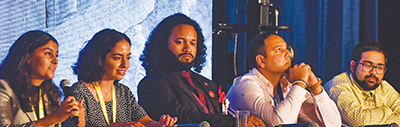
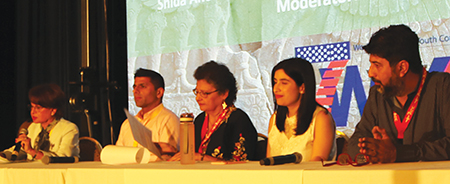
From l: Shida Anoshiravani, Viraf Mehta, Katayun Kapadia, Shazneen Munshi, Arzan Wadia
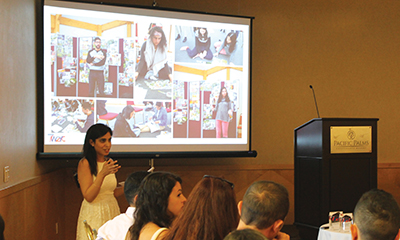
Sanaya Master at the Empowering Future Leaders session
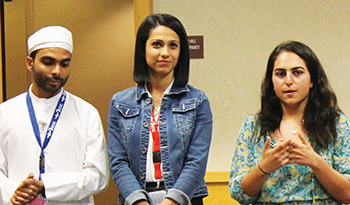
From l: Ervad Sheherazad Pavri, Tinaz Karbhari, Layla Mazdayasni
Zoroastrians have a long history of working for the good of the public and impacting society, starting with Iran and progressing to India, Pakistan, Hong Kong and more recently to the western world. Shroff spoke about how much the Zoroastrian community is revered in Hong Kong that it has streets named after Zoroastrians like Mody, Kotewall and Bisney. He also spoke about his work to expand educational opportunities for ethnic minorities in Hong Kong. Farhangi spoke about bridging the gap across religious communities by being an ally for other faiths like Muslims and Sikhs. Vazquez summed up the argument with a call to action for all Zoroastrians: never be quiet in the face of oppression; educate yourself; wrestle with your own biases and history; get connected; approach issues with militant compassion.
Participating in the panel discussion on "The Joys and Pitfalls of Community Service” were founder member of the California Zoroastrian Center (CZC), Shida Anoshiravani, Bombay Parsi Punchayet trustee, Viraf Mehta, vice president of the Federation of Zoroastrian Associations of North America (FEZANA), Arzan Wadia, and president of the UK based Young Zoroastrians, Shazneen Munshi. This session to encourage and empower youth to get involved in community service as elected leaders in their own local and national community organizations was moderated by former FEZANA president Katayun Kapadia.
Three dynamic panelists who spoke at the 63rd session of the United Nations Commission on the Status of Women in March 2019 shared their experiences with the delegates of the 7WZYC during the panel discussion on "Zoroastrian Presence at the United Nations.” It was moderated by Behnoosh Sethna who works for an investment bank in Baltimore and is interested in learning about the economic challenges faced by developing nations. The other panelists were Ana Verahrami, a research assistant and science communicator for the Elephant Listening Project, a research group at Cornell University, and Nadia Jam who holds a social science degree in French Immersion.
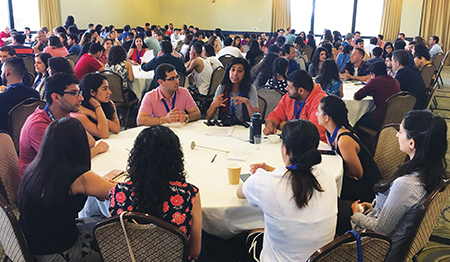
One of the activities at the Congress that had a large turnout from the attendees was the speed networking event organized by the World Zarathushti Chamber of Commerce (WZCC) Youth Wing. Midway through the Congress, this event allowed attendees to break out of established social groups and meet over 50 Congress attendees over a 60-minute period. Each person spent about one minute introducing himself/herself to the other members at the table; after 10 minutes, participants switched tables and repeated the activity. This allowed for global cross-collaboration and the ability for the college-aged youth to meet the more career-established youth. Contact information was exchanged, and new personal and professional relationships developed.
The business component of the Congress had arranged for four more presentations on the third day. Xerxes Wania, a Canadian serial entrepreneur and mentor to technology start-up chief executive officers, elaborated on "The Reality of Starting Your Own Business.” Cyrus Mistry, group product manager with Google, shared "Seven Secrets to Leadership and Innovation.” Tanaz Mody, co-founder and head of operations at Olmo, a personalized networking concierge start-up, delivered a talk on "Professional Networking Done Right.” Homa Dashtaki, co-founder of White Moustache Yogurt Company, revealed how her Zoroastrian heritage proved more lucrative than her Ivy League law degree in her talk on "Opportunities from Yazd to Brooklyn.”
Religion was woven into the Congress on different days. On the first day health guru and life coach Mickey Mehta in his keynote address spoke on "Humata, Hukhta, Hvarshta: Wellness, Wellbeing, and Healing,” while founding chair of the WZYC, Meher Amalsad’s address was on "Building a Consciousness of Righteousness.” Arman Ariane, current president of CZC, introduced Zoroastrianism in "The Future God.”
Morning sessions on the third and fourth day touched on religion too. Mobed Fariborz Shahzadi, California based practicing priest who has authored books on Zoroastrian ceremonies and prayers, spoke on "Zoroastrianism 101: 20 Things You Did Not Know about the Religion.” Ervad Jimmy Madon, youth coordinator for the World Zoroastrian Organisation, spoke on "Practical Zoroastrianism: The Way of Life for Our Generation.” Nazneen Engineer, a postdoctoral researcher at the SOAS Shapoorji Pallonji Institute of Zoroastrian Studies, summarized "The Lasting Impact of the Mazagon Navjotes.” Tinaz Karbhari, chair of the 6WZYC in New Zealand, made an appeal for the Udvada Atash Behram.
Youth engagement
Endeavors to infuse pride in the Zarathushti youth were reflected through different programs. In the session on "Return, Reconnect, Revive,” Tanya Hoshi and Kayras Irani of Canada, and Ervad Sheherazad Pavri of India related their experiences of both attending and leading the Zoroastrian Return to Roots (RTR) program, the sixth edition of which is currently accepting applications. Co-founder of the Zoroastrian RTR program, Rosheen Kabraji spoke on "Home and Belonging: Reimagining the Global Zarathusti Youth” where she explained how transnational Zoroastrian youth have negotiated their experience of home and belonging given the community’s long history of displacement and migration. "Holistic Path to Youth Involvement in the Community” was the subject of Pearl Mistry’s presentation. Mistry is a director at the Della Group and is keen to encourage the youth to give back to their community. Sanaya Master of New Zealand, who had conceptualized and managed the first World Zoroastrian Youth Leaders Forum at the ASHA Centre in the UK, in her address on "Empowering Future Leaders” urged Zoroastrian youth to share knowledge and resources whilst developing an integrated and global network.
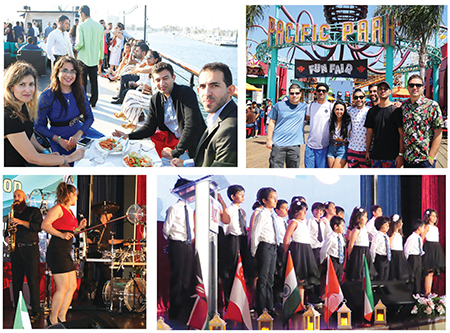
The daylight hours of the Congress were spent discussing thought-provoking topics — academics, business and community building. The evening events were exclusively social. On the first night, the Congress screened the recently released film, Bohemian Rhapsody, on Freddie Mercury’s life. The youth were encouraged to attend wearing their best "Freddie Mercury look.” Night two was spent exploring the city of Los Angeles. Night three was a combination of stand-up comedy and dance, featuring Iranian-American comedian Max Amini who cracked jokes in English and Persian and included the musical stylings of Deejay Al.
Night four coincided with the July 4, Independence Day holiday in the US. To celebrate, the Congress committee planned a dinner cruise from Marina Del Rey in Los Angeles. After dinner, the attendees who included a mix of local Zoroastrians and Congress participants spent the evening dancing on two different dance floors and enjoying the night sky on the three-story yacht. Around 9 p.m., the boat stopped in the middle of the harbor and the attendees watched an impressive 20-minute fireworks display before returning to shore. On the final night, 7WZYC hosted a traditional gala night filled with dancing, Indian food, speeches of gratitude and traditional wear. Like the other social events, the gala was open to the broader Zoroastrian community and not just to Congress participants. Over 600 attendees decked out in their most elegant saris, daglis, Persian attire and formal western wear danced the night away.
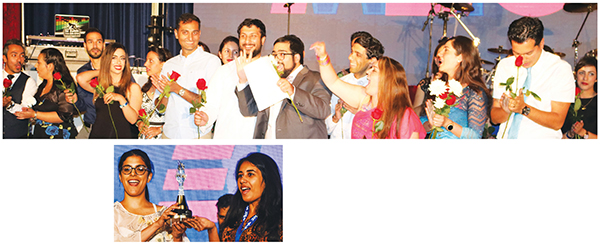
Top: 7WZYC organizing team at the gala; above: Sheherazad Kapadia (l) and Sanaya Khambatta
Closing
After the late-night gala celebrations, a much smaller group of dedicated early risers attended the closing ceremonies of the 7WZYC on the sixth day. Program chair Wadia opened the ceremonies with the help of a short benediction by Ervad Zerkxis Bhandara. Wadia provided a retrospective on the accomplishments of the 7WZYC, expressed gratitude to the organizers and participants, and presided over the passing of the torch to the leaders of the next WZYC in the United Kingdom. Planned for 2023, the 8WZYC in London will be co-led by Sheherazad Kapadia (president of the UK Young Zoroastrians) and Sanaya Khambatta (vice-chair of the Young Zoroastrian Trust Funds of Europe). After the ceremonies ended, the Congress hosted one final brunch to provide time for everyone to exchange their goodbyes.