
Women’s valued voices
As guardians of heritage, women should be empowered by the community to take on leadership roles, recommended the panelists at the 12th World Zoroastrian Congress
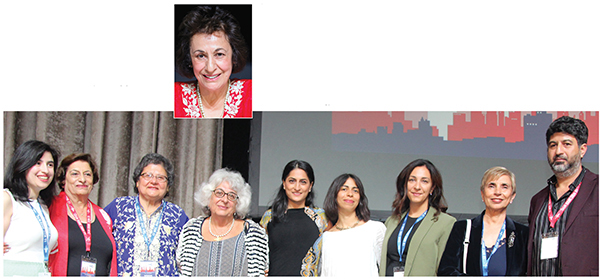
Moderating the panel was Zerbanoo Gifford, human rights campaigner, author, founder of the ASHA Centre in the UK working for the empowerment of young people, one of the pioneering non-white, female politicians in Britain, and former director of Anti-Slavery International.
The panel included erstwhile president of the Federation of Zoroastrian Associations of North America (FEZANA) Katayun Kapadia and former president of the World Zoroastrian Organisation Shahin Bekhradnia of London, thespian and musician Freny Pavri; political scientist and Zoroastrian scholar Dr Rashna Writer, and FEZANA president and 12WZC co-chair Arzan Wadia.
A firm believer that "women have been sent here to bring joy and love to the world,” Gifford reminded the ladies in the diaspora that "the progress… and fate of the community is in your hands…It is a woman’s responsibility to see that the faith continues and to give back to the world a sense of honesty, decency, equality, social security and most importantly happiness in this crazy world of ours.”
The lessons she has learnt along the way, she shared with the audience: "Don’t take yourself too seriously in life; never speak for more than 10 minutes; never get between a man and his drink!” She also advocated that one should serve on a committee for only two terms to permit fresh blood and energy to be brought in. Keen to see women come forward and reflect on their needs as also the young to take leadership roles, she felt, "My generation let you down.”
Leading community organizations
A chartered accountant, certified internal auditor and fraud examiner with over 40 years of international experience, Kapadia acknowledged that she got "empowerment from the organizations I worked with.” She recalled being raised in "a conservative society in Bombay, wearing naughty boy shoes to school, the vice principal lifting uniforms to check the right length of the underpants, no make-up, no boyfriends, no dating…” When she settled in the USA where "Zoroastrians were a minuscule community,” she assumed responsible positions on the boards of her local Zoroastrian Association of Pennsylvania and New Jersey as also FEZANA under the guidance of three women who served as her mentors: Dr Dolly Dastoor, Roshan Rivetna and Khorshed Jungalwala.
Regretting that currently there is no woman on the FEZANA executive committee, Kapadia urged ladies to "contribute their skills and abilities and experience a sense of belonging… Zarathushti women make proud, exemplary leaders… They see the wider solutions. They can empathise, offering a different perspective. They are trusted by their colleagues. They are assertive but considered to be aggressive. They would like their feelings and wishes to be respected. They play an understated role of nurturing the family and cultural values while taking forward initiatives in the community.”
According to the Gathas, men and women are equal, asserted Bekhradnia. "We are the ones who give birth to men!” she reminded. Convinced that the Gathas continue to be relevant in the 21st century, she added that an "understanding of their deep mindfulness helps in arriving at rational decisions.” Having completed 29 years of service as a magistrate in the criminal and family courts in Oxfordshire, she is a long-standing trustee of SMART which helps people marginalized by substance abuse and homelessness find their way back into society. The Pouruchista Skills Foundation she founded in Yazd enables young women to earn a living. She further assisted in opening a senior citizens’ day care center in the same town. With her detailed knowledge of environmental policies she had contested as a Green Party candidate in the United Kingdom.
"Gender discrimination is outrageous in the 21st century. We should be challenging and not accepting of male authority. Women have a right to sit on the priests’ council. Zoroastrians should be better acquainted with religious texts and challenge discriminatory rights… According to the Rivayats, a non-Zoroastrian woman should be treated as a Zoroastrian if she has served her master well and borne his children,” she noted.
"Our history is like a jigsaw puzzle,” observed Pavri. "To keep searching and finding more pieces of the puzzle,” the London based actress, instrumentalist and yoga teacher recommended the setting up of an "Arts Council or Cultural Department that would be more meaningful, not just commercially successful.” Through story telling or other mediums of art "we can make sense of our history/our past,” suggested Pavri who was keen to "take forward our ancient heritage and cultural traditions while not losing our authenticity. We are more than our arguments… our socialization… We need to move forward with truth — the good, the bad and the ugly... Most sacred things do have a darker side,” stated Pavri.
Having trained at the Royal Academy of Dramatic Art in London, she directed playwright William Shakespeare’s Coriolanus which was adapted to exploring the Kurdish language, political situation and the ancient connection to the Zoroastrian world. Besides working on a dance drama on Yashodhara (Buddha’s wife), she is curating a festival celebrating the life and art of the Sufi heroine Noor Inayat Khan. Pavri who plays the sitar and rudra veena is recording her first classical music album. Born in an orthodox household in India she chose to "stay away from the community for a long time until I was inspired by Zerbanoo,” she said.
At the launch of the ZASHA website Photo: 12WZC 2022
Male perspective
The lone male on the women’s panel, Wadia stressed that men "need to become active allies to bring about parity” instead of mouthing platitudes like "I’m there for you.” Running his architecture and technology practice in New York City, he cited the case of the American Institute of Architecture conferring an award on a man although both he and his wife have been practicing architecture together for 50 years. "If we allow the status quo to continue, it may take 60 more years to bring about parity.”
FEZANA has been fortunate to have had "an amazing slew of women,” said Wadia referring to past presidents Kapadia and Dastoor who "continue to be active” as also the youth leaders who take an active interest in ZYNA (Zoroastrian Youth of North America). Hoping to see this trend in more organizations, Wadia referred to Aban Marker and Dr Shernaz Cama who, chairing the Return to Roots program, have "changed our perspective,” for women "bring about an organizational change and make it more humane.” While Wadia was addressing the delegates, the screen behind him showed one single line, "The future is Here.” At the penultimate minute, the ‘e’ from the word ‘Here’ was crossed out to read "The future is Her” with Wadia concluding "I think the world will be a better place if it happens.”
Binding force
In Yasna 53, Verse 3 of the Gathas, Zarathushtra beseeches his youngest daughter Pouruchisti to preserve "good thinking and alliance of truth and wisdom,” reminded Writer. Erstwhile senior teaching fellow in the Department of Religions at the School of Oriental and African Studies, University of London, she lectured on Zoroastrianism in the ancient and modern worlds. Viewing Zarathushtra’s message as "a template for all time,” Writer believes it reflected the "centrality of women in society,” showing them as "resilient, empowered by educational opportunities…
"Even at the height of the empire there were regional differences between Zarathushtis,” said Writer who felt women have a role to play in "the coming together of Iranian and Parsi Zoroastrians to galvanize our community. There is a millennial separation between Iranian and Parsis — in the language, religious interpretation, history, understanding of music, food… Do we want to be atomized into Parsi and Iranian? Are we so petty that we cannot enjoy both dhansak and berry pulao?... Separation must not be allowed to become acceptable. In reality, English is our thinking language… Why don’t we teach our children Farsi/Dari?” she asked rhetorically. "Language is among the one or two identity markers” that the community should not lose. To the women in the diaspora who are "brilliant at doing things, teaching and learning from each other,” Writer stressed, "We are the keepers of memory, guardians of our heritage — to be handed down to young Zoroastrians and yet-to-be-born Zoroastrians.”
During question time, a delegate observed that a male is generally willing to take on a new role with only 60% preparation while a woman feels the need for 100% preparation.
"To develop personally and professionally as also to do community work you have to get up to the plate and take positions of accountability and responsibility. You don’t have to give up something to do something. You do though need the support of your husband, family, friends,” stated Kapadia. "It is not unusual for women to multitask, to be organized, to carve out a little more time and perhaps sleep a little less,” observed Bekhradnia.
"We need to be inspired to come to a place. What do we want from the community? What can I give to the Congress? There is so much potential I never saw because I never came!” admitted Pavri. "To educate a child, you have to educate the mother first,” Writer referred to the old dictum, reiterating the importance of teaching history and culture to a woman.
This session at the Congress was made possible with the cooperation of four other women facilitators: Co-chair of the program committee Aban Rustomji, and her colleagues on the committee Mantreh Atashband and Benafsha Shroff, as also Shazneen Munshi, the youngest elected managing committee member of the Zoroastrian Trust Funds of Europe.
ZASHA website launched
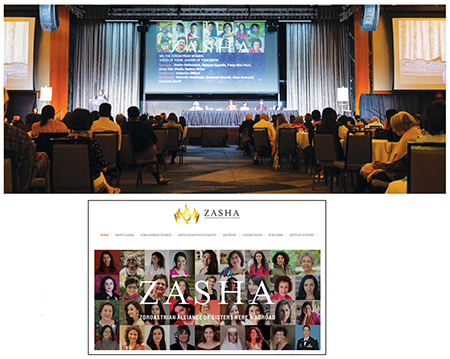
Considered to be a gift from Gifford "to celebrate the various and magnificent achievements of Zoroastrian women worldwide,” the website zasha.info was launched that afternoon to represent the work of the newly constituted Zoroastrian Alliance of Sisters Here and Abroad (ZASHA).
"I believe it is a tipping point in redefining the role of Zoroastrian women in our fast-moving world. It is also an appropriate way to recognize the extraordinary achievements of Zoroastrian women. The ZASHA website will in time be a place for lodging and locating archival material for the worldwide Zoroastrian community and for easy access to events, news and views,” notes Gifford’s statement on the website. "I have boldly named the website ZASHA, which incorporates Z for Zoroastrian and ASHA which is the name of the Centre I helped found in Gloucestershire, England for the enrichment of people’s lives especially the young.
"It is to help connect those who wish to enrich and empower women to take their rightful place leading their communities and actively participate in the global arena. In uncovering these short stories of fascinating Zoroastrian women, alive and deceased I have been left in awe of their achievements,” wrote Gifford. She sent out letters to several outstanding women asking them to submit their life profile in brief. Using the first names of the women, an alphabetic listing has been made of the nearly 400 who responded. They are also listed under different heads depending on their field of specialization, the maximum number of 66 featuring in academia with wellness and medicine showing the next highest count of 64. The least number, six, feature under public life/politics with the listing under faith showing seven.
Reports on other sessions at the 12WZC will be carried in forthcoming issues of Parsiana.