
12WZC
Religious reins
Priests in India and the West should be able to guide their flock on spiritual matters, recommended the panel at the 12th World Zoroastrian Congress
How are the mobeds coping with the new realities of tending to those under their pastoral care? To increase the reach of the thinly attended session on "Global Mobed Community: Serving Zoroastrians Worldwide” on the third day of the 12th World Zoroastrian Congress (12WZC) in New York on July 3, 2022 the organizers and the five priests on the panel had to make repeated entreaties to those networking outside to settle down in the hall.
"As the Zoroastrian presence worldwide has evolved, so have the mobeds who serve, guide and educate the laity. In addition to their mobed training, their professionalism in their respective academic, scientific and business fields has equipped them to lead their congregations,” noted the Congress brochure introducing the five priests from different diasporas: Dastur Khurshed Dastoor and Ervad Sheherazad Pavri from India, session moderator Ervad (Dr) Arda-E-Viraf Minocherhomjee who just completed his four-year tenure as president of the North American Mobeds Council (NAMC), Ervad Kaivan Antia from Melbourne and Ervad Yazad Bhadha from the UK.
"As the Zoroastrian presence worldwide has evolved, so have the mobeds who serve, guide and educate the laity. In addition to their mobed training, their professionalism in their respective academic, scientific and business fields has equipped them to lead their congregations,” noted the Congress brochure introducing the five priests from different diasporas: Dastur Khurshed Dastoor and Ervad Sheherazad Pavri from India, session moderator Ervad (Dr) Arda-E-Viraf Minocherhomjee who just completed his four-year tenure as president of the North American Mobeds Council (NAMC), Ervad Kaivan Antia from Melbourne and Ervad Yazad Bhadha from the UK.
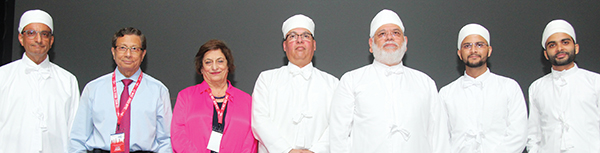
From l: Ervad (Dr) Arda-E-Viraf Minocherhomjee, Astad Clubwala, Aban Rustomji, Ervad Kaivan Antia,
Dastur Khurshed Dastoor, Ervads Yazad Bhadha and Sheherazad Pavri
Confident that "mobeds will continue to guide us as they have for thousands of years,” when introducing the session, Arzan Wadia, co-chair of the Congress and president of the Federation of Zoroastrian Associations of North America (FEZANA), stressed that in North America "it is absolutely imperative we look up to the guidance NAMC can provide us. When questions come to FEZANA on ‘why this?’ and ‘why that?’ we politely do not give a comment and direct the query to NAMC. We are not the experts. Our strength is logistics, administration, governance. On religious matters, we look to the mobeds.”
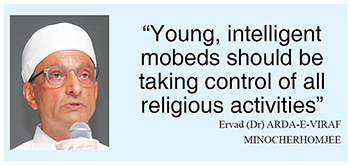
"Unless we change the way we operate in North America, we will not be very successful. We lack focus, lack effective strategic vision,” regretted Minocherhomjee exhorting the community "to change a few things to empower mobeds.” What is empowerment? "To behdins, it is empower mobeds to do what we tell them to do. Because of the way our institutions are set up, we have boards of behdin directors telling mobeds what to do. That cannot be the case. Young, intelligent mobeds should be taking control of all religious activities,” asserted Minocherhomjee, founding and managing partner of Chicago Growth Partners, a private equity firm
 that manages $ 1.2 billion (Rs 9,734.1 crore) in assets. A postdoctoral fellow in pharmacology at the University of Washington Medical School, he was a Wall Street Journal All Star Analyst in the medical device and pharmaceutical sectors.
 "Start everything in the name of Ahura Mazda,” urged the moderator. He further recommended: mobeds should be given autonomy to make their own decisions on all religious matters; all boards and associations should have a mobed representation to advice on religious matters and to preserve the mobeds’ interests. "We mobeds pay our dues to the association but we have no representation. That tantamounts to ‘taxation without representation,’” stated Minocherhomjee. "That should change. There is a tendency to respect mobeds if they agree with you otherwise…they (behdins) fight with you. There is no reason to have such a relation... to be acrimonious. Some will try overtly or covertly to subjugate mobeds and that cannot happen in the 21st century.”
He referred to one disgruntled member of his association whose grievance concerning a mobed was carried to the executive committee. When the committee did not support him, he wanted a vote taken where again he lost. "What would have happened if a mobed had said we want to discuss women’s issues here? No one would have submitted to that kind of humiliation. Not any woman or LGBTQ (lesbian, gay, bisexual, transgender, queer) member. They all have rights. The only people who don’t have rights are mobeds. No rights. That needs to change very quickly.
"After covering the fixed costs, associations should be able to inform the community, one year prior, how much will be spent on religious versus cultural activities. Association members will find monies to hire a live band on New Year’s eve but when it comes to mobeds, suddenly the funds are not there. There cannot be a religion without mobeds. We have to figure out a way to have a full-time practicing priest in each of our atash kadehs in North America otherwise we will just have a structure. Our associations find millions of dollars to have a structure but they do not find one dollar to have a mobed which is mind boggling,” stated Minocherhomjee. He was happy to announce that the NAMC Institute of Zoroastrian Studies has introduced programs to educate both mobeds and laity, as also scholarships to teach the Avesta language to young priests.
Change will take time
"Times are changing and so are the mobeds,” reminded Dastoor. "We too would like to change and anything that does not change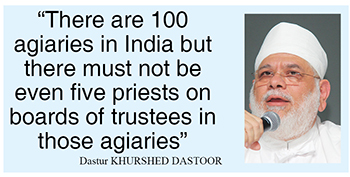 will wither.” Instead of merely clamoring for change, first study whether it is warranted, said the Udvada High Priest. "We don’t want the Indian diaspora to say ‘we don’t care for the West’ and we don’t want the western diaspora to say ‘we don’t care for the East.’ Between the east and the west is the south that is the home of Ahura Mazda… There will be change but it will take time. For 1,300 years we have been in India. You have been in the diaspora for only 100 years. We are ready to take one step forward…”
Alluding to the umpteen references to gender equality during the Congress, Dastoor asked rhetorically, "Has the community given the same equality to the mobeds? Mobeds were once respected as a family member… The younger generation of mobeds wants respect. Mobedi is a profession which we are privileged to be born into but at the same time today, if someone were to ask me whether I would like my son to continue in it, I would think twice about it.
"Do you care for the mobeds? There are young mobeds here. Start caring for them. All mobeds in all countries should be well compensated for the services they provide. If one can’t sit on the floor for afargan-faroksi, a priest is dead, retired dead. There is nobody to support him. There is no system to support him. No provident fund, no sick leave, no pension, no monthly salary… There is nothing financially. The status of the mobed has to change to a commanding position from the current helpless one. A priest should be on the board of trustees of an agiary or atash behram or dadgah. There are 100 agiaries in India but there must not be even five priests on boards of trustees in those agiaries.
"If you don’t like something that we say, don’t create a rift. Agree to disagree. That is our religion. Without the laity, mobeds will not survive. Priests are like horses… There are two kinds of horses — the one who runs the Derby and the one who draws the carriage. Which one do you want? The one who takes the load or the one who runs the Derby?” enquired the high priest.
"Times are changing and so are the mobeds,” reminded Dastoor. "We too would like to change and anything that does not change
will wither.” Instead of merely clamoring for change, first study whether it is warranted, said the Udvada High Priest. "We don’t want the Indian diaspora to say ‘we don’t care for the West’ and we don’t want the western diaspora to say ‘we don’t care for the East.’ Between the east and the west is the south that is the home of Ahura Mazda… There will be change but it will take time. For 1,300 years we have been in India. You have been in the diaspora for only 100 years. We are ready to take one step forward…”Alluding to the umpteen references to gender equality during the Congress, Dastoor asked rhetorically, "Has the community given the same equality to the mobeds? Mobeds were once respected as a family member… The younger generation of mobeds wants respect. Mobedi is a profession which we are privileged to be born into but at the same time today, if someone were to ask me whether I would like my son to continue in it, I would think twice about it.
"Do you care for the mobeds? There are young mobeds here. Start caring for them. All mobeds in all countries should be well compensated for the services they provide. If one can’t sit on the floor for afargan-faroksi, a priest is dead, retired dead. There is nobody to support him. There is no system to support him. No provident fund, no sick leave, no pension, no monthly salary… There is nothing financially. The status of the mobed has to change to a commanding position from the current helpless one. A priest should be on the board of trustees of an agiary or atash behram or dadgah. There are 100 agiaries in India but there must not be even five priests on boards of trustees in those agiaries.
"If you don’t like something that we say, don’t create a rift. Agree to disagree. That is our religion. Without the laity, mobeds will not survive. Priests are like horses… There are two kinds of horses — the one who runs the Derby and the one who draws the carriage. Which one do you want? The one who takes the load or the one who runs the Derby?” enquired the high priest.
Losing authority
"Mobeds are not just boring men dressed in white,” said 27-year-old Pavri, one of the handful of mobeds who can perform the nirangdin ritual. "Mobeds have lost their authority… Even at the 12WZC, mobeds had to depend on the organizers to line them up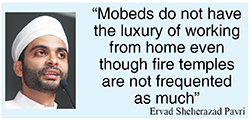 at the inaugural session,” he observed. Bearing lamps in hand, over 50 priests had walked up the aisle in pairs before making their way to the dais. The contributing factors he listed for priests losing their stature were little knowledge of the outside world, poor social skills, inability to address the grievances of the laity, infighting, insecurity about their own profession.
"Mobeds are not professional,” is a grievance frequently aired in the community, "but we were not taught to be professional,” admitted the young priest who after his graduation in biotechnology has transitioned into data science. While serving as a volunteer for the Zoroastrian Return to Roots program he is also an ambassador for the Gen Z and Beyond: A Survey for Every Generation (see "Significant survey,” Zoroastrians Abroad, pg 12).
A core committee member of the Empowering Mobeds program which has introduced initiatives to improve exposure, increase stature and enhance rapport between the mobeds and behdins, Pavri stated, "We have so much to learn from the behdins.” Last April the Empowering Mobeds trust was launched that will focus on five areas: rituals, prayers, presentation skills, soft skills and relations with the laity. While Empowering Mobeds is now moving online, there has been on site learning too for mobeds in the form of heritage walk, mental health awareness and counseling program, workshop on writing skills, or building teamwork through a football match. "Mobeds do not have the luxury of working from home even though fire temples are not frequented as much… I hope at the end of the panel we will be able to look at mobeds from a different angle,” he concluded.
"Mobeds are not just boring men dressed in white,” said 27-year-old Pavri, one of the handful of mobeds who can perform the nirangdin ritual. "Mobeds have lost their authority… Even at the 12WZC, mobeds had to depend on the organizers to line them up
at the inaugural session,” he observed. Bearing lamps in hand, over 50 priests had walked up the aisle in pairs before making their way to the dais. The contributing factors he listed for priests losing their stature were little knowledge of the outside world, poor social skills, inability to address the grievances of the laity, infighting, insecurity about their own profession. "Mobeds are not professional,” is a grievance frequently aired in the community, "but we were not taught to be professional,” admitted the young priest who after his graduation in biotechnology has transitioned into data science. While serving as a volunteer for the Zoroastrian Return to Roots program he is also an ambassador for the Gen Z and Beyond: A Survey for Every Generation (see "Significant survey,” Zoroastrians Abroad, pg 12).
A core committee member of the Empowering Mobeds program which has introduced initiatives to improve exposure, increase stature and enhance rapport between the mobeds and behdins, Pavri stated, "We have so much to learn from the behdins.” Last April the Empowering Mobeds trust was launched that will focus on five areas: rituals, prayers, presentation skills, soft skills and relations with the laity. While Empowering Mobeds is now moving online, there has been on site learning too for mobeds in the form of heritage walk, mental health awareness and counseling program, workshop on writing skills, or building teamwork through a football match. "Mobeds do not have the luxury of working from home even though fire temples are not frequented as much… I hope at the end of the panel we will be able to look at mobeds from a different angle,” he concluded.
Safeguard spiritual needs
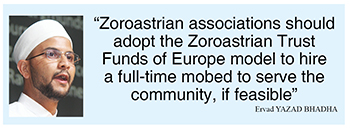
"The best way to have a joyous community is to have a synergistic relationship between the mobeds and humdins. Mobeds have skills for which they need to be monetarily compensated. Other Zoroastrian associations should adopt the ZTFE (Zoroastrian Trust Funds of Europe) model to hire a full-time mobed to serve the community, if feasible,” urged Bhadha, resident priest for ZTFE since 2014. He referred to a shortage of mobeds in the UK who can perform religious ceremonies at short notice and how trained mobeds prefer alternate employment that is more remunerative. Among his multifarious responsibilities, Bhadha teaches the XYZ Children’s Fun Club, is the social events organizer on the Young Zoroastrian Committee, and secretary and speaker liaison for the upcoming Eighth World Zoroastrian Youth Congress in London next year.
 After completing his Master’s in commerce, he was given an opportunity to pursue his Master’s in Zoroastrianism at the School of Oriental and African Studies, University of London. Representing ZTFE at the Harrow Interfaith, Faiths Forum for London and the Religious Educational Council for England and Wales, Bhadha believes it is a mobed’s duty "to safeguard religious and spiritual needs of our future generations and to guide and advise on Zoroastrian religion, heritage and culture.”
Realizing that respect has to be mutual and to be earned, he stressed on the importance of mobeds serving the community with dedication, commitment and acquiring knowledge on religion and the texts.
"The best way to have a joyous community is to have a synergistic relationship between the mobeds and humdins. Mobeds have skills for which they need to be monetarily compensated. Other Zoroastrian associations should adopt the ZTFE (Zoroastrian Trust Funds of Europe) model to hire a full-time mobed to serve the community, if feasible,” urged Bhadha, resident priest for ZTFE since 2014. He referred to a shortage of mobeds in the UK who can perform religious ceremonies at short notice and how trained mobeds prefer alternate employment that is more remunerative. Among his multifarious responsibilities, Bhadha teaches the XYZ Children’s Fun Club, is the social events organizer on the Young Zoroastrian Committee, and secretary and speaker liaison for the upcoming Eighth World Zoroastrian Youth Congress in London next year.
After completing his Master’s in commerce, he was given an opportunity to pursue his Master’s in Zoroastrianism at the School of Oriental and African Studies, University of London. Representing ZTFE at the Harrow Interfaith, Faiths Forum for London and the Religious Educational Council for England and Wales, Bhadha believes it is a mobed’s duty "to safeguard religious and spiritual needs of our future generations and to guide and advise on Zoroastrian religion, heritage and culture.” Realizing that respect has to be mutual and to be earned, he stressed on the importance of mobeds serving the community with dedication, commitment and acquiring knowledge on religion and the texts.
Earn respect
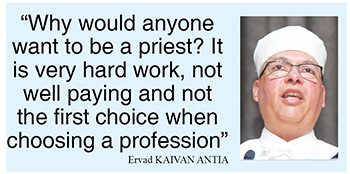
"Why would anyone want to be a priest? It is very hard work, not well paying and not the first choice when choosing a profession. There is no scope for advancement in this profession,” regretted Antia. To him, the solution lies in "looking at the issue as a whole (not area specific). We should have a global organization for mobeds, run by mobeds with support available. Frequently asked questions should be addressed. Rather than demand respect, as priests we should earn it by our actions and service to the community.”
 During his 18 years in Melbourne, Antia has "noticed that first generation migrants are interested in connecting with the Zoroastrian community. However, due to lack of a dar-e-meher there is nothing to connect them with their roots. Elders do not have the knowledge skills even though they may be genuinely interested in imparting knowledge of history and culture and religion to their children. Dar-e-mehers are so important for Zoroastrian children to identify with their religion from an early age and learn to pray in front of an atash. Associations must endeavor to engage the youth more. When preparing for the navar ceremony, teach the significance of prayers to the initiates. The ultimate aim is to empower mobeds.
Chair of the Religious Cultural Committee of the Zoroastrian Association of Victoria, he has introduced Friday night prayers, muktads and other religious observances for the community. Coming from a family with four generations of priests, he has "witnessed firsthand the sacrifice, hard work, devotion and passion of mobeds to serve the community” although succeeding generations may have been dissuaded to join priesthood. As a group risk manager he advises companies in Australia, New Zealand and the UK. Before migration, he attended a one month refresher course at the Andheri Madressa that helped him offer his priestly services when he relocated to Melbourne. According to Antia, for Zoroastrian settlements, "a full-time mobed is a requirement, not a luxury. Mobeds and behdins are dependent on one another and when we all work in harmony it will result in a great outcome for our Zarthosti deen (religion).”
Reports on other sessions at the 12WZC will be carried in forthcoming issues of Parsiana.
"Why would anyone want to be a priest? It is very hard work, not well paying and not the first choice when choosing a profession. There is no scope for advancement in this profession,” regretted Antia. To him, the solution lies in "looking at the issue as a whole (not area specific). We should have a global organization for mobeds, run by mobeds with support available. Frequently asked questions should be addressed. Rather than demand respect, as priests we should earn it by our actions and service to the community.”
During his 18 years in Melbourne, Antia has "noticed that first generation migrants are interested in connecting with the Zoroastrian community. However, due to lack of a dar-e-meher there is nothing to connect them with their roots. Elders do not have the knowledge skills even though they may be genuinely interested in imparting knowledge of history and culture and religion to their children. Dar-e-mehers are so important for Zoroastrian children to identify with their religion from an early age and learn to pray in front of an atash. Associations must endeavor to engage the youth more. When preparing for the navar ceremony, teach the significance of prayers to the initiates. The ultimate aim is to empower mobeds.Chair of the Religious Cultural Committee of the Zoroastrian Association of Victoria, he has introduced Friday night prayers, muktads and other religious observances for the community. Coming from a family with four generations of priests, he has "witnessed firsthand the sacrifice, hard work, devotion and passion of mobeds to serve the community” although succeeding generations may have been dissuaded to join priesthood. As a group risk manager he advises companies in Australia, New Zealand and the UK. Before migration, he attended a one month refresher course at the Andheri Madressa that helped him offer his priestly services when he relocated to Melbourne. According to Antia, for Zoroastrian settlements, "a full-time mobed is a requirement, not a luxury. Mobeds and behdins are dependent on one another and when we all work in harmony it will result in a great outcome for our Zarthosti deen (religion).”
Reports on other sessions at the 12WZC will be carried in forthcoming issues of Parsiana.
◆ ◆ ◆
From the archive