
Promise and potential
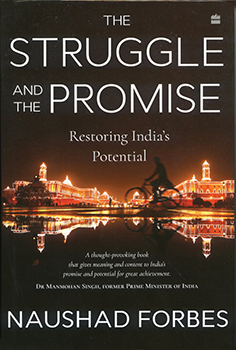
The Struggle And The Promise: Restoring India’s Potential by Naushad Forbes. Published in 2022 by Harper Business, an imprint of HarperCollins Publishers 2022, 4th Floor, Tower A, Building No 10, Phase II, DLF Cyber City, Haryana 122002. www.harpercolins.co.in Pp: xv + 373. Price: Rs 699.
For the most part, economists, industrialists and government policy makers dwell within their own separate worlds and mindsets, with the result that countries often adopt suboptimal national policies. Dr Naushad Forbes (Stanford PhD) (pictured), co-chairman of the Forbes-Marshall industrial house, former president of the Confederation of Indian Industry and collaborator with some of the  world’s leading economists, has written a brilliant book on the future progress of India in an encyclopedic sweep encompassing all necessary aspects of economic, social and institutional factors that make for a great nation. Forbes treats India’s policies towards trade and foreign investment, supply chains, education, the perils and advantages of democracy, youth unemployment, innovation and many other issues, comprehensively. He has done this in simple language and minimal jargon so that it has become a book that all thinking persons should read, in India and abroad.
What really strikes the reader is the absence of polemics and a refreshing balance in his views. Even when writing about sensitive issues such as the regulatory hand of the government and "license raj,” there is a sense of compassion, fairness and wisdom. This is a book written by a person in love with India and an optimist about India’s potential. But that does not prevent him from gently pointing out areas where policy needs to be redirected.
Forbes zeroes in on many key issues. But the salient one he addresses is jobs. He indicates that "…only labor intensive manufacturing has been able to move millions of unskilled people to higher productivity occupations in a single generation.” A World Bank report (Correcting Course: Poverty and Shared Prosperity 2022) cites studies estimating that between 150 and 210 million Indians live in abject poverty earning less than USD 2.15 (Rs 175) per day. Add to that the seasonal agricultural worker, the seller of balloons on the street, typifying the "informal” employment sector as Forbes puts it, and the total may swell to as many as 350 million Indians. Even with the "Make in India” campaign of the government, emphasizing and encouraging the private sector to make investments in manufacturing, the share of manufacturing in India’s Gross Domestic Product (GDP) is persistently stuck at 15%. India’s manufacturing output at USD 412 billion is roughly one-tenth that of China’s at USD 4,000 billion. Forbes cites the example of agarbatties (incense sticks) which were imported by India from Vietnam (or at least until 2019 when import restrictions were imposed). This, despite the fact that Vietnam’s manufacturing labor is twice as expensive as India’s.
The book implies that Indian firms are willing to make big investments in manufacturing, but are held back by the absence of "ease of doing business” in India, including restrictions on growth, labor laws, difficulties in acquiring land, policies that favor small over large scale, corruption and the persistence of elements of the license raj. Forbes indicates that a "large garment factory in India employs 3,000 to 5,000 people, while a large garment factory in Bangladesh employs 30,000 to 50,000 people.” He reports on a Vietnam agarbatti maker employing 10,000 persons. Aided by Indian government policies that encourage small scale enterprises, many agarbatties are made by hand. Vietnam also automates production and makes machines that spit out the wood or bamboo core sticks at the rate of one every 0.7 seconds. In fact, such Vietnamese agarbatti machines are now advertised and sold in India.
 The author’s conclusion is that if only the government would focus on "…get(ting) the state out of the way…leaving the rest to India’s entrepreneurial energy, private enterprise and the market,” India could achieve the nine to 10% growth rate that is needed to pull the 350 million underemployed — part-time farm workers, the sellers of balloons on the streets, the delivery boys who speak good English, to give only a few examples of the underutilization of talent — into more productive occupations where they can learn higher level skills and discipline.
What a waste of human talent! Yes, but in those hundreds of millions un/under/employed also lies a bright promise for India’s future potential — to take over from China or Vietnam (with much higher wages than in India), the title "factory for the world.” The author, an optimist, uses these two words "promise” and "potential” in the title of his book.
Happily for India, the license raj is in retreat. Forbes’s book mentions this diminution, in passing, as an optimistic sign. It indicates several positive developments that can improve India’s institutional integrity. Current governments at the central and state levels have taken small steps to reduce such obstacles to growth. In some cases simply eliminating certain rules or regulations removes the hand of the state and scrutiny by regulators for such transactions.
But there are two other ways whereby the private sector can overcome obstacles. The old suspicion towards big business is mostly gone. When a company is big, it can spread its fixed costs over a larger volume to achieve economies of scale, i.e., reducing the cost per unit of production or service output. It can also afford internal means, and personnel that help it understand and overcome regulatory and institutional barriers. Smaller firms cannot muster such resources. Indeed, India is seeing the unprecedented rise of giant firms (e.g., conglomerates such as the Tata Group and Reliance) encouraged by state and central governments. A second approach is even better, which is to allow greater access by multinational companies to the Indian market or encourage them to use India in their supply chains.
In short, Forbes urges greater openness to international business. He writes, "Whoever has led the world in history has tended to be open. Open to trade.” Seventy-five years after independence, there are enough local Indian firms that can not only compete on equal terms with foreign rivals but learn international standards and techniques from them, so as to become global players in their own right — as many from Tata, Reliance, Vedanta and the pharmaceutical firms, etc have achieved.
To some, the phrase "supply chain partner” suggests servitude, simple or boring screwdriver assembly, or being a minor cog in a global wheel controlled from outside the country. True, at the beginning, many of the employees of Wistron (assemblers of iPhones in India) work long shifts doing repetitive work. Such jobs, however dull, can employ India’s underutilized millions. Better that, than sitting idle on the farm! (Later, such jobs can mature to more skilled work.) The author asks "How can we fix things by learning from best practice elsewhere?” Workers learn new skills when their company is part of an international supply chain. But the far larger benefit is that engineers and senior management in the firms pick up and learn cutting edge technologies and designs from their international partners. The former apprentices can become global masters. This is why participating in global supply chains can lead to "learning and moving up the skill ladder to become global players.” The supply chain apprentice can eventually become a global rival to their former multinational buyers.
"Learning is central to innovation,” Forbes writes pithily. Indian companies are equally capable of learning and becoming global players. The regulatory business environment and infrastructure in India needs to facilitate, more than before, this cross-border flow of ideas, and knowledge — an objective that the Indian government has in its "Vision 2047.” As the Forbes book gently points out, there remains the danger of overdoing protectionism, shutting out international business partners and going back to the failed pre-1991 import substitution policies. Forbes asserts that there is no record of a nation growing rapidly with rigid import substitution policies.
Forbes mentions that in the "first 20 years of their rapid growth” the Asian tigers — Japan, South Korea, Taiwan, Singapore, Hong Kong and China — enjoyed "rapid growth by simple manufactured products” but then used their growth as a springboard to enter into more sophisticated products and services by doing Research and Development (R&D). This leads to products and services with a greater intellectual content, and hence is not only more profitable, but also pulls more persons into higher level and high skilled jobs and creates national wealth. That is the road to prosperity in the 21st century, where customers pay for thought rather than for ordinary matter. For example, in a mobile phone selling for USD 400 (Rs 32,000,) the raw material content may be less than five dollars (Rs 413), but the intellectual content accounts for the bulk of the value — the engineering, the design, the orchestration of the global supply chain or component suppliers stretching over more than a dozen nations. How does Indian R&D compare with other advanced, knowledge intensive countries?
Actually, India has a lot of intellectual talent scattered throughout its large population, an asset that can be leveraged. But the book presents an interesting table comparing nations, including India, on metrics such as R&D expenditures, and whether the R&D is done by corporations or public research institutes or universities. India’s R&D spending as a percentage of GDP is one of the lowest (barely one-third of the world average). But the author takes pains to suggest that India also deviates from the normal allocation in most advanced nations, where the bulk of R&D expenditures are made by companies and universities, as opposed to government research institutes.
Undoubtedly, there is talent in Indian government research institutes, which focus on basic sciences. But as much as 56% of India’s R&D money is spent by government, and only 37% by companies. By contrast, almost no advanced nation, even China, spends more than 17% of its overall R&D outlay via government institutes. It is companies in other nations that account for two-thirds or more of national R&D spending. Now why is this important? Because companies are more attuned to customer and market needs. Ultimately it is the "D” portion of R&D that pays off in terms of profits, prosperity and upgrading of human capital. Basic science, or the "R” portion of R&D is also vital to human progress but has a more uncertain and long-term payoff. Forbes identifies only three sectors out of hundreds — pharmaceuticals, automobiles and information technology — where Indian companies spend barely sufficient amounts on R&D (mostly "D”) so as to be internationally competitive. He sums up his analysis in one sentence: "It is no accident that the firms that invest huge amounts in R&D are generally the most dynamic worldwide.”
The author has a nimble, fertile and wide-ranging mind. The book touches upon a delightfully broad spectrum of topics relevant to national progress such as market reforms (sometimes stymied by vested interests). India has a great asset since 110 million persons possess English language abilities. It treats the importance of social capital and the value of mutual trust (although exhibited only inwardly within traditional business communities such as the Banias or Marwadis). Forbes’s musings also range over primary education, the advantages and drawbacks of democracy and diversity (India has 22 official languages and thousands of dialects, over three major language families — Indo-European, Dravidian and Sino-Tibetan/Kra as well as minor isolates such as the Dai and Austroasiatic languages). This broad sweep is impressive but also frustrating because some readers would have liked to eat more deeply into each morsel of thought (perhaps Forbes can write separate essays, with greater depth, on each of these subtopics relevant to India’s growth). Other readers may become a bit bewildered or lost in some wide-ranging chapters.
Above all, the book is deeply reasoned. All Forbes’s recommendations are on target and exhibit balanced judgment. In a recent speech, Raghuram Rajan (former head of the Reserve Bank of India) correctly identified a current quicker job growth opportunity for India in the export of services ("Rajan says India’s ‘really alarming’ job situation needs equal focus on services,” MoneyControl, October 27, 2022.) And yes, growth of manufacturing output, being fraught with more regulatory and institutional obstacles, is more painful and protracted. But as the Forbes book quietly implies, there is no way jobs can be created in the services sector for more than a few million persons — certainly not for the 350-odd million un/under/employed.
Manufacturing can transform a low wage unskilled economy into skills and innovation. Slowly, over a three decade span, 1989-2022, in one of the biggest economic migrations in human history, some 250 million Chinese left their village homes, families, even leaving their children behind with grandparents, and moved to the eastern coast of China where most of that country’s manufacturing and exports take place. Indians do not like this comparison, and Forbes correctly argues that messy democracies cannot be compared with autocracies. But starting from an equal poverty footing in 1970, China today is a middle income nation with an income per capita five times that in India. All of this was led by manufacturing job creation, at first in low end, basic goods, but later learning from multinational companies, progressing into more R&D or knowledge intensive products and services. (It was only as recently as 2013 that for the first time purely Chinese-owned companies’ exports exceeded exports by multinational company affiliates in China. Before 2013, China’s exports were led or dominated by European and US multinationals’ subsidiaries and affiliates. Long as it took, the Chinese with quiet, long-term determination, gleaned or extracted knowledge from their multinational partners to eventually become global rivals.) They climbed the knowledge ladder — from making toasters to today making sophisticated aircraft. Over many industries, China made the transition from imitator to innovator, from apprentice to master. India can do the same with good policies and incentives.
Many Indians are actually proud that next year India will be the world’s largest nation by population (which portends for the future a huge domestic market as well as international clout). But the much vaunted "demographic dividend” could become a demographic time bomb. More than a few revolutions have been started by frustrated, unemployed youth. This is not likely to happen, at least because wise thinkers such as Forbes and Rajan as well as senior government officials are now alive to the problem.
To conclude, any fan of India, anyone who cares for humanity’s progress, its promise and destiny — as is the author — should make this book necessary reading.
Dr FAROK J. CONTRACTOR
Contractor is Distinguished Professor at Rutgers Business School.