
Religion
“Let us start”
Priests and lay people explore avenues to entice new entrants to the clergy
Money alone "would not work as an incentive,” noted Dastur (Dr) Firoze Kotwal in a recorded video message to a gathering of around 90 priests, trustees and lay people at the Banaji Atash Behram Hall on October 8, 2023. The meeting had been called by Dastur Khurshed Dastoor, president of the Athornan Mandal, to explore measures to enthuse new entrants to the priestly vocation and to "pinpoint and rectify the lacunae in the system.” While the Jam-e-Jamshed, Parsi Times and Parsiana were not invited to the meet, Mazda Multimedia, one of the prime movers of the event, recorded the proceedings and uploaded pertinent excerpts on YouTube. This write-up is prepared from the YouTube recordings and a report of the proceedings prepared by Hanoz Mistry, community activist and co-editor of The Parsee Voice, with some inputs from a few who attended.
"Unfortunately, parents (are) discouraging their boys from practicing the vocation,” Kotwal rued. A secular education should not be pursued at the cost of neglecting mobedi. He was confident that people would give money if the priest performed his duties well. He wanted parents to encourage their children to train as mobeds. But, he noted, the stables were empty as the occupants (mobeds) had already left. The future appeared bleak. To bring about change "you must be a reformer, a reformist,” noted Kotwal, clarifying that reforms entailed "removal of the bad practices and adopting of good practices.”
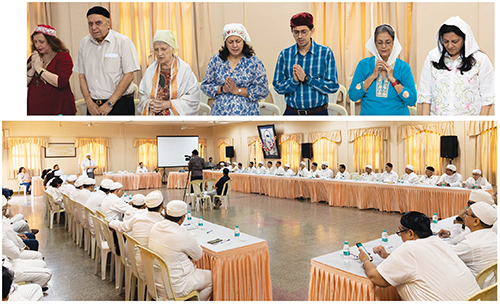
Top from l: Binaifer Sahukar, Dinshaw Tamboly, Armaity Tirandaz, Dr Rati Godrej,
Hormuzd Godrej, Meher Panthaki, Anahita Desai; above: attendees
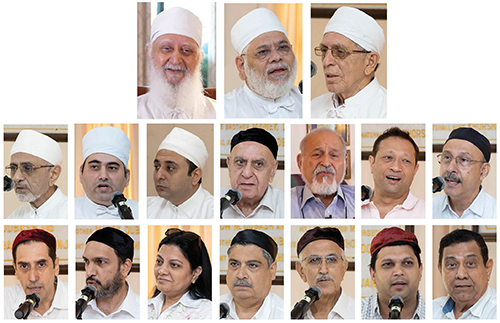
From l, 1st row: Dasturs (Dr) Firoze Kotwal, Khurshed Dastoor, Keki Ravji Meherjirana;
2nd row:Ervads (Dr) Parvez Bajan, Meher Modi, Darayus Bajan, Tamboly, Khojeste Mistree,
Jimmy Mistry, Hanoz Mistry; 3rd row: Karl Sahukar, Ervad Zerick Dastur, Desai,
Noshir Dadrawala, Kersi Limathwalla, Hoshaang Gotla, Maneck Dastur
Dastoor stated that the intention of the meeting was "not to blame anybody… We have to think about the future.” He stressed it was necessary to encourage athornan families to enrol their sons at the Dadar Athornan Institute (DAI) seminary and engage with them to ensure they practiced mobedi. Of the 40 to 50 agiaries in Bombay, about 20 were doing very well, 10 were "okayish” with the balance languishing. Priests were locking up the fire temple premises and departing after offering boi. "Today’s generation does not wish to depend on doles. That’s not how you are going to attract future generations to the mobedi profession.” He felt without adequate compensation newcomers would not enter the field. He cautioned that no immediate solutions were at hand. "It is going to take time, but let us start.”
Dastur Keki Ravji Meherjirana commented, "We were sleeping… the community seemed to have finally woken up to the plight of its priests.” With incomes as low as Rs 35,000 a month, which mobed would be able to attract a decent spouse, he queried? He mentioned that after working 60 years as a priest he had no pension. Those who work in banks receive pensions of Rs 35,000 to 45,000 a month. The World Zoroastrian Organisation Trust Funds (WZTOF) under its chairman Dinshaw Tamboly, however, is giving Rs 80,000 annually to practicing mobeds over the age of 65, Ravji noted.
"There is a very real chance that pav mahal (higher liturgical) ceremonies will collapse in India in the next 15 to 20 years,” warned Ervad Meher Modi, trustee of the Empowering Mobeds Trust (EMT). There were only 18 priests performing these ceremonies. Only one new entrant was admitted this year to DAI taking the total of priests in training to 14. For every four students who graduate from the Athornan madressa "only one takes up mobedi. Two decades ago there were 500-600 mobeds in the country. Today the number is around 315. Of these, about 116 were working full time and 68 persons doing part-time mobedi. Most of the priests performing higher liturgical ceremonies were above the age of 45. Behdin pasbans were doing a good job but they can never substitute for a navar-maratab,” he stated.
(Vendidad, nirangdin, baj and ijashne comprise higher liturgical ceremonies, Ervad Hormuz Dadachanji informed Parsiana. The first two can only be done by a navar-maratab priest whereas the other two can be performed by a priest who is a navar but not a maratab.)
The income of a priest was paid by the trustees of the fire temple, Modi said. For priests not employed by the fire temple there was "no stability of income.” They were like gig workers. He noted that not everybody has the ability to be a Yoazdathregar priest. Often people who ended up in the priesthood were those who may not be qualified to take up other professions. He pointed out that in every atash behram the boiwallas were over 45 years of age. Who would replace them?
Ervad (Dr) Parvez Bajan, panthaky of the Mewawala Dar-e-Meher in Byculla stressed that mobedi was a vocation and the mobed should be a friend, philosopher and guide. Mobeds needed to adopt the principle of deserve and desire. His son Ervad Darayus referred to a "circular effect... Nobody comes to the agiary, there are no priests, no chasniwallas and the volume of work is reducing.” The main cause was the dwindling Parsi population which he attributed to migration and interfaith marriages. At the Mewawala Dar-e-Meher three to four devotees visit on an average a day. He said on a visit to the Iranshah Atash Behram in Udvada he found only two or three devotees present in the sanctum. At the Ranji Agiary in Grant Road where Darayus is a trustee, 10 visitors come in a month. The option was either to sell the properties that were not being utilized or risk having them encroached.
Tamboly also stressed the need to shift (not merge) languishing fires to other existing ones and utilize the moneys earned from disposing the premises to fund the priesthood. The WZTOF has helped raise funds from donors worldwide to assist mobeds with medical, education and other needs. They also extended support during the lockdown. They helped in identifying, sourcing and obtaining fire retardant material for jamas, funded by the Zoroastrian Charity Funds of Hong Kong, Canton and Macao. EMT has held seminars and self-help programs for mobeds.
Tamboly recapped for Parsiana on November 30 the initiatives that Empowering Mobeds, a joint initiative with Athornan Mandal, have taken for priests since inception: live and online seminars for mobeds and families on self-awareness, ethics, mentoring, and mental health; training programs to enhance communication skills and rituals; religious classes for behdin children; survey of mobeds, amongst other programs and activities.
Erstwhile Bombay Parsi Punchayet (BPP) trustee and founder of Zoroastrian Studies Khojeste Mistree felt that mobeds needed to be provided facilities, including housing, that are reasonably comparable with those in the corporate world. He bemoaned that the Athravan Education Trust, set up to provide religious education, "was bogged down due to community politics.” Mistree suggested interviews with athornan families to understand from them what needed to be done to foster priesthood as a career. He recalled that they used to pay students to come to religion classes but the response was not satisfactory. "Why should somebody come to mobedi when there are so many other things young people can do? Parents often tell their kids not to become priests…”
Former BPP trustee and chief executive of the Centre for Advancement of Philanthropy Noshir Dadrawala emphasized that the importance of economics could not be overlooked when considering the overall improvement of the mobed clan. "The Parsis are an asset rich but cash poor community. There was a need to reform and take hard decisions,” he stated. He noted that people talk about preserving assets but "for whom?” he asked. There are hardly any Parsis left.
Ex-BPP trustee and businessman Jimmy Mistry opined that to attract newcomers a corpus of three crore rupees (USD 359,779) should be set up "on a war footing to address immediate needs of increasing emoluments.” In the future, he suggested a corpus of Rs 250-300 crore (USD 29 million-35 million) be formed to support mobeds. This would be partly financed by donations from wealthy individuals and partly from monetization of properties. He believed mobedi had to be "treated as a profession.” The emoluments needed to be "recalibrated.” He pointed out that his Parsi Resource Group (PRG) had earlier created an extensive database of mobeds. Many had benefitted from the mediclaim facility for priests. In his view, a mobed’s monthly salary should be at least one lakh rupees (USD 1,200) with those performing higher liturgical ceremonies earning "much more.” The clergy needed leaders amongst themselves whom they could look up to and emulate, he stated.
Ervad Zerick Dastur, a lawyer and trustee of H. B. Wadia Atash Behram recommended creating volunteer groups who would be involved in assessing various requirements and activities involving fire temples. In his view, the number of mobeds could be increased by training and continuous improvement, recognition and motivation. They required role models to look up to.
Chartered accountant Kersi Limathwalla, trustee of the M. J. Wadia Adaran in Lalbaug too reiterated that parents do not want their children to follow the vocation "due to economic and social issues.” He suggested coordination between various agiaries to alleviate the shortage of mobeds and equipping mobeds with various secular and commercial skills to augment their income. To encourage religiosity, he suggested holding classes on the religion and publishing religious booklets.
BPP trustee and chief executive officer of the World Alliance of Parsi Irani Zarthoshtis Anahita Desai felt the "need of the hour is unity.” Many trusts tended to medical assistance, education subsidies and even housing, but she lamented there was no concerted effort. She appealed for a structured plan to address the issue. While the meeting did not end with such a plan, there was at the end bonhomie, and at least in some quarters, a display of a can-do spirit, according to a mobed who was present there.
Hoshaang Gotla, founder trustee of XYZ (Xtremely Young Zoroastrians) suggested forming groups of youngsters who would adopt agiaries in an area and have regular interactions there. This would increase footfalls. He told Parsiana on November 21 that the youngsters of XYZ had completed visits to 16 agiaries. "We are also taking pictures and videos of the agiaries over the next few months. We will make short reels for social media speaking about the agiaries, the area, how to get there and if there’s anything unique or different about that agiary.”
Maneck Dastur of K. M. Dastur Reinsurance Brokers informed the gathering about the availability of a special mediclaim policy to cover elders. These would include existing ailment and any senior citizen could be covered up to Rs 19 lakh. He also spoke about the possibility of a group medical insurance policy where those financially able could pay the premium, but those unable to do so would be exempt.
A love for mobedi and its importance in the community needed to be inculcated from childhood, stated Hanoz Mistry. Encouraging students in the DAI to concentrate more on their mobedi studies and practicing rituals rather than be distracted with other extra-curricular activities was his recommendation. List deliverables from mobeds, he stressed, do not truncate rituals and ceremonies.
Ervad Pervez Karanjia of Sodawaterwala Agiary noted that the expenditure on firewood (kathi for an agiary) cost Rs 20,000 to 25,000 a month. Ervad Sheherazad Pavri recommended that by the year 2030, 30% of agiary trusts should have at least one trustee who is a priest. EMT trustee Karl Sahukar, who was the meeting’s compere, spoke of the need to brainstorm before it was too late.
Other suggestions included asking parents to maintain some of the discipline of madressa life even when the young priests in training were home on vacation; shifting, not merging, fires from languishing agiaries to ones with more footfalls; creating an up-to-date database of mobeds; encouraging mobeds to function as friend, philosopher and guide to the laity.
The meeting ended with Dastur Khurshed Dastoor assuring attendees that all their suggestions would be given due consideration and an action plan put in place. He told Parsiana after the event that the meeting was "successful” and that further meetings were planned.
The two-part series on "Mobedi Follow Up and Solutions” was dedicated to the memory of Coomi and Soli Dariwala by Meher Panthaki. Mazda Multimedia is headed by Sarosh Daruwalla.
Lunch was catered by Jimmy Gadiwala.
◆ ◆ ◆
From the archive