
The remedy and the relic
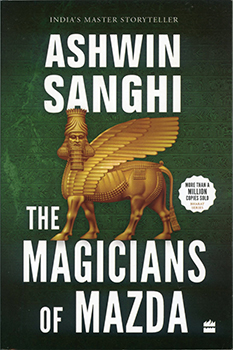
The Magicians of Mazda by Ashwin Sanghi. Published in 2022 by HarperCollins Publishers, 4th floor, Tower A, Building No. 10, Phase II, DLF Cyber City, Gurgaon, 122002. Pp: 468. Price: Rs 450.
After six successful novels in the Bharat series — excluding the two co-authored with American author James Patterson — Ashwin Sanghi (pictured), India’s Dan Brown and master storyteller, has recently published The Magicians of Mazda. It is evident  from the title that the novel would have Zoroastrian themes but Sanghi manages to blend fact, mythology, together with a fast-paced story and a tightly knitted plot. The story moves back and forth in time from the ancient ruins of Persepolis, "the epochs of Islamic jihad, Macedonian revenge, and Achemenid glory,” the migration of the Parsis to India to the current day where we meet the protagonist, Jim Dastoor, a Parsi from Bombay, who has settled in Seattle.
There are two distinct strands to the plot of the novel. The first is the story of Dastoor who is on the verge of discovering a miraculous drug, one which will result in the cure of all diseases and ailments. Hamzaa Dura is "the formulation that could virtually replace every other medicine on the planet.” In keeping with the philanthropic nature of the Parsis he does not want to apply for patents as he believes the drug should serve humanity and not merely fill the coffers of the pharmaceutical giants. However, not all companies are of this view and Asclepius, a mammoth pharmaceutical company, arranges to have him abducted along with his scientific formula and brought to Portland.
Dastoor is once again abducted from Portland and taken to Iran and this is where the second strand of the plot comes into play. What the Iranians are after is the Athravan Star, an ancient relic, which they believe has "the most miraculous properties, almost magical.” This has been passed down from one Parsi generation to another and they suspect that it is now in Dastoor’s possession. They strongly believe that the Athravan Star belongs to Iran and will leave no stone unturned to recover it for their country.
Sanghvi seems to enjoy destabilizing the reader and tosses him/her from one location to the other right from the beginning. The novel starts with the presentation of the Kettering Prize at Oxford. The scene shifts to the British Museum where the representatives of the Ayatollah have just stolen the famous Cyrus Cylinder only to be told that they had erred in their assignment. What the Iranians wanted was the Athravan Star and not the Cyrus Cylinder which the Ayatollah refers to as "a piece of miserable writing by a non-Islamic king following a false faith.” We next move to Seattle in the USA where Linda, Dastoor’s wife, has just woken up and is about to be kidnapped. We are almost immediately transported to Navsari where Pestonji Unwalla is searching for some information in the Meherjirana Library. We suddenly find ourselves in Dastoor’s laboratory in Seattle and his journey home where he discovers that his wife has been abducted. And all this happens in the first 20 pages.
 We gradually realize that Dastoor is wanted by the pharmaceutical giants for Hamzaa Dura, his wonder drug, and by the Iranians for the Athravan Star. Sanghi introduces us to a plethora of characters as Linda and Don, his closest and double- crossing friend take the help of several persons including representatives of the CIA (Central Intelligence Agency) and Mossad to rescue Jim. This part of the plot moves at breakneck speed: Jim’s rescue from Iran and the subsequent escape through Afghanistan and India adds to the tension: will they finally manage to return home safely?
That Sanghi’s interest in history and religion are paramount is more than evident in the novel. He shows us that there are ancient connections between Zoroastrian and Vedic philosophies. Like the Hindus, the Zoroastrians revered the cow; deities like Varuna and Mitra were common to the Gathas as well as the Rigveda; he draws parallels between atash and agni and yasnas and yajnas; "the Avestan verses sounded like Vedic Sanskrit; and while the Zoroastrians had daevas and ahuras, Hindus had devas and asuras.”
Sanghi has done substantial research for this novel. An appendix containing 12 pages is adequate proof of his scholarship. This results in a surfeit of information about the Zoroastrians and the persecution and acute hardships faced by them when they left Iran and landed in Gujarat where they tried to make a second home in an alien land. There is a substantial overdose of the history of Persia and ancient Iran up to the present day. The reader is informed about this through conversations with Jim’s father and grandmother. One wonders if this could have been achieved more subtly and dramatically rather than providing the information in such an unimaginative and obvious manner.
Extensive research may often prove to be a negative as the novel is replete with historical facts which are not always relevant to the main plot. This interferes with the pace of the thriller. One occasionally gets the feeling that Sanghi is lecturing the reader whilst narrating his historical facts.
If one wants to learn about the history of the Parsis there are several reference books for the purpose. However, the general reader is more interested in the plot of a fast-paced thriller rather than extended exposés of history and religion. What a thrilling book this would have made if Sanghi had shown a bit more restraint in this area and concentrated on the search for the Athravan Star!
FIRDAUS GANDAVIA
Gandavia holds a doctorate in English literature and is a retired chartered accountant. He is a compulsive reader of fiction.