
Missing manuscript
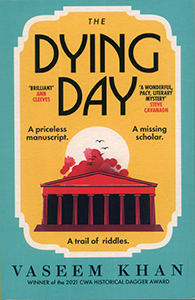
The Dying Day by Vaseem Khan. Published in 2021 by Hodder & Stoughton, a Hachette UK Company, Carmelite House, 50, Victoria Embankment, London EC4Y 0DZ; website: www.hodder.co.uk. Pp: 352. Price: UK £ 8.99, US $ 15.99, Can $ 17.99.
The Dying Day is the second novel in Vaseem Khan’s (pictured) Malabar House crime fiction series. We once again encounter Persis Wadia, a police inspector and India’s first female police officer who earlier played the central role in Midnight at Malabar House. In The Dying Day, Wadia has been called in to investigate the mysterious disappearance of the most treasured manuscript in Bombay, possibly in India — Dante Alighieri’s The Divine Comedy. In his Author’s Note, Khan informs us that the manuscript, "one of the oldest copies in the world,” which dates back to the 14th or 15th century was gifted by Mountstuart Elphinstone,  Governor of Bombay, in the 19th century to The Royal Asiatic Society of Great Britain and Ireland. This theft would cause serious political ramifications as the loss of The Divine Comedy would result in an international event — Italian dictator Benito Mussolini had offered one million pounds sterling for this manuscript in the 1930s but his offer had not been accepted.
Khan starts his novel with an evocative picture of Bombay in the 1950s. He shows he has a keen and perceptive eye in his depiction of the metropolis: the building which houses the Asiatic Society has Doric columns and majestic steps which Wadia and her assistant ascend to meet the president of the Society; the view of Colaba Causeway from the Society which must have been possible at that time; the bustling traffic and the red double-decker bus with an advertisement for Pond’s talcum powder; a brass band playing at a deafening pitch; the overcrowded tram; and the magnificent statue at Flora Fountain.
Neve Forrester, the president of the Society informs Wadia that The Divine Comedy was being examined by the Cambridge educated scholar John Healey, curator of manuscripts and a celebrity in the world of paleography. He was set for a "stellar academic career” but had signed up to fight in World War II and was captured in North Africa. He was a prisoner of war for a year and underwent a traumatic experience that left him a changed man — scarred for life. This imprisonment which Khan casually mentions plays a vital part in the plot.
In Wadia, Khan creates an interesting three-dimensional character. Her job is of paramount importance and she takes it very seriously, in fact a bit too seriously, as a result of her being a female police officer in a male dominated profession. Consequently, her overwhelming need to constantly prove herself as well as the fact that she has been betrayed by the man she loved very much have transformed her into a prickly and rather unpleasant person. It is no surprise that she has very few friends and is an extremely lonely person. She is awkward on all social occasions. Whether the funeral of her uncle Boman or the birthday of her best friend’s son, Arun, she attends events dressed in her uniform. She even forgets to buy a gift for Arun and eventually ends up giving a five-year-old boy a pair of handcuffs. Though she is in love with Archie Blackfinch, an Englishman in charge of forensics, she tries her best to hide her affections and to keep the relationship at an official level.
Parallel to the disappearance of The Divine Comedy, Khan introduces another mysterious strand. A young woman, Francine Kramer, has been murdered and her body been left on the railway tracks near Sandhurst Road station to disguise it as an accident. Once again this could escalate into an international event as the woman is English. She is beautiful and Wadia thinks she may have been a model or a film star; but what is her connection with Le Chateau des Rêves? And who is the man with a long scar running down his cheek who seems to have been her companion? The reader wonders how Khan will manage to link these two separate events.
 Healey does not seem to have robbed the manuscript as he sends Wadia on a treasure hunt leaving clues at several places for her to decipher. It starts with Healey’s Bible which bears the words "What’s in a name?” and a phrase in Greek which could be translated either as "Follow the Truth” or "Follow Alice.” This is just the beginning and Khan ensures that each subsequent clue is even more difficult to fathom than the previous one.
Khan has presented a very tightly plotted novel. When any background information has to be provided, it is relevant, to the point and is skillfully woven into the fabric of the novel. The novel is set in the 1950s, and to give the reader an idea of the political background there are references to the partition of India, the assassination of Mahatma Gandhi and Prime Minister Pandit Jawaharlal Nehru’s agrarian and economic reforms to place the novel in post-independent India. Similarly, references to the Parsis and their customs are briefly described but not needlessly elaborated on. Hence, the excitement and the suspense are never cluttered with extraneous facts.
Khan also presents his minor characters with great skill. There are wonderful portraits of Wadia’s father who runs a bookstore, the continual banter between him and his friend Dr Aziz who has concerns about his health which Mr Wadia is unwilling to accept; Persis’s boss Roshan Seth, with a tumbler of Scotch in his hand, wreathed by a haze of smoke; her Aunt Nussie who has taken care of her ever since her mother died and is extremely keen on seeing her married; Raj Bhoomi, Bombay’s chief pathologist in charge of autopsies, his eagerness to get married and his doubts about whether he should reveal his profession to the woman he is about to meet.
The Dying Day is an exciting read and a novel in which the reader can get totally absorbed. One can only hope for more novels with police inspector Persis Wadia in the future.
FIRDAUS GANDAVIA
Gandavia holds a doctorate in English literature and is a retired chartered accountant. He is a compulsive reader of fiction.