
Multiple murders
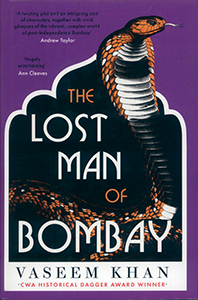
The Lost Man of Bombay by Vaseem Khan. Published in 2022 by Hodder & Stoughton, a Hachette UK company, Carmelite House, 50, Victoria Embankment London EC4Y 0DZ; website: www.hodder.co.uk. Pp: 367. Price: UK £ 16.99, US $ 26.99, Can $ 32.99.
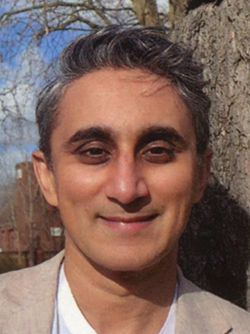 In The Lost Man of Bombay, author Vaseem Khan (pictured) returns to Bombay, a city he seems to be close to and knows very thoroughly, as well as his favorite protagonist, Persis Wadia, the first and only female inspector who had made it to the Indian Police Service.
The novel begins with two men making their way up the Himalayas heading towards Tibet when one of them spots what he presumes is a human form. On further scrutiny, they discover it is indeed the body of a dead white man with his face almost destroyed by what they think are falling rocks. All they find on him is a journal with the words "Bombay Press 1943” on the flyleaf. Three pages have been torn from the book and there is a request that the journal be sent to his wife. There is also an ambiguous statement, "Caesar’s Triumph holds the key.” No one knows who the man was or how long he has been in the mountains and for want of any identification he is called "The Ice Man.” Was his death an accident? Bhoomi, who conducts the autopsy, is convinced it is murder.
Khan intensifies the suspense by adding more murders to the list. The first is the double murder — of an Italian, Stephen Renzi and his wife. The reason for this murder is not clear. But the author raises our suspicions: What is an Italian doing in Bombay in 1950? Renzi has made it known that he loved Indians and that he wanted to get away from Italy as it was not the best place to be after the war — reasons which are not totally convincing.
This is followed by a third murder, that of a German, Grunewald, the ward of Fr Francis Rebeiro, the priest of a diocese. That Grunewal was an austere man is understandable, but something arouses the reader’s suspicion when Khan describes his "sheer wild-eyed fervor” and mentions that he still practiced mortification of the flesh and flagellated himself with a braided whip till he bled.
 Wadia is sure that these are not unrelated incidents. The Ice Man, Renzi and Grunewald have all had their faces smashed, bludgeoned beyond recognition. The murderer seems to be the same person. But what is it that links these three people together that they should have a common murderer?
Khan increases the suspense by placing regimental dolls at the site of the murders of both Renzi and Grunewald. These, Wadia later finds out, are Gharwal regimental dolls. But how do all the pieces in the puzzle fit? The Gharwalis are known to be intrepid soldiers. Does this mean that the victims were all soldiers? Wadia travels from Bombay to the Military Academy at Dehradun in search of the answer.
Khan also introduces a bank locker, the key to which was given to Renzi’s mother-in-law for safe-keeping. When the locker is finally opened, all it contained was a piece of paper with some alphabets which seem to be a code. A similar coded message is found in Grunewald’s crucifix. Wadia notices that both these pages have been torn from the book which had been in the possession of the Ice Man. Thus her suspicions are justified: there was some connection between the Ice Man, Renzi and Grunewald. But Khan heightens the suspense further. Three pages had been torn from the note book — one more still needs to be recovered to solve the puzzle.
But in addition to these problems, Wadia has her own personal demons to face. Khan creates a wonderfully complex character. The police inspector has a difficult role to play in a profession dominated my men and has to tolerate their barbs and misogynistic comments. When she visits the Military Academy in Dehradun, Col Shyam Batra whom she meets has no hesitation in telling her that it is unlikely that women would be employed in the armed forces in the near future. "Fighting on the front line is a little different to policing sleepy local neighborhoods.”
So focused is Wadia on her profession that she has made a total mess of her private life. She has no friends, is unmarried and has had an unsuccessful love affair which has left her embittered. The only person who can bring a balance to her life is Archie Blackfinch, an English criminalist who, in addition to having an excellent sense of humor, is tall and handsome; but she is always battling to curb the "unwelcome surge of emotion” he evokes. A further disturbing factor is that she had lost her mother when she was very young and her father now wishes to marry again, a situation she abhors. Wadia is extremely rude to and cold with her father’s future wife and so suspicious that she even has the latter followed. She realizes that her father will no longer need her once he remarries and that is something she cannot accept.
Khan balances the murders and the investigation with a deep and perceptive character analysis which makes the novel more than just a detective novel. The Lost Man of Bombay is a wonderful read and one waits with eager anticipation for Persis Wadia’s further exploits.
FIRDAUS GANDAVIA
Gandavia holds a doctorate in English literature and is a retired chartered accountant.