
Armed Force
“Sleight of shoulder”
A physical disability did not hinder an Indian Navy’s wartime flying sortie 50 years ago
Events trigger memories, some of which bring a smile to one’s face. And that is precisely what happened during the recent live webcast of the 1971 Indo-Pak War — the Indian Navy’s finest hour. It was a casual query by the curator that brought back a flood of memories of an innocuous event on board the aircraft carrier INS Vikrant two score and 10 years ago. An event which nearly prevented me from actively participating in the War. But this needs a short preamble to correctly appreciate the situation I had landed myself in, just a few hours before we were to go to battle.
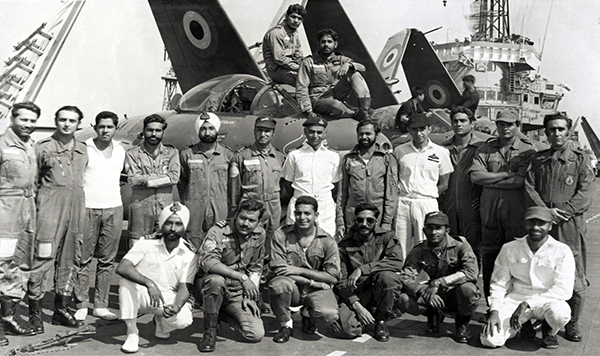
Group photo of 300 Squadron aboard INS Vikrant, 1971, Cmde Medioma Bhada, standing 2nd from l
I had joined the National Defence Academy (NDA) in 1956 with an unperceivable and undeclared physical disability. I was suffering from a recurring dislocation of my left shoulder. This happened whilst in school and continues to plague me to this day. I had, however, mastered the art of setting it right within a few, excruciatingly painful, seconds. And it is with this "sleight of shoulder” that I managed to go through my entire training at the NDA and subsequently in the Indian Navy. Not that it went unnoticed. All my colleagues in the NDA and subsequently throughout my service career were aware of my physical drawback and I must admit, in praise of them all, none ever thought of bringing it to the notice of the authorities. Yes, I had many harrowing experiences whilst doing physical training, swimming, horse riding, boxing. I still remember the boxing bout I had with my colleague Shivpuri. In the middle of the bout I dislocated my shoulder and moved back towards my Red corner. So did Shiv, on realizing what had happened. Within a few seconds I had set it right and it was "box on” with me turning southpaw, to the astonishment of the referee. Needless to say, the result was inevitable, "Well fought Red, Blue is the winner.”
It was just a few days before the War. INS Vikrant, along with her escorts, was anchored off Port Cornwallis in the North Andaman Islands, eagerly awaiting orders for the commencement of hostilities.
And that it is when it all happened. I dislocated my left shoulder during a friendly brawl with my fellow squadron mate at the bar late one evening. Fortunately, as was my wont, I set it right and it was all back to normal. Unfortunately, this discomfiture was witnessed by the new Air Force doctor, Flt Lt Nair, who was seated in one corner. He immediately brought the incident to the notice of his superior, Surgeon Commander Christian, the ship’s principal medical officer, who summoned me to his cabin that very evening. I had no option but to admit that I had dislocated my left shoulder and tried to convince him that it was an old defect which had thus far not in any way affected my performance in the cockpit or outside it. I even brought it to his notice that this had happened earlier and that I had been cleared to fly by the senior advisor in surgery at the Naval Hospital INS Asvini. He remained unconvinced and was adamant about grounding me.
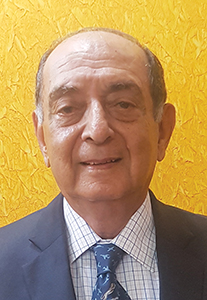
Cmde Bhada (retd)
Thus, began my tryst with destiny.
It was quite late in the evening when I knocked on the cabin door of my squadron commander, Cdr Santosh Kumar Gupta, affectionately called Gigi, and apprised him of what had transpired. He seemed worried, not because I was to be "grounded” but by the fact that he would be deprived of a fully operational pilot just a few hours before the War was to commence, with absolutely no hope of getting a replacement at this late stage in the middle of the Bay of Bengal. He had just 15 fully operational pilots on board and could ill afford to lose one of them.
Cdr Grewal (Garry), the commander (air) responsible for all flying operations on board, was informed and the four of us trooped up to the doctor’s cabin. Regrettably, not all our pleading and cajoling could move him. I was then reminded of the line from the Rubaiyat of Omar Khayyam: "The moving finger writes and having writ moves on, nor all thy piety nor wit shall lure it back to cancel half a line.”
He stuck to his earlier decision. The panic button had now been pressed.
Though it was late at night, the situation warranted the ship’s captain’s intervention. Capt Swaraj Prakash was woken up and apprised of the serious situation but even his request to the doctor to temporarily allow me to fly during the period of the operations, did not move him. Finally, Rear Adm S. H. Sarma, fleet commander and the officer in tactical command of all the naval operations in the Bay, who was flying his flag on board the INS Vikrant was approached. The ramifications of this decision by the ship’s principal medical officer on the overall operational capability of the naval fleet and the aircraft carrier in particular were highlighted by Capt Prakash.
The admiral then took the doctor aside and had a long chat with him at the end of which the doctor agreed to clear me to fly only for the duration of the War and on the explicit understanding that I would have myself appropriately treated at the first opportunity thereafter. He also wanted to convince himself that none of my actions in the cockpit would be such as could cause a dislocation of my shoulder. The next morning, I was strapped in the cockpit of the Seahawk aircraft in his presence and made to perform all the movements a pilot would be required to do, under various situations. Only then was Christian convinced and I was finally cleared to fly during the operations.
It was just a few hours later that the fleet received orders to weigh anchor and proceed to the area of operations. I was fortunate to be included in the first wave of four aircraft, led by Gupta for an attack on Cox’s Bazar. I flew many sorties thereafter, including over Chittagong harbor (Untold Story of the 1971 War).
Soon after the War, the squadron returned to Dabolim, Goa, our shore base. In the euphoria of the success of the War, all promises of getting myself treated for the recurring dislocation of my shoulder were forgotten and I continue to live with my Achilles’ heel even after retirement.
Medioma Bhada is a retired Commodore of the Indian Navy.
◆ ◆ ◆
From the archive