
Cover Story
“Bringing a legend alive"
Using scraps from INS Vikrant, a sculpture was created to commemorate India’s first aircraft carrier
The sculpture looked daring by daylight and defiant under floodlights. Specially conceived by Cmde Medioma Bhada (Retd) and created by artist Arzan Khambatta in honor of India’s first aircraft carrier INS Vikrant, the memorial was unveiled at the triangular traffic island opposite Lion Gate at dusk on January 25, 2016.
"We, her shipmates, offer this monument to the iconic Vikrant, crafted from her recovered memorabilia, as an offering of our everlasting tribute,” read the engraving on the scrapture that was jointly unveiled by Vice Adm S. P. S. Cheema, then flag officer commanding-in-chief, Western Naval Command and the municipal commissioner of Bombay Ajoy Mehta.
"We, her shipmates, offer this monument to the iconic Vikrant, crafted from her recovered memorabilia, as an offering of our everlasting tribute,” read the engraving on the scrapture that was jointly unveiled by Vice Adm S. P. S. Cheema, then flag officer commanding-in-chief, Western Naval Command and the municipal commissioner of Bombay Ajoy Mehta.
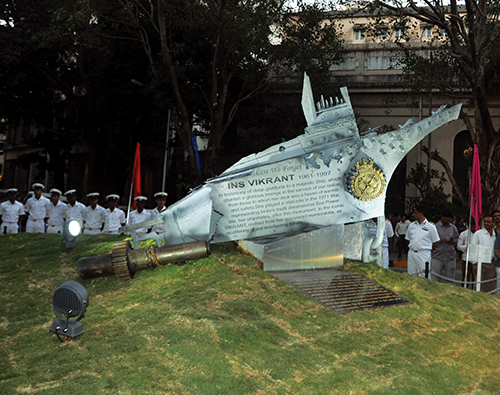
Vikrant memorial
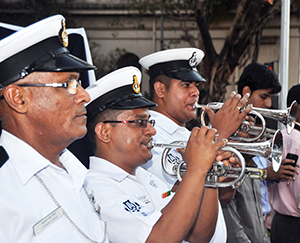
Buglers at the launch
Thanking Bhada for "bringing the legend alive,” Cheema commented, "Her story of guts…will live on, in emotion and symbolism.” Describing the sculpture as an "amazing…spectacular job,” the vice admiral expected it to inspire all personnel departing from Lion Gate. "Carrier operations cannot be built overnight. It requires the teaming of thousands of officers on and offshore… Vikrant has written its own history… She has gone but left her traits of good ethos, good tradition. Today we have two carriers, INS Viraat and INS Vikramaditya. The mother of these two is INS Vikrant,” he reminded.
Detailing the "saga of this memorial,” Bhada revealed that its genesis "lies in nostalgia,” having flown operational sorties from Vikrant’s deck during the 1971 Indo-Pakistan War. He was pained that after serving the Indian Navy for 36 years when she "effectively projected India’s sea power and her carrier borne air power,” and thereafter served as a museum for nearly a decade, the British built ship, "finally had to go under the hammer and to be sold to the highest bidder as scrap. In 2014 she was towed away unsung.”
Convener of the Vikrant Memorial Forum, Bhada acquired over a ton-and-a-half of material at his cost from the scrap owners, he had related to Parsiana (see "Memorial for INS Vikrant,” Events and Personalities, May 21, 2015). When he decided to dedicate a memorial to her, he took Khambatta’s help to identify components from the original ship that could be redesigned. In addition to Bhada who donated parts of Vikrant scrap for the sculpture, Khambatta was given credit for having "maintained the pristine condition of the parts whilst projecting Vikrant’s air power.” Conceived in April 2015, the project "ironically fructified nine months later… In all my efforts, every single door opened to me, the Navy, BMC (Bombay Municipal Corporation), Police, BEST (Bombay Electric Supply and Transport Company), traffic… Everyone was cooperative and enthusiastic,” appreciated Bhada, content that they were able to create "a testimony of deep gratitude to a majestic ship which charted a glorious innings in the service of our nation.” Bhada was among those "to whom her deck was a haven of warmth and safety. She played a vital role in the early victory of the 1971 War, representing India’s multidimensional sea power.”
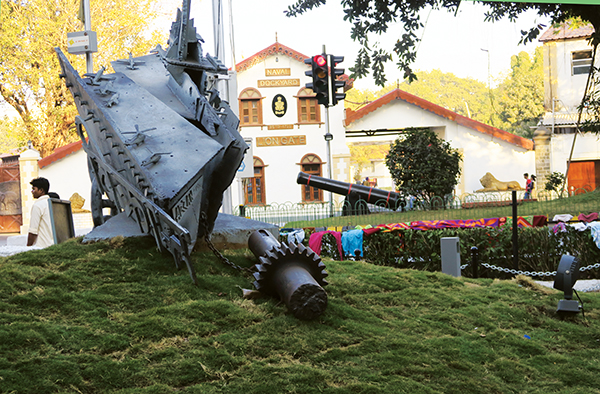
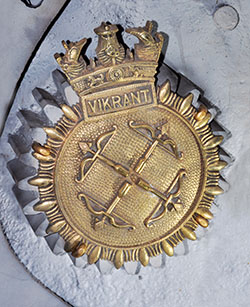
Vikrant memorial and its crest (right)
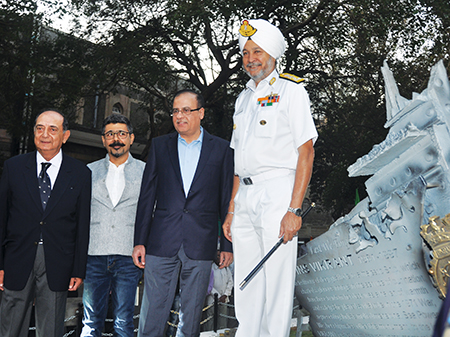
(From left) Cmde Medioma Bhada (Retd), Arzan Khambatta, Ajoy Mehta, Vice Adm S. P. S. Cheema
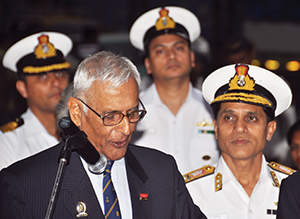
Vice Adm I. C. Rao (Retd) with naval officers
As inscribed on a tablet at the base of the memorial, "We acknowledge the unstinted support of the Western Naval Command without whose continuous involvement the memorial would not have been possible to create and sustain... We thank Mazagaon Dock Shipbuilders Limited for their sponsorship and assistance. We are indebted to the MCGM (Municipal Corporation of Greater Mumbai) for providing an appropriate venue for paying tribute to this historic ship.” In his vote of thanks Vice Adm I. C. Rao (Retd) thanked Mehta for providing space "within the most prestigious, historic precinct of Bombay,” and the chairman and managing director of Mazagaon Docks, Rear Adm R. K. Shrawat (Retd), for sanctioning funds for this special monument.
Khambatta stated in a chat with Parsiana that he was able to create the artwork within a month although "the actual process started three months prior” when his expertise was first sought. "Mounted on a grass mound, it weighs close to a ton and is 10 ft in length and five feet tall,” he added. Determined not to use any other material for the sculpture, the artist was quoted by The Indian Express of January 29, 2016 as stating, "Even the large nameplate in Devnagiri is from the original.” Although the sculpture is painted battleship grey, the propeller shaft was left unpainted as Khambatta wanted the city to see how it weathers, believing that "probably for 100 years it’ll remain unchanged, that’s how strong and beautiful it is.”
Within a week at least five small flags of India had been lodged in the appendages on the memorial since these are available in abundance on the days leading to the Republic Day!
The venerated Vikrant
The building of the carrier under the name HMS Hercules was initiated for the British Royal Navy in the early 1940s but the construction was put on hold with the end of World War II, according to a detailed write-up on the ship on Wikipedia. India purchased the ship from the UK in 1957 and reconstruction was completed four years later when she was commissioned into the Indian Navy by the then Indian High Commissioner to the UK, Vijayalakshmi Pandit in Belfast on March 4, 1961. Eight months later she joined the Indian Navy’s fleet in Bombay when she was received at Ballard Pier by the then Prime Minister Jawaharlal Nehru. Her motto was the Sanskrit expression Jayema Sam Yudhi Sprdhah which means "I completely defeat those who dare to fight with me.”
During the Indo-Pakistan War of 1965 when the ship was in dry dock undergoing modifications, Pakistan reported that it had sunk Vikrant. In the Indo-Pakistan War of 1971 she was pressed into service after necessary modifications when a crack was detected in a water drum of one of its boilers powering her steam catapult. Initially stationed off the Andaman and Nicobar Islands, she was subsequently redeployed towards Chittagong at the outbreak of hostilities when intelligence reports conveyed that the Pakistan Navy was planning to use camouflaged merchant ships to break through the Indian naval blockade. Sea Hawks from Vikrant struck shipping in the Chittagong and Cox’s Bazar harbors, sinking or incapacitating most ships in East Pakistan. Fortunately, not a single Sea Hawk was lost.
Post 1979, Vikrant was given an extensive refit several times but following her poor condition she was formally decommissioned on January 31, 1997. Capt Pritam Singh was the first commanding officer of the carrier and Cdr Harinder Singh Rawat (Retd) was the last captain before it was decommissioned. When speaking to Parsiana at the launch of the memorial Rawat recalled the "awe of getting onto the ship” after alighting from his motorcycle. With his working hours stretching from five in the morning to 11 at night he referred to the captain being "responsible for everyone on the ship and controlling all aircraft.” Vikrant’s air arm had four squadrons: Sea Hawk and Sea Harriers, Alizes, Alouette III and Sea Kings.
The only World War II era British built aircraft carrier to temporarily serve as a museum, from 2001 Vikrant was left open to the public by the Indian Navy for short periods but in the absence of funding and unable to find an industrial partner to maintain her, the museum closed in 2012 after Vikrant was deemed unsafe. In December 2013 the Indian government decided to auction the ship, a move confirmed by the Bombay High Court and the Supreme Court when a public interest litigation by the Save Vikrant Committee opposed it. Ultimately, in January 2014 Vikrant was sold through an online auction to a Darukhana ship breaker for Rs 60 crores and by 2015 its scrapping was completed.
The Vikrant memorial is not the only site where the remains will be honored. When launching the motorcycle Bajaj V on February 1, 2016, it was announced that metal from the Vikrant scrap has been used for the vehicle. Promoted as "V, the invincible,” the motorcycle’s fuel tank assembly will bear the Vikrant metal "because that’s always the signature of a distinctive bike,” explained Rajiv Bajaj, managing director of Bajaj Auto, to The Economic Times of February 2, 2016. He further added, "The metal of INS Vikrant has been bought, melted, purified and shaped by us to be an intrinsic part of the V. In the most authentic manner possible, the spirit of INS Vikrant will continue to be an integral part of the everyday life of Indians for many years in the future.”
◆ ◆ ◆
From the archive