
Parsi Controversies
The eighth atash behram – I
Berjis Desai’s new column "Parsi Controversies” takes a historic look at disputes over religious, social, cultural, economic and political issues amongst community members and institutions.
The four atash behrams of Bombay are but a short distance of each other, within a radius of about 500 meters. Two of them are Shahenshahi; and the other two Kadmi. The Shahenshahis and Kadmis fought bitterly over the Zoroastrian calendar; the fight resulted in a few murders. The Shahenshahi atash behrams are located close to each other. Was this due to a shortage of space in the late 19th century when Parsis owned half of Bombay? Did an excessive number of zealous devotees necessitate yet another fire temple? Was Dhobitalao a sacred spot? (In which case, the 105-year-old Parsi Dairy Farm is also a sacred community institution!) The actual reason: a clash of egos between priests and merchants, priests and priests, Navsari and Bombay.
On a cold December morning in 1885, at Khurshed Wadi where wedding receptions are held, under the chairmanship of the High Priest of Navsari, the venerable Dastur Darab Mahiyar Meherji Rana, several leaders of the Bhagarsath Anjuman and 100 priests, most sporting luxuriant beards, gathered in an agitated frame of mind. The 800-year-old hegemony of Navsari had been directly challenged by a group of priests and rich merchants in Bombay. Hitherto the navar ceremony, which initiates a boy into the priesthood, was performed only at India’s most ancient agiary, the Vadi Daremeher in Dastur Vad, a stone’s throw from the venue of the meeting, and young boys from priestly families all over India had to necessarily come here to be ordained. However, the newly appointed High Priest of the H. B. Wadia Atash Behram, Ervad Peshotan Sanjana had cocked a snook at the dharam ni tekri by nonchalantly performing navar ceremonies in the Wadia fire temple. Navsari was aghast. They threatened to excommunicate the Sanjanas.
On a cold December morning in 1885, at Khurshed Wadi where wedding receptions are held, under the chairmanship of the High Priest of Navsari, the venerable Dastur Darab Mahiyar Meherji Rana, several leaders of the Bhagarsath Anjuman and 100 priests, most sporting luxuriant beards, gathered in an agitated frame of mind. The 800-year-old hegemony of Navsari had been directly challenged by a group of priests and rich merchants in Bombay. Hitherto the navar ceremony, which initiates a boy into the priesthood, was performed only at India’s most ancient agiary, the Vadi Daremeher in Dastur Vad, a stone’s throw from the venue of the meeting, and young boys from priestly families all over India had to necessarily come here to be ordained. However, the newly appointed High Priest of the H. B. Wadia Atash Behram, Ervad Peshotan Sanjana had cocked a snook at the dharam ni tekri by nonchalantly performing navar ceremonies in the Wadia fire temple. Navsari was aghast. They threatened to excommunicate the Sanjanas.
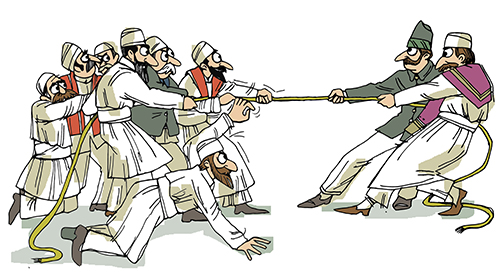
Illustration by Farzana Cooper
To appease the incensed power center, Sir Jamsetjee Jejeebhoy (J. J.), First Baronet, and chairman of the Wadia Atash Behram went as an emissary. Sir J. J., a son of the soil, had munificently donated much wealth and property to his hometown. He enjoyed much goodwill. For all practical purposes, he was king of the Parsis. If anyone could douse the fire, it was him. The mood at the meeting however was ugly. "Today even if Zarthost Saheb comes down, we will respectfully disagree,” said Kangaji, a nonagenarian priest.
Sir J. J. was a charmer. In simple Gujarati, and in a deferential tone, he explained that the merchants of the Wadia family did not hail from Navsari and were therefore ignorant of its hallowed traditions. His argument cut no ice. It was alleged that the Sanjana priests had conspired with the Wadia family to weaken the hold of the Bhagarsath priests of Navsari. They were the puranu mathak (ancient power center) and their vadpun (leadership) had to be respected at any cost, stated Navsari. Sir J. J., mildly rebuffed, failed in his mission. What could they do anyway, thought the Sanjana mobeds, the Wadia Atash Behram was under their patrons’ control. But the Empire was ready to strike back, in ways none could have imagined.
Peshotan was no Martin Luther. His Sanjana family became persona non grata. The JamaspAsa family was now to represent the Navsari Bhagarsath Anjuman in Bombay. For nearly 50 years no navar from the Sanjana priestly family would be permitted at the Navsari Vadi Daremeher. Those priests of the Wadia Atash Behram who were opposed to Sanjana breaching the navar tradition left the Wadia Atash Behram and were temporarily allowed to practise in the Dadysett Atash Behram a few lanes away while the Vatican bristled at the unceremonious breaking of its hegemony.
When Lee Iacocca, the mercurial executive of Ford Motors was fired by his boss Henry Ford in 1978, he told the latter: "I will f… you in the marketplace.” Iacocca went on to become the boss of Chrysler and surpassed Ford. In the same vein, Navsari decided to teach a lesson to the rebels. In 1887, a dadgah was set up just across the way from the Wadia Atash Behram. And then came the momentous announcement. They were going to consecrate a new atash behram there. Right in their face. The seeds of a vicious battle had been sown. This dispute would reverberate in the Parsi Press and the courts and the Bombay Parsi Punchayet for decades to come.
Consecrating an atash behram, the Zoroastrian temple of the highest degree, was even then a momentous task. India at that time already had seven of them. The holiest of holy, the most exalted, Iranshah in Udvada, the Bhagarsath Desai in Navsari, two in Surat, both consecrated in the same year, Dadysett, the first Kadmi one in Bombay; Banaji, the second Kadmi fire temple, and of course, the Wadia. Now an eighth one was being contemplated. After recovering from the initial shock, the opponents of the new atash behram began to mount a counter offensive. Where is the need for a second Shahenshahi atash behram, and that too, almost across the road? Preposterous, they thundered.
Seven is the holiest number of profound spiritual significance in Zoroastrianism. "Jarthosti gébi babato ma saat tabbaka avé (There are always seven stages in all Zoroastrian occult matters)!” Consecrating an eighth atash behram will be apocalyptic. The celestial balance will be disturbed, and a curse will come upon the community. The priests were divided as never before. So were the merchant princes of Bombay. On one side were the Wadias and the Jejeebhoys; on the other, the Petits. The stage was set for a battle royale. To be continued
Berjis Desai, lawyer and author of Oh! Those Parsis, and recently Towers of Silence, is a chronicler of the community.
◆ ◆ ◆
From the archive