
Cover Story
Arresting architecture
Architect Hafeez Contractor believes in designing buildings to suit aesthetics and the market conditions
Initially there were references to his transforming the landscape. Within a few years he came to be known for altering the skyline. From conceptualization to concretization, excavation to elevation, architect Hafeez Contractor has managed to leave his imprint on several areas of Bombay, India and even beyond in Dubai and China. His architecture has been described as brilliant and breathtaking by some and as eccentric and strange by others.
A quarter century in this profession, from 1982-2006, was marked with the production of a massive 564-page coffee table monograph Architect Hafeez Contractor: Selected Works 1982-2006, priced at Rs 4,500. Published by Spenta Multimedia (PiramydSpenta, Mathuradas Mill Compound, N. M. Joshi Marg, Lower Parel, Bombay 400013, tel: 34811010), the book written by Prathima Manohar gives insights into the persona of the maverick and the multiplicity of his creations. The first 69 pages feature articles in English with their Hindi translations. Thereafter it’s a visual delight, with his myriad housing projects photographed from rare angles, with appropriate plans and explanatory notes to interest students of architecture and the layman. His melange of works include bungalows and residential complexes (85-90 percent of the Hiranandani complex that put Powai on the real estate map has been designed by him), hospitals like Hiranandani in Bombay, Apollo Indraprastha in Delhi and Sahara in Lucknow, and hotels like Hyatt Regency, ITC Grand Central and ITC Grand Maratha Sheraton in Bombay, and Le Meridien in Poona. The Delhi International Airport and Bombay Domestic Airport Terminal have been modernized by him and the Turbhe Railway Station in New Bombay bears his signature mark. "If architects are defined by the quantity of projects, Contractor has surpassed the existing contenders in India and probably falls within the global top 10 architects,” comments Harshad Bhatia, urban designer, architect and critical thinker in his appraisal of Contractor’s contribution, carried as an introduction to the book.
"I survive on constraints and I am at my best when confronted with extreme challenges… India offers a fantastic scope to explore, pushes individuals to arrive at innovative solutions to work within limited resources. But to create something in our cities with their uncertain regulatory environment, zillion bureaucratic hassles and other standard real estate exigencies is itself a miracle,” sums up Contractor in his foreword to the book.
The architectural academia may view him as a populist or builder’s architect, a non-conformist who accepts all types of projects to pander to the consumer but Contractor has his reasons that he conveys in his foreword, "Even though most purists might term my residential work gimmicky, it comes out of valid rationale. The numerous styles that seem to tick off many people are simply a response to the aspirations of the consumers and the market context… Today’s architects have to deal with an ever-evolving culture which can be utilitarian, consumerist, materialistic, ostentatious, idealistic, capitalistic, pragmatic, etc all at the same time.”
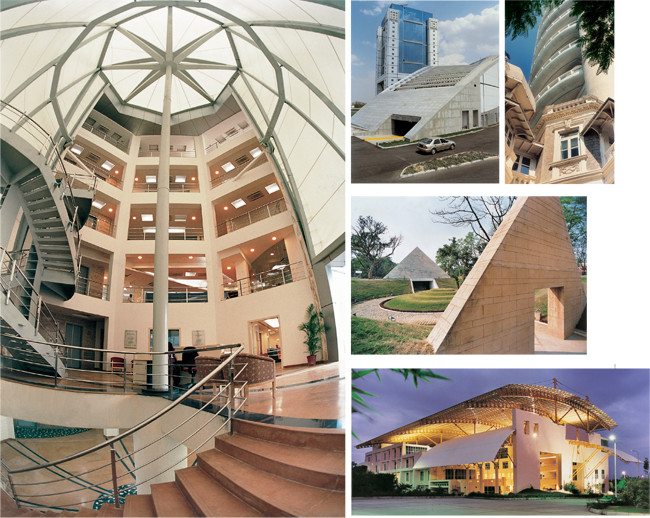
(Left) atrium at the Textile Laboratory and Research Institute; (Top right) Nestle building (left) and Buckley Court; (below) The Rusi Modi Centre of Excellence Photos courtesy: Architect Hafeez Contractor: Selected Works 1982-2006 ; Bottom right: International Institute of Information Technology;
His commercial architecture persistently uses glass, steel and aluminium. Some of his flamboyant "look-at-me” buildings that attempt to create a symbol for the organization are The DLF Atria in Gurgaon, Infosys, Shanghai, A. V. Birla Centre in Bombay… As he believes, "A lot of times architecture has epitomized a brand or added value to it. Powerful architectural statements are a big part of branding.”
Institutions that have transformed their image thanks to Contractor are the National Institute of Construction Management and Research and the International Institute of Information Technology in Poona, The Rusi Modi Centre of Excellence in Jamshedpur, Textile Laboratory and Research Institute in Bombay.
His unusual perception of aesthetics soon started a revolution. Tired of matchbox houses, buyers were willing to pay a premium for designer buildings. Looks mattered and Contractor played a role in the marketability of buildings.
He believed in using every inch of FSI (floor space index) allotted to the builder to give the building new shapes that bore his unique stamp. Excessive use of Reinforced Cement Concrete characterize his complexes as do a double-walled skin. Besides using a lot of builtup area, the original nine-inch thick walls were prone to water seepage which made the buyers fix irregular awnings or chhajias. To circumvent this difficulty Contractor introduced six-inch walls with an external skin. This functional feature thus became a potential for an aesthetic element. Instead of the monotonous rectangular windows, his towers bear concoctions like arches, circles, triangles, crescent or stepped openings. In roofs too he saw a potential to display his creativity. "People like dreams, fantasy is fun. Modern architecture is very boring — heavy, chunky and predictable. Perhaps the toy-like quality of my buildings appeals to people…These were two areas not controlled by FSI and the builders allowed me to play over there,” he is quoted in the book. Standing tall are an array of his buildings — some resembling spaceships like the 90-storeyed landmark in Dubai, 23 Marina, others sporting circular, arch-shaped and crescent windows like in the 21-storeyed Brookhill Towers, Vastu that resembles a capsule or Peregrine-Tata Housing, inspired by Batman.
His residential clusters are marked by a central recreational area for the entire complex. Responding to technological trends, his buildings now incorporate international lighting and ventilation, fire prevention, car parking norms, garbage disposal systems and other amenities. The concept of green buildings too has been catching on. The choice of material available to an architect today is wider thanks to global access and often a building in India may have superior glass and metal curtain wall made in England or Germany and granite or marble imported from Italy. He has also noticed that some materials from China work out cheaper than that sourced locally.
For the 18 million population in Bombay that survives on a small land area of just 438 sq km as pointed out in a chapter in the book titled "Transforming Shanties,” Contractor believes that there is a solution to the spatially challenged city. "The only way to provide better living conditions is by building higher and preserving more open spaces,” says Contractor who has designed not just for the rich but is also involved in slum rehabilitation projects.
"Cities can’t be frozen in time, they do change. A city should explore solutions that would prioritize different aspects of urban growth in such a way that they do not deter developmental growth and at the same time do not fade the city’s heritage values,” believes Contractor. Although he has been entrusted with the redevelopment of several heritage properties, Buckley Court in south Bombay became a contentious issue. One of the few remaining examples of Indo-Saracenic architecture in Bombay, the architect was required to revive this quaint run-down structure and propose a new residential development. The heritage committee had initially proposed a low-rise scheme to integrate with the old structure but Contractor felt that the old-world charm of the structure would be lost if only part of it was visible. He therefore proceeded to create a much taller building with duplexes leaving the intermediate floors bare to create a neutral backdrop for the old structure.
The Western Waterfront Development proposal is a grandiose scheme envisaged by the avant garde architect to develop the 26-km under-utilized and neglected waterfront area of Bombay with seafront parks and walkways, eventually connecting the city’s downtown center to its suburbia. Besides expecting to increase the green public space fourfold, an underground tunnel below the waterfront would decongest the choked roads.
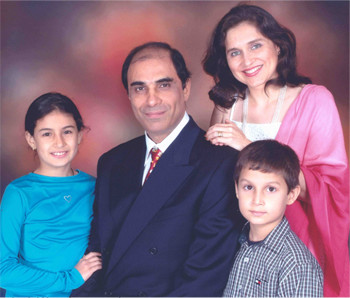
Hafeez and Perl Contractor with daughter Zoish and son Yazd
Lasting images
Contractor’s predilection towards art and architecture was evident to his teachers from the time he studied at the Boys’ Town Boarding School at Nasik. Known to be a mischievous child with a sense of ingenuity, when a button went missing on his shirt, he carved it out of chalk and stuck it to his shirt to avoid punishment, it is reported in his biography carried in the book. His school textbooks and workbooks would be full of intricate illustrations of aeroplanes and battlefields to the dismay of his teachers who tried unsuccessfully to interest him in academics. The words of ‘Mr Tattoo’ who customarily wrote on the blackboard, "No luck without hard work,” was subconsciously engraved on this student who is now known to be a workaholic.
In fact he is so pressured that an interview with him which we had been seeking for a long time finally materialized on a Sunday afternoon (June 22, 2008) at his plush residence at the Dadar Parsi Colony. Walking down memory lane, 58-year-old Contractor vividly remembered being summoned by his school principal Bejon Desai when he was in his final year to give him a 15-minute lecture on the "need to take care of yourself hereon. The only way to be strong is to study…” One of the other precipitating factors was his mother Roshan’s insistence that he join Jai Hind College. With the influence of his fua (uncle) Sarosh Wadia he got admission where he says, "a new world started unfolding before me. I realized where I stood. I knew I had to study, forget all about games and entertainment.”
Until he was in his last year of school, he says he never knew that his widowed mother (he had lost his father Sorab before he was born) was running the household on Rs 90 a month. (Fortunately his father’s business partner Nariman Nallaseth continued to send her a monthly sum.) When he came home to Navsari for the holidays and demanded gifts and other purchases, even a shirt for Rs 10, she would buy it for him! The only time she ever refused was when he wanted money to go on a trip to Delhi-Agra, explaining, "Dikra (son) we can’t afford this.” But the outstation trip did materialize for Hafeez’s cousin, well-known architect Tehmasp Khareghat offered to finance him.
For other reasons too Contractor is grateful to Khareghat: When taking French tuitions at Khareghat’s office, the young Hafeez observed that a particular drawing of a window by an architect was faulty. An amused Khareghat challenged him to recreate the detail when Hafeez surprised him with correct construction methodology. Spotting his innate talent Khareghat advised him to enroll for architecture training forthwith. With a recommendation from Homi Dallas, then president of the Indian Institute of Architecture and by faring brilliantly at the entrance examination, Hafeez secured admission at the Academy of Architecture. For the next seven years at the architecture college, he topped the class each year. He would attend morning college and then work at Khareghat’s till late at night, mentions Contractor, giving his cousin credit for inculcating in him the fundamentals of the profession. Subsequently Contractor qualified as a Tata scholar to complete a one-year postgraduation course from Columbia University, New York.
The day he graduated he took a return flight home. For the next three-four years he worked as an associate with his cousin before parting ways in 1982 over a difference of opinion: whether black or grey was a better color option for a particular project, Contractor had conveyed to Moneylife (July 7, 2006). Starting his independent practice from a storehouse on Bank Street at Fort with a staff of two members, Contractor has expanded his set-up in the same area, employing more than 300 senior associates, architects, interior designers, draftsmen, civil engineering staff and architectural support staff with some of them working in three shifts… The book displays many of Contractor’s freehand building designs done on scraps of paper or even newspapers which are later configured on the computer screen and finally erected as his grandiose structures.
All on a platter
"The trouble with the Parsi community is that our parents are devoted to their children, making life very easy for them with everything provided for. If not parents, then there are uncles and aunts ready to indulge,” observes Contractor. To those on the threshold of a career he advises, "If we let those crucial five or six years slip by, then it is very difficult to get a grip. I keep reminding my children too (daughter Zoish studies in Std X at J. B. Petit School and son Yazd is in Std V at the Cathedral and John Connon School).
"Shielded and isolated as we are in our colonies most don’t know what is happening beyond. Our colonies are great gifts that have been left for us by great people but unfortunately it has led to mediocreship.” Dissatisfied with the performance of Parsi boys who have worked for him Contractor comments, "They want success overnight. They are not willing to work hard. They leave me saying they are going abroad but after some years when you meet them you realize they have never left the shores of India.”
Is he in favor of developing baugs or preserving them as they are? Contractor jocularly draws an analogy to a train journey where those comfortably settled on their berths are reluctant to make place for newcomers. He too candidly declares, "Yes I love my house in a Parsi baug. But when you ask ‘should I preserve it?’ as a selfish individual I may feel inclined to say ‘yes.’ But there are ways of preserving it. How you do it is very crucial and complicated.” He refers to old-timers from the Colony who remember the days when the bungalows were surrounded by large wadis (fields). Then came the buildings with ground plus one-upper, to be followed by ground and seven-upper. Staying in one such building he says he refused to sign a petition initiated by some ladies demanding cessation of work when a proposed 22-upper in the vicinity threatened to block the free passage of air and light. "Life has to go on,” he maintains, "we have to make space for more people to live.” Unfortunately in India there are uniform laws with the same rules applicable to heritage buildings and new plots, regrets Contractor.
Among the fire temples in Bombay Contractor says he likes "Wadia Atas Bahram the most.” While he appreciates the architecture of most agiaries he comments on those located in idyllic surroundings which generate a sense of peace that he finds particularly appealing. The architecture of the Navsari atash behram that he frequented as a child "is the best,” maintains Contractor.
When asked if he feels inclined to design an agiary, he looks askance: "We already have enough. Let’s just maintain them properly.” He would much rather focus on the "tough time that the community is passing through… How long will the baugs and charity last?” he asks rhetorically. "Somebody has to replenish it. Everything comes with success and money. It’s a dirty way of looking at things. In our community we let go of money easily even when it’s our due. People take advantage of us.”
Although he was brought up to believe, "Jéma samaj nai hoi, téma parvanu nahi (better not meddle in matters where you have limited knowledge),” he questions, "How did our numbers increase after we sought refuge in India? You have to change as per circumstances” as did our forefathers after landing on the shores of India.
Hafeez married Perl only after his mother was reconciled to the idea of accepting a non-Parsi daughter-in-law. Now seeing so many from his family settle with spouses of other faiths, he feels that by turning away our girls who have married out "we are bleeding our community to death. We are losing our youth. We are asking the best of our stock to go out.”
In the colonies "some good teachers should ready our youth to face the competitive world, make them into a real force. Barring the legal profession, our strategic position in every other profession is declining.” In the field of architecture earlier the prominent firms were started by Parsis: Khareghat, Mehta and Contractor, Pheroze Kudianwala, Jehangir Vazifdar, Dara Mistry, Phiroze Javeri, Rusi Khambatta... Today there are few names to reckon with.
Contractor’s practice though continues to progress. Among the major assignments he is presently handling are the 65-storeyed SP (Shapoorji Pallonji) Towers in Bombay, a new BARC (Bhabha Atomic Research Centre) complex in Visakhapatnam, a 130-storeyed hotel in Dubai and a 70-storey building in Kenya. He may create architectural blunders or scenic wonders but even as he soars in the sky he leaves behind memorials on the sands of time.
◆ ◆ ◆
From the archive