
Navsari Tales
A superiority complex
Navsari Parsis behaved, felt and believed that they were superior to all other non-urban Parsis. They however freely conceded that Bombay Parsis were in a different league. Of course, after the ’70s, all such distinctions were obliterated.
Behramji’s only daughter, Rutty, fair and pretty, was in a desperate hurry to get married to anyone who was based in New Delhi. Her obsession with the national capital was the sole criterion for selecting her life partner. All the kaajwalis (matchmakers) of Navsari failed to meet her requirement; finally, a distant cousin recommended a boy in Delhi, originally from Bulsar, as Valsad is called in Navsari. On the given day, the entire family descended upon Navsari. They could have as well arrived from the Andromeda Galaxy. There was not the slightest trace of anything Parsi in their accent or dialect or demeanor or manner of conversation. They knew little about Parsi wedding and engagement traditions or customs. Noses began to sniff. The boy, half expecting to be rejected, was stunned when his pretty bride-to-be instantaneously nodded her assent to the match. Jawaharlal Nehru and India Gate had done the trick. Of course, the brother of the girl, who resided in Bombay, was aghast. He kept glowering at his sister not to agree but she was already imagining herself on the Dehradun Express. Several others made politically incorrect statements about the boy’s dental architecture and complexion. This happened 62 years ago and the marriage was a grand success.
Behramji’s only daughter, Rutty, fair and pretty, was in a desperate hurry to get married to anyone who was based in New Delhi. Her obsession with the national capital was the sole criterion for selecting her life partner. All the kaajwalis (matchmakers) of Navsari failed to meet her requirement; finally, a distant cousin recommended a boy in Delhi, originally from Bulsar, as Valsad is called in Navsari. On the given day, the entire family descended upon Navsari. They could have as well arrived from the Andromeda Galaxy. There was not the slightest trace of anything Parsi in their accent or dialect or demeanor or manner of conversation. They knew little about Parsi wedding and engagement traditions or customs. Noses began to sniff. The boy, half expecting to be rejected, was stunned when his pretty bride-to-be instantaneously nodded her assent to the match. Jawaharlal Nehru and India Gate had done the trick. Of course, the brother of the girl, who resided in Bombay, was aghast. He kept glowering at his sister not to agree but she was already imagining herself on the Dehradun Express. Several others made politically incorrect statements about the boy’s dental architecture and complexion. This happened 62 years ago and the marriage was a grand success.
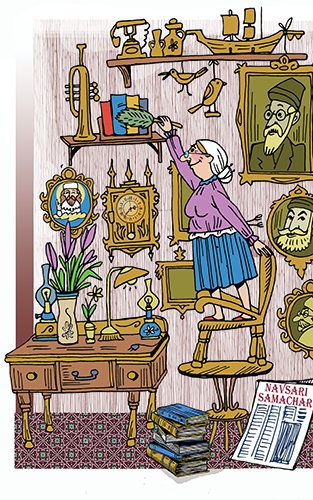
Illustration by Farzana Cooper
Surat Parsis, once upon a time a stronghold of the community under the East India Company, were richer, more business-minded and adventurous than their Navsari counterparts. However even the Surtis conceded that the latter were superior in intelligence. India’s first industrialist, Jamsetji Tata; India’s premier philanthropist, Sir Jamsetjee Jejeebhoy; the saintly First Dastur Meherji Rana who nearly converted the Mughal Emperor Akbar; the first Indian to become a British MP, Dadabhai Naoroji; the doyen of the bar, the venerable Sir Jamshedji Kanga; and a host of eminent doctors were the product of much smaller Navsari. One rather nasty uncle in Navsari used to ask whether Rusi Surti was the best that Surat had to offer. For the uninitiated, Surti was a dashing Indian Test cricket all-rounder who electrified the field. Once, when playing the famous leg spinner Richie Benaud, he was caught in the gully position, which resulted in a leading Gujarati newspaper publishing a headline loaded with double entendre: "Beno na ball saathé aasnai karva jataa, gali ma pukdai gayéla Rusi Surti [trying to play Benaud, Surti was caught in the leg gully (slip)].” Believe us, this is not an apocryphal story. Our vote for the most outstanding Surat Parsi goes to the actor who has brought tears of laughter to our eyes for decades, Yazdi Karanjia.
Navsari was hailed as the dharam ni tékri, the bastion of theological excellence. The scholarly Sir Jivanji Modi, the universally acclaimed High Priest Dastur (Dr) Firoze Kotwal, the learned Kutar brothers, hailed from this tiny town on the banks of the Purna river. Udvada did produce priests who were spiritual giants but none of comparable scholastic achievement. From times immemorial, religious controversies emanated from Navsari which often bullied others into submission. The Iranshah resided in Navsari for 300 years before an accident of history resulted in the shift to Udvada, which would have otherwise remained an unknown hamlet.
Many years ago we had the misfortune of employing a particularly daft Parsi lady clerk who made mistakes galore. When chided, she would say with a disarming smile, "I am from Bharuch. We are a bit dull.” She made the most outstanding bharuchi akuri, though. One snooty but poor family from Navsari had a daughter-in-law from Bharuch who had brought with her as dowry the most priceless huge Ming vases. She did no housework, hated to soil her fingers even while eating trotters, and uttered one sentence in a fortnight. Her rambunctious mother-in-law wanted to wrap her up in a coir mat like a roasted Bharuchi bhing (shad, a giant herring) and send her back to Bharuch. Incidentally, the bhing, though full of bones was simply delicious.
For Navsariites, Parsis from lesser towns like Bilimora and Sanjan and Nargol and Karad were only slightly better than juddins. They used to be called gaam na Parsi (those hailing from villages) and often doubts were expressed about their ethnic origins. Most were employed as temple workers or pallbearers at the Towers of Silence. Some of them were dark and handsome but stentorian fathers would not permit their fair daughters to wed them. The alliances between Parsi men and non-Parsi women were fewer in Navsari than in these villages where most worked as farmers and fell in love with comely Adivasis. A grand uncle, who could make Pretoria blush in the heydays of apartheid, often remarked that Navsari Parsis looked different, talked different and even smelt different.
Pride has its fall. Udvada is now a UNESCO (United Nations Educational, Scientific and Cultural Organization) heritage town looking very Zoroastrian. Surat and Bharuch Parsis have prospered. There are vibrant Zoroastrian associations in several other cities and towns. The once mighty Navsari is in shambles. Its Parsi ethnicity has been strangulated. Grandeur has been replaced by homes for the geriatric. Once its Parsi inhabitants inspired awe, today they generate amusement, even pity. There is a famous doggerel about Lord Curzon, former Viceroy of India, which goes: "I am Lord George Nathaniel Curzon,/ I am a most superior person,/ My cheek is pink, my hair is sleek,/ I dine at Blenheim once a week.” Like Curzon and all other things, Navsari was very superior, but only for a while.
Berjis Desai, author of Oh! Those Parsis and The Bawaji, occasionally practices law.
◆ ◆ ◆
From the archive