
Navsari Tales
Those mohollas we left
It is heart wrenching to accept that Parsi Navsari has permanently dissolved into the great Indian melting pot. A 1,000-year-old cultural heritage has been wiped out in the last 70 years. Cosmopolitanism has gnawed the innards of its unique identity. Its disappearance is as catastrophic as the destruction of a grand museum housing priceless anthropological artefacts. If, like Pompeii at noon, had it been suddenly submerged, at least centuries later it could have been excavated intact. Instead, in a reverse Cinderella act, adorable Navsari has been progressively turned into a nondescript town, bristling with the ugly warts of overdevelopment.
Navsari was the nursery of Parsi prosperity. From here came the House of Tata, the limitless philanthropy of the Jejeebhoys, the Grand Old Man of India Dadabhai Naoroji, the genius of Zubin Mehta, the saintly First Dastur Meherji Rana who mesmerized Emperor Akbar and began a lineage of the most impressive high priests. This was the religious powerhouse, the Parsi Vatican whose 800-year-old hegemony in ordaining priests was challenged only 125 years ago. Our reason for so claiming: the Iranshah resided here for three centuries until by an accident of history the most holy was shifted to the tiny hamlet of Udvada. The DNA of Sasanian Iran continued in Navsari’s sacred mohollas where the refugees turned into a quasi ruling class.
From Diu to Sanjan to Bahrot, the refugees converged on and consolidated in Navsari. Over a 1,000 years, it was the capital of the faith; most of the eminent Parsis were nurtured here. Without dissipating the uniqueness of its people, it gracefully assimilated what was best in India. It was conservative but not neurotic. It was cautious but not regressive. It may not have been prosperous but was frugal and contented. It tickled the palates of gourmets but was not hedonistic. It was classy, cultured and understated. It jealously preserved the Zoroastrian environs without being xenophobic. It felt good; it smelt good. Then what went so suddenly wrong?
Navsari was the nursery of Parsi prosperity. From here came the House of Tata, the limitless philanthropy of the Jejeebhoys, the Grand Old Man of India Dadabhai Naoroji, the genius of Zubin Mehta, the saintly First Dastur Meherji Rana who mesmerized Emperor Akbar and began a lineage of the most impressive high priests. This was the religious powerhouse, the Parsi Vatican whose 800-year-old hegemony in ordaining priests was challenged only 125 years ago. Our reason for so claiming: the Iranshah resided here for three centuries until by an accident of history the most holy was shifted to the tiny hamlet of Udvada. The DNA of Sasanian Iran continued in Navsari’s sacred mohollas where the refugees turned into a quasi ruling class.
From Diu to Sanjan to Bahrot, the refugees converged on and consolidated in Navsari. Over a 1,000 years, it was the capital of the faith; most of the eminent Parsis were nurtured here. Without dissipating the uniqueness of its people, it gracefully assimilated what was best in India. It was conservative but not neurotic. It was cautious but not regressive. It may not have been prosperous but was frugal and contented. It tickled the palates of gourmets but was not hedonistic. It was classy, cultured and understated. It jealously preserved the Zoroastrian environs without being xenophobic. It felt good; it smelt good. Then what went so suddenly wrong?
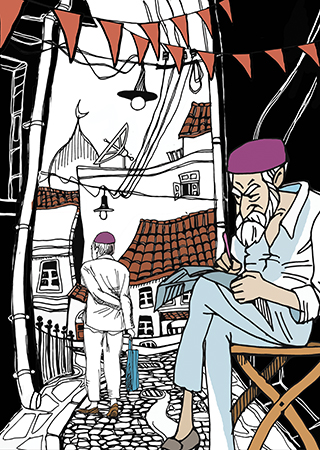
Illustration by Farzana Cooper
The Second World War was the inflection point. Earlier, the Great Depression had knocked the world economy out of shape. Runaway inflation was the new reality. There were no savings to speak of. Food became scarce on the dining table. It was fine to be Spartan, but another to starve. The young people of Navsari decided to migrate to Bombay in search of jobs. Between the late ’30s and the early ’50s, every Parsi moholla was rendered bereft of its youth. Aged parents soon followed to look after the grandchildren to enable young couples to go out and earn. After centuries, houses came to be locked, fell into disrepair and were ultimately sold to other communities. The vads (neighborhoods) retained their Parsi names but not their Parsi inhabitants. Parsipanu evaporated under the glare of time.
India’s independence was another turning point. Between the British rulers and the supine Gaekwads, the Parsis of Navsari felt comfortable. Overnight almost, there was a new dispensation to be dealt with. Pancham George (George V) and his successor George VI were replaced by the much detested Morarji Desai. The comfort zone fast dissipated. In the baugs and colonies of Bombay they felt more secure with their own ilk instead of having non-Parsi neighbors cheek by jowl in deserted Navsari.
The few who were very rich or the very poor remained behind. Marrying cousins feverishly had hastened the demographic decline. Yesterday’s neighbors were country cousins left behind, staring vacuously at a world that had changed. Every passing year spelt the death knell of Parsi Navsari. Rutty Mansion became Raziya Manzil. The bells of Ushain gah from the most ancient Vadi Dar-e-Meher in Dastur Vad were drowned in the cacophony of C-class Bollywood music. The once proud body language of the Navsari Parsis was replaced by the diffidence of the few, apologetic about their existence. The gorgeous Atash Behram is perhaps the only remnant of a glorious heritage.
Is it too late to create a Navsari Parsi "village,” as a world heritage site, on the lines of Udvada? One could buy land over the 200 meters circumference around the Atash Behram, if some philanthropist chips in with Rs 200 crores or so.
Gulzar, the famed lyricist, has captured the poignancy of a similar situation in a ghazal: "Chhod aayé hum, woh galiyan /Jahan téri édi sé/Dhoop uda karti thi/Suna hai oos chaukhat pé/Ab shaam raha karti hai (We left behind those mohollas where once upon a time sunlight used to glisten from your dainty heels. We now hear that only a gloomy evening lingers on the doorstep).”
Berjis Desai, author of Oh! Those Parsis and The Bawaji, occasionally practices law.
(Navsari Tales concludes with this column. Berjis Desai will hopefully reappear with a new column for Parsiana readers — editors)
◆ ◆ ◆
One reader wrote
This is one of the most evocative things I have ever read in Parsiana. Now that Navsari is nearly emptied of Parsis, is it Bombay's/Mumbai's turn next? Alas, the problem with the sugar in milk story is that eventually sugar disappears in the milk.
From the archive