
Zoroastrians Abroad
The deft dean
"We think that when we make a discovery, we’ve answered a question; but almost always what we’ve done is posed a new question,” commented astrophysicist Nergis Mavalvala, the first woman to serve as dean at the prestigious Massachusetts Institute of Technology (MIT) School of Science. The Curtis and Kathleen Marble Professor of Astrophysics who is renowned for her pioneering work in gravitational-wave detection expected her new role from September 1, 2020 to offer "opportunities to make an important and hopefully lasting impact,” according to a communication from the MIT News Office.
Commending her "brilliance as a researcher and educator,” MIT president L. Rafael Reif stated, "She is a deft, collaborative problem solver, a wise and generous colleague, an incomparable mentor, and a champion for inclusive excellence. As we prepare for the start of this most unusual academic year, it gives me great comfort to know that the School of Science will remain in such capable hands.” Provost Martin Schmidt valued her "unerring sense of scientific opportunity, infectious curiosity, down-to-earth manner and practical wisdom.”
Commending her "brilliance as a researcher and educator,” MIT president L. Rafael Reif stated, "She is a deft, collaborative problem solver, a wise and generous colleague, an incomparable mentor, and a champion for inclusive excellence. As we prepare for the start of this most unusual academic year, it gives me great comfort to know that the School of Science will remain in such capable hands.” Provost Martin Schmidt valued her "unerring sense of scientific opportunity, infectious curiosity, down-to-earth manner and practical wisdom.”
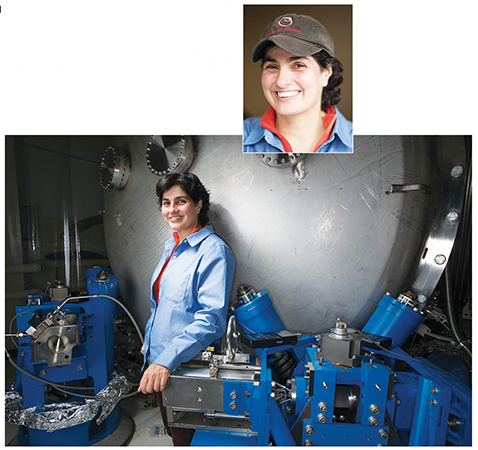
Above (and inset): Nergis Mavalvala researching gravitational waves at MIT Photo: Bryce Vickmark
The six departments in the School – biology, brain and cognitive sciences, chemistry, earth, atmospheric and planetary sciences, mathematics and physics – "are consistently rated among the best in the world,” according to the website science.mit.edu. Approximately 275 faculty members guide 1,200 graduate students, 800 undergraduate majors, and comparable numbers of postdoctoral researchers and research staff at the School of Science. "MIT is one of the top places in the world for doing cutting-edge science, and we will continue to maintain that eminence. At the same time, we also have to push on issues of diversity, issues of racial and social justice, and of work-life balance,” maintains the scientist.
As associate head of the physics department for the preceding five years she was involved in the department’s academic programing, student well-being and the digital learning portfolio. She has also been given credit for co-founding the Physics Values Committee that developed the first values statement to advise the department on issues of well-being, respect, inclusion, collaboration and mentorship.
The astrophysicist was elected to the National Academy of Sciences in 2017, the same year the Carnegie Corporation of New York honored her as a "Great Immigrant.” An openly queer woman scientist of color, in 2014, the National Organization of Gay and Lesbian Scientists and Technical Professionals recognized her as the LGBTQ+ Scientist of the year.
"There’s this idea at places like MIT that to be as excellent as we are in science and education, that has to come at the cost of all other aspects of being human. I reject that idea. So part of what I’d like to do, and part of my vision of a better MIT, is to find ways for those things to coexist, in good balance,” declared Mavalvala who is a parent of two children.
Daughter of Minoo and Meher Mavalvala, in an earlier correspondence with Parsiana Nergis appreciated that "I grew up in a family where the stereotypical gender roles were not really observed (see "Creating waves,” Zoroastrians Abroad, Parsiana, March 7, 2016).” Nergis’ early education was in Karachi before she proceeded to the US to pursue science. At Wellesley College, she earned a bachelor’s degree in physics and astronomy, before moving to MIT in 1990, where she pursued a PhD in physics. After five years at Caltech where she studied the cosmic microwave background, she returned to MIT in 2002 to join the faculty as assistant professor of physics.
◆ ◆ ◆
From the archive