
Zoroastrians Abroad
Waves of research
The ‘genius grant,’ as the $ 500,000 coveted MacArthur Fellowship has come to be recognized, was conferred on MIT (Massachusetts Institute of Technology) astrophysicist Nergis Mavalvala in September 2010. She is among the 23 recipients selected for the 2010 award, the others including a stone carver, a jazz pianist, a high school physics teacher, a marine biologist, a theater director, an American historian, a fiction writer, an eco-nomist and a compu- ter security scientist. "They are explorers and risk takers, contributing to their fields and to society in innovative, impactful ways. They provide us all with inspiration and hope for the future,” noted a press statement by MacArthur president Robert Gallucci.
The no-strings attached award that will be received over the next five years can be used for "speculative, risky, flat-out ideas that would otherwise be hard to get funding for,” an excited Mavalvala told Sunita Sohrabji of India West. When she received a call in mid September from MacArthur Fellows Program director Daniel Socolow, Mavalvala initially thought it was a hoax until she received 200 congratulatory e-mails 10 days later.
A professor in the MIT’s department of physics beginning last year, Mavalvala has been associated with the Institute since 1997 when she did her PhD in physics. Over the years she has been direct supervisor to over 10 doctoral graduate students and three postdoctoral scholars.
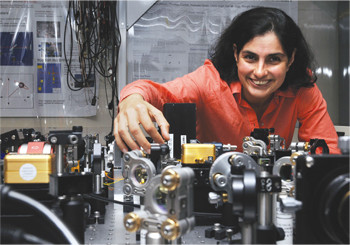
Nergis Mavalvala: keen to unravel the mysteries of nature
Her field of specialization being gravitational waves which can penetrate regions of space which light or electromagnetic waves cannot, Mavalvala declares on her blog, "Presently our knowledge of the universe comes from observing the light that is radiated by stars; from the spectacular light shows that accompany the explosive births and deaths of stars; and ancient light from the Big Bang itself. But light may not be the only messenger to carry the secrets of the distant universe to us. Many of these spectacular events also emit another kind of radiation known as gravitational waves… (that) are ripples in the fabric of space and time that were predicted to exist by Einstein in 1916. They are very faint, however, and have never been directly observed… Directly detecting gravitational waves will open a new window to further our understanding of the Universe… tell us about black holes that gobble up light but radiate gravitational waves, and about the earliest moments after the Big Bang…
"My work involves making instruments called interferometers that are sensitive enough to detect gravitational waves… I’m one of a team of several hundred talented scientists around the world who contribute to the LIGO (Laser Interferometer Gravitational-wave Observatory) effort… My work has involved designing and perfecting different parts of this complicated instrument (2.5 miles long using laser beams)… Over the years as the LIGO detectors have become increasingly more sensitive… the very basic laws of quantum mechanics have become an impediment… This problem has fascinated me almost as much as the quest for the elusive gravitational wave itself. So this leads me to the second part of my work: quantum measurement science (and art!). I lead a group of scientists exploring how quantum mechanics limits the performance of the LIGO detectors…”
Born in Karachi to Minoo and Meher Mavalvala (who now live in Vancouver) Nergis credits her parents for recognizing her ability in math and science when still young. She also acknowledges the inspiration she received from her physics and chemistry teachers at the Convent of Jesus and Mary High School in Karachi. Since advanced biology meant dissecting an animal, "I knew I couldn’t do that so I quickly moved to the physical sciences,” she told India West. From Wellesley College she graduated in physics and astronomy when she was conferred the Phyllis Fleming Award for excellence in physics. Spenta Kandawalla who is the Wellesley College’s admission representative for Pakistan vividly recalled interviewing the teenager in 1985 when she "stood out as an incredibly engaging, bright and focused young woman, consumed by her passion for physics,” noted a write-up in the November 2010 issue of What’s on, the newsletter of the Karachi Zarthosti Banu Mandal. Her elder sister Mahrukh who also studied physics is now an actuary living in Seattle. Nergis lives in Arlington, Massachusetts, with her partner Aida Khan and two-year-old son Evren, notes the India West article.
Among the other honors that have come Mavalvala’s way in the last 10 years, according to her curriculum vitae, are the Edgerton award for faculty achievement from MIT, the John de Laeter medal from the Australian Institute of Physics, the Sloan Foundation Fellowship and the Cecil and Ida Green Career Development Chair. Besides contributing papers in science publications, Mavalvala gives public lectures on gravitational waves and quantum optics, and participates in teacher education outreach activities, notes her curriculum vitae.
◆ ◆ ◆
From the archive