
Connect and correct
At the World Zarathushti Chamber of Commerce global conclave speakers urged the delegates to pursue values and activities conducive to growth
Besides giving the country "outstanding businessmen and professionals, we have shared our humor, our food, our way of dressing and even our eccentricity… We believe in truth, compassion and value nature in all its elements. This is why we are liked and adored by all the citizens of the world. Let us not spoil this image. Though we have dwindled in numbers we are still a force to reckon with,” he stressed.
"Stop infighting and focus on real issues facing our community. Stop this groupism of orthodox and liberals. Let us be one united community doing what is best for the survival of our religion. Marry within the community and have more than two children. Consider this as a religious duty… Our community is at a very critical stage. If we don’t act now, all will be lost… While educating the mind of our youth you need to educate their hearts. Remember none can destroy the iron, only its own rust can. In the same way none can destroy our community, only we can,” he cautioned.
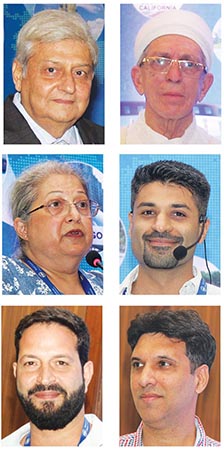
The morning program on January 3 included a brief religious address by Dastur Keki Ravji Meherjirana, an overview of the social welfare activities undertaken by Kinder Trust under the stewardship of its managing trustee Diana Bharucha, an inspirational talk by habit coach Ashdin Doctor and experiences shared by three entrepreneurs who were sanctioned loans between five and 25 lakh rupees by WZCC.
Relevance of religion
Honesty and integrity stems from our practice of religion in our daily life, stated Ravji Meherjirana when addressing the delegates on "Relevance of Religion in Business.” Life without prayer is meaningless, said the Navsari High Priest who has initiated hundreds of boys into priesthood. Atash is the son of God. The sacred fire venerated as the Iranshah in Udvada was consecrated by priests from Iran. The fire was not brought from Iran, clarified Meherjirana.
Spread goodness in the geti material world as also the minoi spiritual world, he urged. The Zoroastrian religion that advocates righteousness requires us to earn our money well; not through gambling or racing. A code of morality and ethics to guide our behavior directs us to speak the truth, keep away from the company of immoral humans, help the needy and bring happiness to others.
Parsi thy name is charity, liberty, honesty, peace and prosperity, stressed the dastur.
Kinder aids kindred
Describing herself as "an activist by circumstances,” Bharucha shared a video of the meaningful initiatives undertaken by Kinder Trust to help the underprivileged residing in the hamlets in the Niligiris. They have introduced transport for children with special needs to enable them to reach the government daycare center. Additionally they run their medical aid, off-to-school and environment improvement programs. One young Parsi social entrepreneur too was assisted by them. Skills development and vocational development have been encouraged by Bharucha who is a fashion designer by qualification and an entrepreneur by profession. She ran a garment manufacturing and export company for 34 years giving direct employment to 150 people and indirect employment to over 500. For a while she also ran a chocolate manufacturing unit.
During the 2018 floods that ravaged Kerala, Kinder Trust came to the succor of many who were displaced. Farmers who have lost their land are introduced to the Nectar Flow project. "Increasing the bee population helps humankind to survive,” she said. Kinder Trust also runs programs to help people understand the government initiatives they can access.
Confirming that "WZCC membership is very beneficial,” she referred to the regular support they have been receiving from the World Zoroastrian Organisation Trust and Eskay Industries. She appealed for sponsorship at the rate of Rs 1,500 a day for their off-to-school project.
Way to wellness
"Have an alarm to go to sleep instead of a wake-up alarm,” advocated Doctor who in his presentation on "Wellness Micro Habits” urged the Parsi gathering to change their lifestyle to emerge healthier and stronger. "Five years ago I was gol-matol (round and fat), working 17 hours a day with no thought of caring for my health,” revealed Doctor who runs a business, Awesome 180, creates habit coaching podcasts and conducts wellness habit workshops. He was in his early thirties readying for work one morning when he started sweating profusely and collapsed.
Treating this as a cue to reassess his priorities, he set out to change his habits – the small actions done repeatedly, their impact compounding over time. It usually takes 21 days to cultivate a new habit, said Doctor, giving "three golden rules” to facilitate an improvement: make the change as tiny as possible; make it so easy you would feel it is stupid; never miss two days in a row.
Wellness, he stressed, is living "in a state of ease and not disease… getting up in the morning full of excitement… having energy at the end of a tiring day to talk or play with a child.” Each of us has four energy tanks: physical, intellectual, emotional and spiritual (PIES). We have use for different energies at different times in life. If there is a leak in a fuel tank, we plug the leak instead of adding fuel. So also when there is a leak in any of the PIES tanks, we need to stop doing things harming us and fill fuel that would help us to grow and thrive. Filling fuel in the wrong tank can be harmful. In case of an emotional conflict, we often tend to fill the physical tank by eating cake and ice cream that is not healthy.
Those low on physical energy tend to feel tired, sluggish, sleepy, out of breath and complain of aches and pains. Physical energy is drained if we eat wrong foods and there is lack of movement in our lives. The body thrives on movement. A hunched posture makes breathing difficult. He encouraged everyone to heave a big sigh by taking one long deep breath and releasing with an "aah.” Stand up and bounce for 10 seconds on your toes, was his next command to the audience. Since chairs tend to drain us, he advocated three minutes of physical movement in the form of stretch and bounce every hour. "A big advocate of intermittent fasting” (after 16 hours of fasting, food is consumed for eight hours in a day) to permit fat stored in the body to be used instead of being replenished, he pointed out that humans tend to confuse thirst for hunger. Boredom and stress are frequently erroneously interpreted as hunger signals. He felt the Japanese practice of stopping food intake when one is 80% full is a healthy habit. While not everyone needs eight hours of sleep, deep, qualitative sleep is necessary to feel refreshed.
To make optimum use of one’s intellectual energy he recommended focusing or concentrating on what is going on in the mind. To draw power from intellectual energy, task switching is more effective than multitasking. Alternate between problem solving and mundane activities, exciting and boring tasks. Arguing at work and worrying that you are not doing enough can be draining. Take regular breaks. Instead of leaving email and WhatsApp notifications on throughout the day, he recommended chunking, to check messages only three times a day. To improve productivity he suggested that creative work should be finished in the morning. The afternoons, when one is sluggish, should be used to respond to messages. Learning a new language or a musical instrument is intellectually stimulating.
Half of our stress arises from unanswered emotions. Feel pain instead of trying to hide or numb it. Don’t try to run away from emotions or fight them; experience them, he recommended. Scrolling on Instagram, spending excessive time on social media, phone addiction, unclear relations, fear of failure, fear of missing out (FOMO) are all emotional vampires that can suck you dry of your energy. Better alternatives are deep, meaningful conversations, solitude to experience calmness or gratitude. "Every month be grateful to three different people,” he recommended.
Spiritual energy is outside of oneself. Working for a nongovernmental organization makes you feel life is worth living. Graceful acceptance of one’s circumstances with understanding and compassion resonates with spiritual energy.
Emerging entrepreneurs
Of the six entrepreneurs funded under the WZCC Initiative, Cyrus Pithavala and Cyrus Mistry attended the global conclave to give five-minute presentations on their ventures. Pithavala spoke of his experience at the Hazira Container Yard, 30 km from Surat, offering a one-stop solution for all shipping container handling requirements including logistics, storage and repair. In this business where "capital investment is high,” the loan extended by WZCC enabled Pithavala to expand phenomenally by reinvesting profits in machinery.
Partner of Eco Smart Jewelry, made from lab-grown diamonds, Mistry explained that the nascent business "is like a test tube baby.” Diamonds are simulated in a laboratory instead of mining natural resources below the earth. While the properties of lab-grown and natural diamonds appear to be the same, the advantages of lab-grown diamonds are low cost, no damage to mother earth and faster to make, he stated. According to him, "USA is accepting lab-grown diamonds in a big way. We need to educate Indians.”
The third recipient of the WZCC loan, Urvakhsha Tavadia, who is involved in the manufacture and marketing of Vruzend solderless battery kits sent a two-minute video to explain his venture. His lithium ion battery packs are meant for e-vehicles like electrical bikes and motor rickshaws.
In the corridor outside the Grand Oak Banquet Room, delegates spent time appreciating and purchasing from the array of Eco Smart Jewelry. On another table, delectable goodies and knickknacks from Kinder Trust had found encouraging patrons. Also on sale were copies of From Leapfrogging to Pole-vaulting: Creating the Magic of Radical yet Sustainable Transformation, co-authored by Raghunath Mashelkar, who was the chief guest at the WZCC awards function the following day. Yet another table displayed literature published by Zoroastrians from North America that reflected the community’s emphasis on religious education.
To be continued