
Thoughts for food – II
The second day of The K. R. Cama Oriental Institute’s annual seminar provided a scenario for the future of food in the country
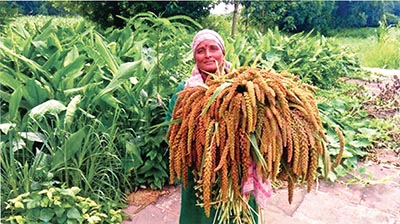
Millets: Forgotten foods and foods of the future Photo: Drona Chetri/The K. R. Cama Oriental Institute (KRCOI)
"Why are all these dishes that combine vegetables with meat or fish not popular? You do not see them on menus of major eateries,” Doctor commented. Anyway, restaurateurs would be unsure whether to place them in the vegetarian section or the non-vegetarian sections of their menus, he opined. "Semi-vegetarian food is seen as food of the poor,” Doctor stated. (A few Parsis in the audience reminded him later about the bheeda ma gos, masoor ma gos and guvarsing ma kolmi that some community members are partial to!) There are very few publications about the cuisine of the Dalits, he said.
Semi-vegetarian dishes are slowly vanishing from India, said Doctor who hosts a podcast and also blogs about food. These dishes "are not vegetarian enough for vegetarians who demand purity (perhaps for religious or health reasons) and not non-vegetarian enough for non-vegetarians,” he quipped. Even home cooks are dwindling, as older family members who "valued such food are cooking less.” Eating meat or fish with greens is sustainable and nutritionally balanced, he said.
"A tattered cloak patched together by institutional power and poor taste” is Dr Krishnendu Ray’s analogy for what passes for "national cuisine” today. The sociologist and chair of the department of nutrition and food studies at New York University talking on "The Cultural Politics of Taste,” stated that good food can be local, regional or vernacular. "Even better if (its) provenance is far away from the heartland… in the nooks and crannies…and margins of the subcontinent.” Punjabi food, for instance, is closer to food eaten in Pakistan than it is to dishes from eastern India; Bengali food has more in common with that of neighboring Bangladesh than that of Gujarat. The rice wines of Orissa feature nowhere on our national stage, he bemoaned. Emphasizing how spices from the coasts of India are popular overseas, he referred to the humble curry leaf that features in Cambodian cuisine, roasted and made into soup, and how Malay and Burmese cuisines draw from Indian food.
"It is now expected that nations have cuisines as they would have flags or anthems…Is this necessary?” queried Ray, stating that taste was best left to the individuals, and not to Western philosophers who have "denied legitimacy to taste on the tongue while theorizing on taste in general.”
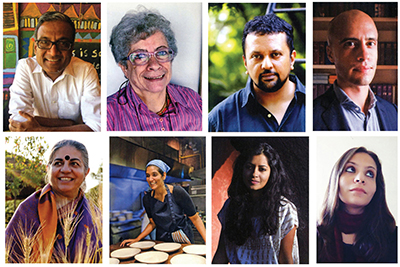
"Food has gone from being a footnote to the front page,” quipped Siegel. Available literature on food in India today can be bucketed into four areas: that dealing with aesthetics, tastes and senses; technologies of food preparation and consumption patterns; human welfare; agricultural production. No material is available on the growing divide between producers of food and its consumers.
Siegel wrote the conference theme paper "The Past and Future of Food on the Indian Subcontinent: Identity and Cultural Heritage” with journalist Khorshed Deboo.
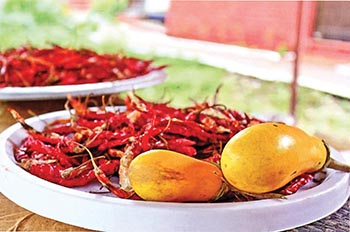
How we rank
Siegel provided sobering thoughts: India is placed just ahead of Zimbabwe and North Korea on the Global Hunger Index; countrymen are spending less on food, as per reports of the National Sample Survey Organisation; the Global Food Security Index states that India has failed to invest adequately in fundamental agricultural research.
Food sovereignty advocate, activist and founder of Navdanya, a native seed bank, Dr Vandana Shiva also had more sobering thoughts: every fourth Indian is hungry and half of our children are malnourished; most chemical pesticides that are in use in the country are derived from gases used to murder Jews in the Third Reich; most herbicides are derived from defoliant Agent Orange used by the USA during the Vietnam war to defoliate densely jungled areas. "We used to have about 10,000 species of edible plants in the country… Why are they so few now?” asked Shiva. The country is seeing high levels of diabetic disorders. "This is the background in which we have to feed 1.5 billion people.”
Hunger is growing in the country today due to poor distribution systems, claimed Shiva. Farm outputs are not accurately measured. The metrics are based on sales value, ignoring losses in production, transit and in local markets. "We had affordable food with farmers getting just prices” in the early years after Independence. "It was not the best as it was rice and wheat based, but it served its purpose.”
Shiva, who has spoken and written extensively on multinationals like Cargill and Monsanto in the food industry, said that their attitude was "God Move Over.” She was playing on the acronym GMO (Genetically Modified Organism) that both companies are proponents of. Get over the "everything we have is inferior attitude,” and look towards India’s indigenous produce for nutrition, was her message.
While Shiva provided a touch of the here-and-now in the area of food, independent scholar and ex professor of archeology and ancient history at Jawaharlal Nehru University, Prof Shereen Ratnagar provided a perspective on the evolution of agriculture. In her talk "The Plants We Grow,” she stated that the earliest known agriculturists were in Anatolia (Turkey) and the Levant. Early farmers then moved towards Egypt and eastwards towards what is now Iran and Baluchistan. Rice and wheat were staples of the Harappan civilization. "There could have been some local crops too, but this is not verified,” she said. Agriculture needed people to live closer to their fields and also preserve their produce for lean months, hence hunting-gathering became less important. Food producing groups create their own economy: they made improvements to habited areas, planted trees for shade, and also built fences. Granaries in Mesopotamia which were attached to temples provided food to craftsmen and tradesmen. This marked the start of the dependence on agriculture to fuel economies.
While it is generally believed that millets came to India from Africa, Ratnagar said that "we may have to change our mind about its origin… There is no documented trade route.” Together with bulk cereals like rice, wheat, barley and maize, smaller grained millets and legumes too were included in the diets of prehistoric and also the historic periods, she stated. Given the scenario that Indian soil is losing its top cover in many areas, and given the acquisition of land by some "by unscrupulous means,” the country needs to rely more on millets and legumes. "Millets tolerate infertile soil…drought, grow fast and intercrop well with others…are not labor intensive,” explained the academician.
Amrita Gupta of the Agroecology Fund, a grant making organization that supports grass root movements globally, provided examples of how local communities can help sustain themselves with ecologically sustainable cropping through informal cooperation. "Today’s industrial food system impacts food sovereignty and biodiversity,” she stated. The minutiae on her detailed charts that Gupta used for most of her session unfortunately were not visible beyond the third row of the audience. Millets are now being grown in the Himalayan region thanks to Agroecology’s partners educating local farmers. The session on the talks by Shiva and Gupta were chaired by Kumud Dadlani, "part-time food writer and full-time farmers’ rights advocate.”
"We need a new kind of satyagrah” to liberate ourselves from multinational corporations that are engaged in genetic modification of crops, noted Shiva while wrapping up her session.
Concluded