
Books
Reflections on recipes
Cuisine for a Cause. Celebrating Parsi Recipes and Philanthropy compiled by Meher Gandevia-Billimoria and Noshir Dadrawala. Published in 2012 by Centre for Advancement of Philanthropy, Mulla House, 51, M. G. Road, Flora Fountain, Bombay 400001. Pp: ix + 262. Price: Rs 1,000.
It is probably going to sound rude to suggest that Cuisine for a Cause, a book that celebrates Parsi food and philanthropy, might have made for a better calendar. But really no insult is intended because calendars can have real value beyond the most functional one of telling you the date.
A good calendar is a companion through the year, something you will look at far more often than you would a book. The image for the month can be informative and leave a lasting impression. I remember many years ago when Parsiana was just launched it created a calendar with drawings of the statues that commemorated famous Parsis of this city, and I often remember it when I pass some of them, still standing dignified despite their pigeon stains.
Many of the subjects of this book deserve maybe not pigeon stains, but certainly a month up on our desks or walls to remind us of the excellent work they do (of course, some also produce excellent calendars of their own, like Welfare of Stray Dogs’ charming one featuring Bombay’s mongrels). A calendar would also have suited the culinary side of the book too. Food fits very well with calendars since recipes can be chosen to reflect the foods in season each month. Kalnir-nay, the calendar-almanac-magazine that may be the highest selling Indian publication always has recipes at the back of the page for each month.
But the compilors — Meher Gandevia-Billimoria and Noshir Dadrawala — have chosen to make this a book, not a calendar, and a beautifully designed and printed book it is too. It strikes me that it could hardly have been cheap to produce, and while it has been sponsored by a corporate trust and a company that makes steam engines, I wonder if it is really going to find many takers at Rs 1,000, no matter how good the cause, for what is something in between a charity brochure and a coffee table book.
But the finances and purposes of the non-profit sector are largely a mystery to me, and presumably they are not for the Centre for Advancement of Philanthropy which has produced the book. Perhaps the book will sell a lot. Perhaps such books are the way to people’s wallets. For the sake of the many excellent causes and admirable people covered by this book, I certainly hope so.
I rather doubt that many people will buy it for the recipes, and the price tag is just part of it. Kitchens tend to be practical places, with little space for a book where it’s not easy immediately locating a recipe. Because there’s no overall index, just lists of contents for each section, you have to keep flipping through it, past all the NGO (nongovernmental organization) profiles, to get to the Ratan Tata Institute’s recipe for kid gosh (mutton cooked with almonds and cashew nuts) or the recipe for bhaaji ma marghi (chicken in spinach) that dancer Astad Deboo borrowed from his sister.
To be fair, this disdain for the index is a common failing with fancy cookbooks and it is a pity the publishers didn’t take a lesson from one of the organizations they cover, the Time and Talents Club, whose formidable (and well-indexed) cookbook is an excellent example on how to produce something really useful for a charitable cause. The few lines that Cuisine for a Cause gives on how the Time and Talents Club started, along with their recipe for sas ni macchi (fish in a piquant white sauce), are interesting and perhaps one could have learned more, if this book was more focused on being a guide to NGOs, or a cookbook, instead of being neither this nor that.
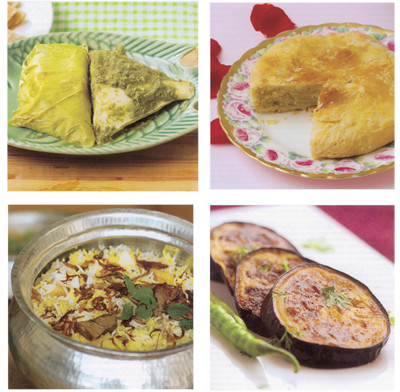
Variety spread (clockwise from top left): Patra ni machhi, dar ni pori, vengna ni kaatri and gosh no pulav
Cuisine for a Cause does have some culinary value. I had wondered what there was left to say about Parsi cooking, since this is one community that has been well served by cookbooks. From the Time and Talents cookbook, which is as much about cosmopolitan Bombay to Katy Dalal’s Parsi village recipes in her second Jamva Chaloji book (her instruction to take seven bottles toddy, should be on the sweeter side, for Tadi-no-Batervo is probably the recipe I would most like to make someday) to My Bombay Kitchen, Niloufer Ichaporia King’s brilliant recollections of her life and the recipes in it, to the Zoroastrian Stree Mandal’s pleasantly homely cookbook (sold from the Parsiana Book Club), most ground would seem to have been covered.
But Cuisine for a Cause brings in an important new element — the Parsi caterers who produce such fabulous lagan nu bhonus. The last and best section in the book interviews three of the most famous ones, Kaizad Patel, Kurush Dalal and Tanaz Godiwalla. Caterers tend to be cagy about sharing their secrets, but perhaps the charitable nature of this book persuaded them to part with a few — Patel’s bhujeli kaleji, Dalal’s dahi kesar ma marghi and Godiwalla’s sali boti.
They also share stories and interesting information, like Dalal’s point that today’s wedding menu is a relatively recent development, and in the past it was more likely to feature two types of mutton — khattu gosh and bhajidana ma gosh. This section suggests how there is still a fascinating book to be done on the customs and cooking of the food served at Parsi community occasions, and perhaps someone could take it up, for charitable reasons or otherwise.
VIKRAM DOCTOR
◆ ◆ ◆
From the archive