
Bawa Musings
Ghaas phoos can be tasty
It’s a myth that Parsi vegetarian fare is not delicious
Woe betide the vegetarian diner at a Parsi wedding who spurns the ‘Gujarati’ thali and opts for what is almost contemptuously called paréji (literally, food for a person having multiple dietary restrictions or undergoing penance). The server will dump on his patru a medley of lesser vegetables like okra (lady finger), aubergine (brinjal), cauliflower and potatoes from battered aluminum utensils.
These poor veggies look semi-boiled, dull and suddenly ‘surprised.’ They taste like gooey mash; eminently qualifying as a hospital dietician’s recommendation for a patient suffering from multiple organ failure. Some vegan NRI (non-resident Indian) from Los Angeles would then ask the server, "No mushrooms, broccoli, asparagus or water chestnuts?” The server, laden with illicit hooch would give her a smile reserved for idiots. This paréji must be singularly responsible for the myth that Parsis cannot conjure up delicious vegetarian fare.
These poor veggies look semi-boiled, dull and suddenly ‘surprised.’ They taste like gooey mash; eminently qualifying as a hospital dietician’s recommendation for a patient suffering from multiple organ failure. Some vegan NRI (non-resident Indian) from Los Angeles would then ask the server, "No mushrooms, broccoli, asparagus or water chestnuts?” The server, laden with illicit hooch would give her a smile reserved for idiots. This paréji must be singularly responsible for the myth that Parsis cannot conjure up delicious vegetarian fare.
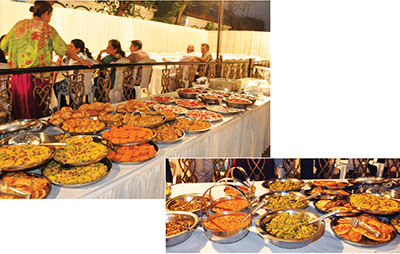
Vegetarian meals ready to serve
In the olden days, a Parsi vegetarian was an anthropological rarity. You had to be a Theosophist or an Ilm-e-Khshnoomist or a Pundolite (followers of a self styled guru called Minocher Pundole who forbade them from eating flesh, lest it corroded their etheric bodies; though Pundole himself savored mutton dhansak, since he purportedly possessed a superior etheric body) or a member of the almost defunct Parsi Vegetarian and Temperance Society (whose founders were labelled as lunatics, more for their abjuring booze than meat). These days, of course, there are lots of ‘out-of-choice’ Parsi vegetarians, like your columnist. The rest of the farcha munching, lobster grabbing Parsis look upon Parsi vegetarians as poor sods who do not know what they are missing. It is like having Marilyn Monroe as your wife and remaining celibate. The reality is, that Parsi vegetarians can have a ball.
You need not enviously watch your brethren enjoy the Sunday dhansak. The same light brown rice, garnished with crimson fried onions, and the same tomato chilly kachumbar, and the same thick brown dal, a perfect mixture of aubergines, tomatoes and ground spices. Only those meat balls will be replaced by soya chunks — never to be overboiled, marinated in curd overnight or dunked in the dal. Many a gourmet will fail to single out these imposter meat balls. What about the mutton kebabs though, snorts the carnivore. Sooran (yam) comes to the rescue of the Parsi abstainers. Soft boiled sooran is soaked in pure ghee and mixed with lime and ginger paste in a grinder; then placed in little cups of potato mash, rolled into balls, dipped in whipped egg and rava (semolina) and then fried or grilled. Blindfold the mutton lover and see him fooled by the transformed yam. Similarly, try and distinguish mutton kheema from nutrella nuggets run through a liquidizer, its inadequacies cured by a deft application of the magical vaghaar (tadka) comprising of diced onion, tomatoes, green and red chilies, ginger and garlic paste, sauted in desi ghee (according to Ayurveda it actually unclogs blocked arteries).
The lowly papdi (Indian flat beans) have their Cinderella moment when mixed with tiny soya kebabs and simmered on slow heat, to preserve their essential juices and flavor. Onion rings soaked in vinegar, mixed rice and jowar flour whitish chappatis and methiya nu achaar (mango fenugreek pickle) are its critical accompaniments, for a veritable vegetarian feast.
Most Parsi vegetarians are eggetarians. Thinly sliced potato diamonds, slapped with yellow haldi (turmeric) and red mirchi powder, packed in a pan. Greatly whipped eggs with a little cream are then gently poured over the potatoes — some of it percolating to the bottom of the pan, which is lightly oiled, to avoid sticking. The resulting papeta per eedu is to be eaten with thick, ghee laden, multi layered wheat rotlis and gor keri nu achaar (sweet mango pickle). Perhaps, a thin fried papad too (though strangely, we are told by those who do colon wash that undigested papads remain in the dark corners of the intestines for decades, as they are most difficult to digest).
Titori dal (sprouted averakai), harvested during the winter months and soaked overnight in water, made slightly (not overtly) sweet and sour, by tamarind and jaggery paste is an outstanding Parsi vegetarian delicacy. Some prefer its subtle pungent and astringent taste. Never to be mashed up, like other dals, each seed to remain clearly intact, when serving. Lovingly simmered over a very low flame, with a dash of coconut milk, and garnished with fresh coriander. The same accompaniments as the papdi.
Large brinjals sliced into circular rings are marinated in multi spice paste and a little vinegar, and then lightly fried, to retain the softness of the flesh which melts on the palate. Some embellish it with eggs, à la papeta per eedu, converting the oft detested vegetables into the rather lurid sounding vengna per eedu, but tasting divine. Many a brinjal hating Parsi can be converted by its spruced up avatar.
Vegetarian Parsis retain their genetic penchant for non-vegetarian fare and secretly yearn for its allegedly superior taste; say our carnivorous friends. May be so. Simulated kheema patty, undistinguishable mock frankies and other delicacies conjured by the intelligent use of soya and egg, masked with hot spices will satisfy their taste buds and yet make them feel superior, as not participating in consuming our animal friends, who are evolving into the next humanity and are our brothers in evolution, according to the Theosophists.
Berjis M. Desai, senior partner of J. Sagar Associates, advocates and solicitors, is a writer and community activist.
◆ ◆ ◆
From the archive