
Zoroastrians Abroad
Vigil against violence
"Until government officials, service providers and citizens come together… we will all remain bystanders to violence against girls and women, and they will continue to face unimaginable risks, their access to economic and social opportunities will be limited and their full participation in society will be undermined,” commented Sia Nowrojee when introducing her report, "Working Together for Girls’ and Women’s Safety in Public Spaces: Lessons from India.” Serving as program director of the Washington DC-based 3D Program for Girls and Women which is working in partnership with local government, civil society and corporate social responsibility initiatives, Nowrojee had come to India for the release of her report on June 28, 2019 under the joint auspices of the Women’s Studies Center at the ILS Law College in Poona.
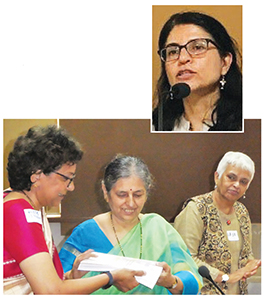
Inset: Sia Nowrojee; above,
from l: Geeta Rao Gupta,
Vaijayanti Joshi, Jaya Sagade
Photos: Vanessa Coello
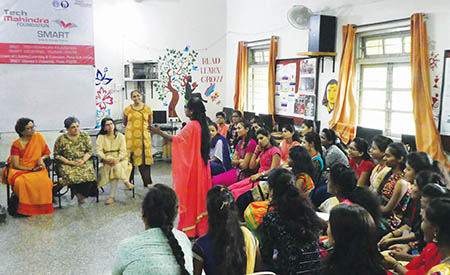
3D Program team interacting with rural girls from Poona
"This report on public safety was written for girls and women — those who have not survived the violence and those who do, who get up the next day and bravely step out into the world,” clarified Nowrojee. She has over 25 years of experience in international development. Her endeavors involve public policy, advocacy, training and capacity building, institutional strengthening and strategic communications with a focus on gender, reproductive and sexual health and rights, violence against girls and women. Prior to joining the 3D Program she was senior gender consultant with UNICEF (The United Nations Children’s Fund). Before that she served as senior technical writer and editor with agencies of the Aga Khan Development Network including the University of Central Asia and the Global Centre for Pluralism.
The report written jointly by Nowrojee and her colleague on the 3D Program Kalkidan Shebi is based on a review of over 425 documents on the literature and evidence on violence against women and girls, with a focus on public safety. Additionally 25 experts, advocates and implementers in Poona and across the world were consulted to determine innovative responses to prevent violence, safe urban spaces, violence against women in politics, mapping risk and accountability.
"The 3D Program advances gender equality and girls and women’s empowerment… We believe that girls and women are best served when traditional boundaries are crossed and the barriers of siloes (isolation) are broken so that stakeholders — including girls and women themselves — can come together to get things done. We call it good governance through convergent action,” notes their website www.the3Dprogram.org. Founded in 2017 by Geeta Rao Gupta who is the executive director, their team includes core staff in Washington DC where they are hosted by the United Nations Foundation, staff from the International Center for Research on Women and a pool of expert consultants. The 3D Program team believes in involving more ladies in the design, implementation, monitoring and evaluation of programs, filling the data gaps and training service providers.
In her subsequent email response to Parsiana, Nowrojee added, "There is no question that more needs to be done. India’s economic prosperity has not translated into economic and social wellbeing for girls and women. They still face horrific levels of violence in their homes and in public spaces. Girls drop out of secondary school at rates much higher than boys and continue to marry too early. Women’s participation in the formal workforce is actually dropping.” She considered herself privileged "to work closely with partners in local government, civil society and the private sector to improve services and increase opportunities for girls and women. A lot can be done with commitment and coordinated planning and execution.” She referred to a partnership with the district government or zilla parishad in Poona to ensure that planning committees take into account female perspectives and priorities. Further, the 3D Program worked with the nongovernmental organization MASUM, S.N.D.T. University in Poona and Tech Mahindra Foundation to implement a job skills training program for rural girls who tend to be overlooked.
The program director who is also co-chair of the Learning Working Group of the Movement for Community-Led Development has a Master of Social Services (Clinical) and a Bachelor of Arts in Sociology (Honors) from Bryn Mawr College in Pennsylvania. Daughter of teacher and author Villoo Nowrojee and human rights lawyer and author Pheroze Nowrojee, Sia states, "I have been an advocate for gender equality most of my life. Being a member of the Parsi community has meant that I have always been surrounded by strong women who are making a difference in the world, starting with my mother Villoo and my sister Binaifer (honored on the Gender Justice Legacy Wall at the International Criminal Court in The Hague, Netherlands). Additionally in my work with the 3D Program I have been privileged to interact with some incredible Parsi women, including Maja Daruwala of the Commonwealth Human Rights Initiative, our Program advisory committee member Rati Forbes of Forbes Marshall and Armene Modi of Ashta No Kai which runs programs for girls in rural Poona.”
Sia is married to Alex Boston who after two decades of public service in government including as director of homeless services for the City of Baltimore and stints in the US Foreign Service and Peace Corps works as a realtor in the Washington DC area, serving on community boards and commissions. They have two sons, 20-year-old Daraius who is studying mechanical engineering at the Worcester Polytechnic Institute in Massachusetts and 17-year-old Zorhan who is in his last year at George Mason High School. Both of them have been initiated as Zoroastrians. P. G.
◆ ◆ ◆
From the archive