
Learning from the Achemenians
The ancient Persian conquerors were more humane than their Greek counterparts
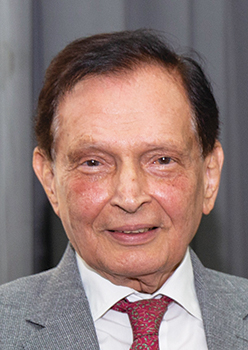 The Achemenians (550-330 BCE) "brought in universal peace in a universal state," noted the physician. While other vanquishers would raze large parts of conquered lands and enslave their peoples, the Achemenians "eschewed wanton cruelty." He narrated how Cyrus the Great spared the life of the famed wealthy King Croesus of Lydia after winning his territory in battle. "Just as Croesus was to be burned at the stake, the fire was extinguished by rain. Taking it as a sign, the emperor forgave Croesus." Moving on to Babylonia, the Persian annexed that kingdom too, but paid homage to their god Marduk.
"How could those labelled ‘decadent’ (by the Greeks) control so much of the then known world? The Greeks were equally expansionist," the doctor informed the packed-to-capacity Hall. The only thing lacking for the Achemenians was language. Their prose was "not as communicative as the Greek language... They had no Socrates, no Aristotle." While the Greeks wanted the Persians to be as democratic as they believed themselves to be, Udwadia pointed out that the Greeks lived only in a "sort-of" democracy. Women and slaves were considered inferior, as were the peoples of the many city-states that came into their fold, he stated. The Greco-Persian Wars (499-449 BCE) marked the first divide between the east and the west, according to Udwadia. "And it continued...observe the Crusades, the dismantling of the Ottoman Empire," the Suez Crisis down the ages, he explained.
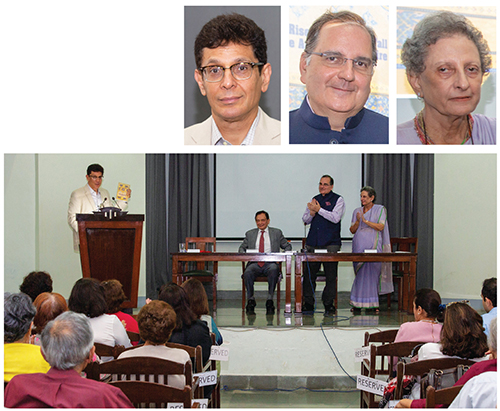
Amongst the many reasons ascribed to the downfall of the Empire were that the Persians were "too used to luxury... They never ‘Persianized’ their subjects... There were palace intrigues and crimes." The higher echelons were reserved only for Persians and this may have aroused animosity among the numerous non-Persians within the Empire, Udwadia noted. "All universal states are ephemeral...given their deformities, they implode from within," he noted. Quoting from poet Alfred Tennyson’s The Passing of Arthur, the doctor concluded with "The old order changeth, yielding place to new; And God fulfils himself in many ways, Lest one good custom should corrupt the world."
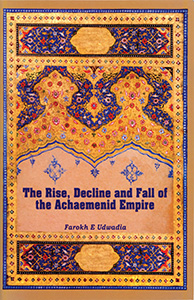 Senior counsel, former advocate general for Maharashtra and additional solicitor general of India, Darius Khambata, who presided over the evening’s function quoted novelist and playwright Walter Scott: "A lawyer without history or literature is a mechanic, a mere working mason; if he possesses some knowledge of these, he may venture to call himself an architect," as a preamble to describing Udwadia’s fondness of history, literature and music. The qualities of tolerance and generosity that the Achemenids showed are exemplary, according to Khambata. Cyrus the Great is said to have liberated the Hebrew captives in Babylon to resettle and rebuild Jerusalem, earning him an honored place in Judaism, "the only Gentile (non-Jew) referred to as the protector of the law," he narrated. The Jewish festival of Purim is believed to commemorate the saving of the Jewish people by King Xerxes’s Hebrew wife Queen Esther, from an Achemenid official who was planning to massacre the Jews. Udwadia’s book "does not attempt to tilt the readers in any way," stated Khambata. He describes two versions from recorded history, for instance, of Darius’s rise to the throne of Persia.
"Contrast the Achemenians’ tolerance with the anxiety of modern political leaders to demolish all that is different," said Khambata, referring to the massacre of Native Americans in the USA by early settlers, the destruction of the famed Russian palaces by the Bolsheviks and the Bamiyan Buddhas by the Taliban in Afghanistan. "This makes it all the more important to understand the Achemenians," he noted.
Pulmonologist Dr Zarir Udwadia who released his father’s booklet said he was "not sure" why he was asked to do this. Acknowledging the senior doctor’s "keenness of intellect," he called him a metaphysician — "one who touches one’s soul." Alluding to his father’s interests in music, art and ancient history, Zarir referred to the author as "all in all a Renaissance man." In his concluding remarks, Farokh, in a compliment to Zarir’s skills as a doctor said, "It’s time for me to say ‘I am the chip and you are the block.’"
Farokh is the only physician to be elected as honorary fellow of the Asiatic Society of Mumbai in 2018, notes the Foreword to the booklet by KRCOI president Muncherji Cama. Referring to his over 60 scientific papers and his nine books, Cama stated that the avid bibliophile of ancient history and its personalities "brought to bear his rich width of learning in the sumptuously illustrated public lecture (in 2016)."
In her welcome address, KRCOI honorary secretary Dr Nawaz Mody recalled that Farokh had delivered the centenary address on a similarly rainy day, and yet the Hall was full. Calling the lecture and the theme of the booklet unique, she said, "There is hardly any material available on this topic." Mody’s vote of thanks included KRCOI governing council member Burzine Waghmar for providing editorial support, and their printers Pramit Prints.