
“How can a mother die?”
The greatest influence on the poet and social reformer Behram Malabari was his mother
The following extract is reprinted from I am the Widow: An Intellectual Biography of Behramji Malabari with permission from the author, Harmony Siganporia, and the publishers, Orient Black Swan. The information on Malabari’s early life was gleaned from Dayaram Gidumal’s The Life and Life-Work of Behramji M. Malabari and R. P. Karkaria’s India, Forty Years of Reform and Progress, Being a Sketch of the Life and Times of Behramji M. Malabari.
Malabari (1853-1912) was a social reformer, poet and journalist. He championed the rights of Hindu women and successfully campaigned against child marriage amongst other social causes.
Malabari writes of this journey that his mother used to recount to him in later years: how she concealed herself and young Behramji under bales of hay in the cart that was serving as their getaway vehicle from Baroda. Near Navsari, "the cart attracted a gang of robbers...they swooped down upon us...she pinched me to make me cry (the only time in her life) in order to excite pity, (but) I declined to cry.” Luckily for the two, the headman of the gang took a liking to the young infant, "took me in his arms and proclaimed peace, saying it was only a girl and a baby in the cart,” following which his mother cooked khichri for the robbers "whilst I was playing with them, and the faithful cartman was preparing bhang,” the fallout of which was that the gang of robbers actually escorted the mother and child to their destination: the city gates of Surat.
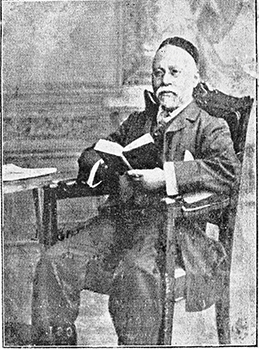
Behram Malabari (above and below): deeply imbibed empathy Photo: Wikipedia
However, his mother’s return to her birthplace was not to prove fortuitous for her. Malabari writes that she was never happy thenceforth: "fire, flood, domestic bereavements and differences — all these aggravated her troubles — and finally, to help me to a decent sort of life, but more to oblige her parents, she remarried,” her first husband having died of illness by the time Malabari was around six years of age. Bhikhibai’s new husband, Merwanji Nanabhai Malabari, was considerably older than her, having "consigned two wives already to the Towers of Silence at Surat,” before he married Bhikhibai at the age of 50. He owned a druggist’s shop and was an importer of "sandalwood, sugar, scents and spices from the Malabar coast — hence his surname Malabari.” The marriage was not a happy one, and soon after his adoption of Behramji, a misfortune fell upon Merwanji’s business when a vessel bringing in uninsured cargo from the Malabar coast sank, considerably straitening the family’s financial condition. Merwanji then started practicing the craft of a hakim or traditional/alternative medicine practitioner to eke out a living, and his adopted son had to help him, often having to do a great deal of "pounding and pulverizing,” to help prepare the medications his step-father dealt in.
 Both biographers assiduously stress that Malabari owes a great deal more to the influence of his mother — a resourceful and compassionate lady by all accounts — than to either his father, whom he barely knew, or his step-father, who initiated him early into the world of work. The initial chapters of both biographies sparkle with anecdotes which stand testament to his mother’s strength and nature; how she routinely went out of her way (and sometimes at great cost to her social standing) to help those less fortunate than herself.
Behramji’s friend Dayaram Gidumal says of Bhikhibai, "She was often to be seen in the sick room of her neighbors, Hindu or Parsi, with little Behram toddling behind her, or holding onto the skirts of her simple sari...What was most admirable in her was her catholicity and impulsive unerring goodness,” this last mentioned in the light of an event Malabari was to glorify (even as he incorporated it, by changing the characters and ‘setting,’ so that it could serve his reformist agenda) in his first collection of English verse, The Indian Muse in English Garb (1876). Bhikhibai once found a wailing, sickly infant deposited at her doorstep, with no explanation. Noticing that it was near-starved to death, she immediately suckled it, without a thought as to whose child it was, or what its caste or creed were. What followed was a veritable scandal, for it turned out to be the child of the local street scavenger, a Mahar. Bhikhibai was severely chastised for this by her Parsi neighbors, who were appalled by her lack of class-consciousness, "still, few could (but) help loving this utterly unselfish woman.”
The obvious reverence and deeply imbibed empathy of Malabari’s own account is more poignant yet: "What a mother mine was! A picture of self-sacrifice... She died at 33, but still she lives in the memory of many who knew her. To me she has been, and will be, alive always. How can a mother die? There is an aroma of immortality about the word and the idea it clothes... I carry my mother about in the spirit. She is always present to me. In every good woman I see my mother; I pity every bad or ill-used woman for my mother’s sake,” outlining clearly that having seen her function, especially in the sphere of domesticity and its implications of dealings with other women which he was privy to because the two lived a life of "perfect friendship and confidence,” was the impetus behind the course and perhaps even choice of Malabari’s life-long engagement with enforced widowhood and the abolition of child and infant marriage. Besides fixing in her young son a deep sense of what it meant to care for those less fortunate than themselves even in the face of apathy or outright hostility, Bhikhibai also instilled in him the love of song, apart from teaching him how to cook, sew, prepare domestic medicines and nurse the ill.
However, the Jam-e-Jamshed also mentions that Malabari was infamous for his "perpetual listlessness and mischief,” and that "his pranks and frolics are still remembered at Nanpoora in Surat,” a fact corroborated by his own autobiographical reflections in East & West (Malabari 1903) published decades later. What is equally remembered in Nanpoora, the account continues, is Malabari’s felicity for versification and aptitude for music, evinced in his meritorious, if controversial, sessions with the Khiali poets of Gujarat. Of these last, R. P. Karkaria writes that the Khialis were "itinerant bards,” well-known in Gujarat in times past, and that "like the Troubadours and Trouveurs of France, and the Minnesingers of Germany, (the Khialis) travelled around from place to place, leading a semi-ascetic life and (were) dependent on alms, gaining a precarious livelihood by their voice and instruments,” adding that they were particularly marked in their eclectic and liberal views, "free from the narrowness of creed and country.” Their poetry was almost metaphysical in content and structure, and some of the best ethical musings in the Gujarati language owe their origins to these travelling minstrels. It is with them that Malabari fell in, seeing in them kindred spirits who shared his "Bohemian habits,” and he was sometimes involved in the "vortex of their rowdy tournaments, and enjoyed the music as well as the fun of broken head and lacerated skin.”
Gidumal’s is a more detailed assessment of the Khialis’ impact on Malabari’s life. He begins by outlining that the Surat Khiali in particular, was a poet-philosopher, the best of whose compositions were astonishingly sweeping in their range, possessing a near Miltonic tenor. At the time in question, there were two major sects of Khialis, the Kalgiwalas and the Turrawalas, so called because of their particular style of dressing and their choice of musical accompaniment (the ektara or one-stringed guitar still used by folk musicians and bards across large tracts of Gujarat and Rajasthan today). The former worshipped the divine feminine or Sakti principle and held "the female energy to be superior to the male.” It was this sect which was in the ascendancy when Malabari fell in with the minstrels, "but as usual with Malabari in after-life, he attached himself to the weaker party.”
Over the course of the next decade, when Malabari published his first collection of Gujarati verses, Niti Vinod (Pleasures of Morality) in 1875, it was the fulfillment of the promise tendered in these, his earliest verbal (and otherwise) ‘duels’ with the Khiali poets from competing sects.
 To Malabari’s own mind, however, the impetus towards versification in general, and play-acting with story in particular, came from his early exposure to the tales which comprise the Shah-nameh by Firdowsi. These tales would be read out by "a cunning priest or scribe,” who brought to life the adventures of brave knights, the virtues of fair ladies and inspired in the motley crew of relatives and spectators "a strange love of the romantic,” writes Malabari. "These Shahnameh recitals and readings — I was one of the privileged readers and actors — fired my imagination as nothing else did. So great was my ambition in those days of early boyhood, that I hardly think an empire would have satisfied it,” he recalls of those times.
 In keeping with his youthful reputation for listlessness and trouble-making whilst at school, Gidumal discusses how Malabari, not quite 12 years of age at the time in question prior to his mother’s death, could "toss off no less than nine copper cups containing not under a half-pound each of that seductive liquor called Surti Daru (i.e. Mhowra liquor),” with the caveat that he had since become very-nearly a teetotaller. The quelling of what Gidumal calls Malabari’s "animal spirits” was largely owing to the death of his mother in 1865. Bhikhibai had a serious attack of cholera from which she recovered briefly, but into which she relapsed. "To this day Malabari remembers the revulsion of feeling — call it rather a mental cyclone — which swept ‘the offending Adam’ out of him and which sobered him down to the gravity and stillness which have since then been his main characteristic.” Malabari ministered care to his dying mother for the two nights and three days that she suffered most before the end came. The day after she died, Malabari writes, "I became an old man. All my past associations were discarded.” The impact this tragic event had on Malabari, apart from asserting itself in the form of his choice of lifework, also finds mention in The Indian Muse in English Garb, in a piece called "A Sketch.”
Perhaps the most deeply autobiographical of all the pieces which comprise this collection, "A Sketch” opens with Malabari describing his mother’s dangerous journey from Baroda to Surat, before proceeding to outline how he had grown up to be the bane of his many ‘teachers’ (a Parsi mobed: "a man mysterious of the Magus tribe;” a "zealous man” known as the "urchin-herd;” a "seedy Brahmin, with a visage stern” and so on).
He then marks the complete rupture with his past life which comes in the form of the death of his mother:
"Three slow sped years, I watched her bed of care,/ By day and night her vigils long to share.
But still a son’s devout and soul-sprung pray’r,/ Could not with Heav’n prevail, her life to spare.
One day the sun as his decline began,/ Declin’d the sun of this, my earthly span!
Her latest breath below my safety sought –/ To bless her orphan was her dying thought!
No tear I shed, when first my loss I view’d:/ My sense was smother’d and my soul subdu’d.
She clasp’d a child, with sad emotions wan:/ But when the clasp relax’d, there was left a man.
A man at twelve! in whom my grief confide?/ No friend to watch me but the sainted guide!”
As becomes obvious from these heroic couplets (largely composed in iambic pentameter) the moment of Malabari’s mother’s passing marks the definitive end of his youth and its attendant follies.