
Tradition
Cheers for the Chenoys
Generations of the Chenoy family came together in Secunderabad to celebrate the bicentenary of their ancestors’ association with the twin cities
Rare sepia toned photographs were placed on display and everyone tried to recognize their ancestors, old homes in which they had played, attended weddings and other functions. Some 100 members from four generations of the Chenoy family had come together from different parts of India, Pakistan, UK, USA, Canada and Turkey on February 3, 2004 to celebrate the bicentenary of the legendary Chenoys’ association with Secunderabad and Hyderabad. Though no written records are available to corroborate the fact, family historians and proud members confirm that 200 years ago their ancestor Sohrabji Pestonjee Chenoy came to Hyderabad and settled in Secunderabad, writes Mithi Chinoy who sent Parsiana a detailed account of the celebrations. To mark the momentous occasion the family specially minted a silver coin and brought out a souvenir that records the family’s history of fame and fortune under the Nizam VI of Hyderabad, Mahboob Ali Pasha. The coin, the size of a government mint rupee, bears the face of Khan Bahadur Edulji Sohrabji Chenoy while the obverse side shows the family’s Chenoy Anjuman Dar-e-Meher which stands on Mahatma Gandhi Road in Secunderabad.
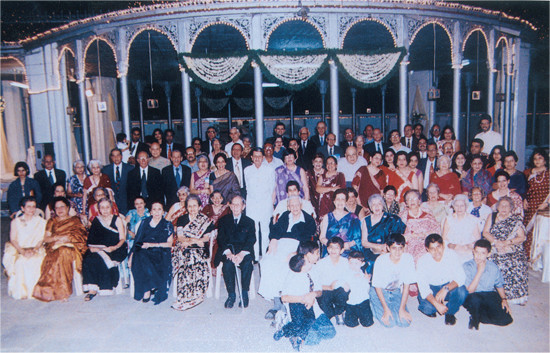
It was at the same Dar-e-Meher that the family launched its celebrations with a thanksgiving jashan. The venue for the grand evening function was the Bai Pirojbai Chenoy Hall and Dharamsala, elegantly decorated by designer Dinaz Chenai. Goolbanoo Y. Chenoy, president of the Parsi Zoroastrian Anjuman of Secunderabad and Hyderabad invited the family of "once removed, twice removed and three times removed cousins” to join in a hambandagi and "enjoy the evening in a spirit of goodwill.”
The oldest member of the family Keki Dalal, the great-grandson of Khan Bahadur Edulji Chenoy was then felicitated by the youngest member, four-year-old Arman Homi D. Chenoy. An eight-page souvenir, professionally designed by architect Yashwant Ramamurthy, was next released by Dalal.
Another memento to mark the occasion was the coin released by senior family member Mithoo Coorlawala who had conceived of this reunion. "Together we can share and experience the continuity of our heritage and the institutions started by Edulji and our ancestors,” she urged. Although the Chenoy charities have extended to 14 memorial blocks/flats in the names of different members, Coorlawala referred to Dalal’s one unfulfilled dream of building a home for the aged and destitute of the community. Dr Polly N. Chenoy read out a special message of greetings and congratulations sent by Hoshang M. Chenoy, vice president Cobra Beer, New York, with great pride and affection. In addition to Goolbanoo and Polly, Khotty S. Chenai, Soona B. Mirza and Roshan M. Patel formed the core group who sent out invitations to the family and organized the event.
A quick narration of the family’s history by prominent city archivist Mirza served to refresh memories. As related in the souvenir:
The Chenoy family came to India in the 18th century at the time of the Hyderabad Subsidiary forces. When the Hyderabad contingency was transferred from the old cantonment of Jalna to Bolarum in 1800, the Chenoys came along with them and were the recognized army shroffs or bankers of the contingent. Rightly has it been said that the "history of this great family is closely bound up with the history of the state for over a century and a half.” Members of the family continue to hold positions of trust and responsibility in the administration of the state and have "with outstanding loyalty and devotion” served the "sovereign ruler and the state. These qualities have invariably distinguished the family...”
Pestonjee Maneckjee Chenoy was in Jalna during the time of Nizam Ali Khan, Nizam II. His son Sohrabji along with 14 other Parsi males came to Hyderabad and settled in Secunderabad at the beginning of the 19th century. Sohrabji’s three sons, Nusserwanji, Edulji and Dinshaji, started their own business. Both Nusserwanji and Edulji were prominent members of the community.
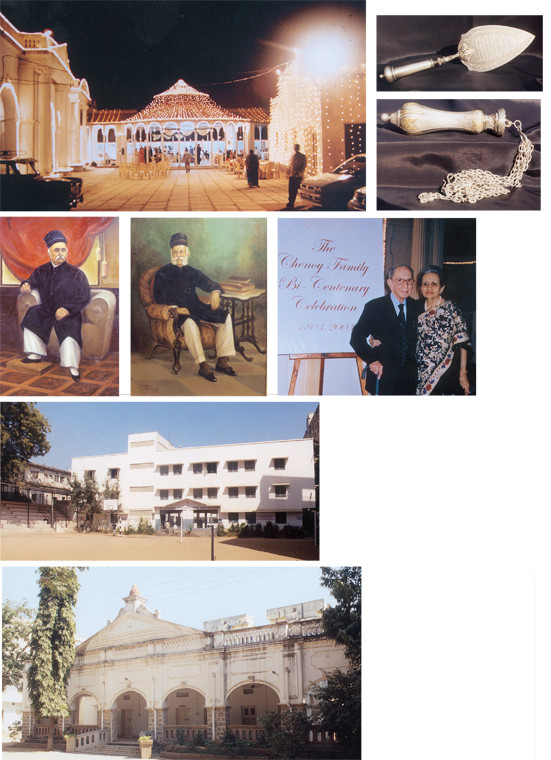
From left (top row): Bai Pirojbai Chenoy Hall; the tapi and key presented to Shapurji Chenoy on the completion of the Dar-e-Meher in Secunderabad (below) Middle row: Edulji and Shapurji Chenoy, Dalal and Coorlawala. Alongside: Bai Ratanbai J. Chenoy School
Nusserwanji had seven sons of whom Rustamji and Dossabhoy distinguished themselves in service. Nusserwanji’s wife Bai Maneckbai was instrumental in having a Dar-e-Meher built in 1904 at Tilak Road, Hyderabad. Rustamji joined the Nizam’s service in Berar and later rose to be the first taluqdar (collector) at Nagarkurnool where he brought about many reforms. When Rustamji was appointed the first taluqdar of Aurangabad he transformed it into a land of gardens, had new roads constructed, repaired government buildings and provided relief measures to the people. He finally retired as subedar (equivalent to a governor) of Gulbarga.
Rustamji’s brother Dossabhoy, 12 years his junior, joined service during the regency of Sir Salar Jung I. He showed great promise and ability and was made a taluqdar and private secretary in the paigah (fiefdom) of Sir Asman Jah Bahadur. When Sir Asman Jah was elevated to ministership, Dossabhoy was subsequently made the aide-de-camp. He streamlined the administration and enhanced the revenue by lakhs of rupees. When Sir Asman Jah gave up the reins of office, Dossabhoy continued to be the private secretary to the Nawab. When his daughter got married the Nizam, Mir Osman Ali Khan Bahadur placed his Rolls Royce at their disposal to convey the bride and the groom. In the Nizam’s birthday honors list the philanthropic Dossabhoy was named Nawab Dost Yar Jung Bahadur.
The second son of Pestonjee was Edulji, better known as Khan Bahadur Chenoy. He was the proprietor of The Europe Shop but instead of confining himself to business alone he took an active interest in the Congress movement and was a prominent member of the community. Edulji had seven sons and it is this branch of the family that has held the highest positions of trust and responsibility in the state. In memory of their revered father the sons had a Dar-e-Meher constructed and consecrated in Secunderabad. Additionally a dharamsala was built for Parsi travelers and a marriage hall. Of Edulji’s seven sons, Shapoorji and Jamshedji sought service in the paigah of Nawab Sir Khursheed Jah Bahadur.
To Shapoorji goes the credit of setting up the first cotton textile mills in Hyderabad called the Mahboobshahi Mills in Gulbarga. He helped Sir Salar Jung I in establishing an efficient administration and was also close to Mahboob Ali Pasha. He was rewarded for his services by the grant of jagirs (estates) in Gulbarga. Being the only Parsi jagirdar (titled landlord) Shapoorji was provided with 20 sardar (Sikh) foot soldiers and 15 Rohila mounted soldiers who guarded his house Shapurwadi in Hyderabad which was the chosen venue for many weddings and navjotes in the family.
Jamshedji was a great philanthropist and his secular charities included Jamshed Hall meant for public lectures and cultural activities. Jamshedji’s eldest son Sohrabji too distinguished himself in the service of the great dewan Sir Salar Jung I and was eventually promoted as first taluqdar. The Nizam conferred the title of Sohrab Nawaz Jung Bahadur on him in recognition of his contribution to the welfare of the people and of the state. He was also made commissioner of customs and had the additional charge as food controller.
Sohrabji’s brother Rustomji had the distinction of belonging to the first batch of the Hyderabad Civil Service. Like his brother he was fluent in Persian and additionally had good command of Urdu, English and Gujarati too. After serving in several departments he was made postmaster general when for the first time the postal department showed a profit. Third brother Hormusji worked as assistant director in the state medical department and after retiring joined Nawab Sir Asman Jah Paigah as chief medical officer. Yet another brother Ruttonji was in the service of Nawab Sir Khursheed Jah Bahadur Paigah and his youngest son Dr Dinsha built the charitable Mira Nursing Home in memory of his parents Mithibai and Ruttonji. It was left to brother Jehangirji to carry on the family business of cotton trade in Bhainsa, Adilabad district. Although a man of wealth he spent little on himself but established the Bai Ratanbai J. Chenoy Parsi School and the Bai Ratanbai J. Chenoy Charitable Dispensary.
Of Sohrab’s five sons, the eldest Themurasp and the youngest Hoshang joined the family business. Erachsha, like his father, earned the distinction of first taluqdar and in fact was even made subedar and finally agent general of Berar. In 1945 the Nizam conferred the title of Nawab Erach Yar Jung Bahadur on him. A great lover of the Persian language and literature he astounded his listeners by his scholarship. Third son Naoshir was a barrister-at-law. Being proficient in Urdu he was able to practise law in the High Court of Hyderabad. He was a director of several companies besides being trustee and managing committee member of the Parsi Anjuman of Secunderabad and Hyderabad. In the field of science was Sohrab’s fourth son Faridoon who entered the Nizam’s public works department as assistant engineer, was subsequently made executive engineer water works and finally the superintending engineer, recognized as chief engineer of Hyderabad state.
Another branch of the family that has distinguished itself is that of Bapooji Edulji Chenoy. Bapooji’s son Dorabji began as a tehsildar at the age of 19 and finally served as commissioner for seven years. On his retirement from service he was appointed controller to Prince Basarat Jah Bahadur. The Nizam appointed him Sadr-ul-maham of the Sarf-E-Khas Mubarak and conferred on him the title of Nawab Darab Jung Bahadur.
Dorabji’s brother Pestonji joined the treasury department as a very minor officer and rose to become the master of the mint, thereby becoming a controller to Prince Basarat Jah Bahadur. Yet another brother Dr Cawasji joined the State Medical Services serving the ailing in many districts. At the time of his retirement he was the first Indian director of medical services in the state of Hyderabad. He did excellent work during the plague epidemic and had written a book on malaria. Also in the medical branch was another brother Dr Capt Feroze who was among the very first Indian officers to be commissioned into the Indian Medical Service. During the First World War he saw active service in various theaters and in 1918 was posted to Zenjan, an inhospitable snow-bound region on the borders of North Persia and Russia as officer commanding the 20th Combined Field Ambulance of the Mesopotamia Expeditionary Force where he succumbed to typhus at the young age of 30.
The transition of Hyderabad from a feudal to an industrial state was considerably eased with the establishment of the Hyderabad Industrial Trust Fund of which legal luminary Nadirsha Bapooji Chenoy was one of the founder members. As trustee of the Parsi Anjuman for five decades, with his legal acumen and foresight he drafted (in 1941) the trust deed of the Anjuman to make it compatible with the existing rules of the Indian government. The Seth Eduljee Chenoy Dar-e-Meher was confirmed as a religious institution thereby providing legal safeguards against disturbances in the changing world of politics.
"It is commonplace to say that no community in the world is more famous than the Parsis for public spirited philanthropy, wherever they may happen to reside, and among the notable Parsi families which have long been settled in this state, none more worthily lives up to this tradition of the race than the Chenoys,” commented the resident Stuart Fraser in a public speech. In 1950 the Nizam’s rule came to an end with the formation of the state of Andhra Pradesh. Since then the new generation of Chenoys have excelled nationally and internationally in medicine, finance, banking, accountancy, business, teaching, private service, journalism, fine arts, social service, among others.
Happy to bond with the extended family, those present hoped that future generations of the Chenoys would come together after a century to bask in their legacy...
◆ ◆ ◆
From the archive