
Zoroastrians Abroad
Lamassu in London
The mythical winged bull, also known as Lamassu, seen at the entrance of many fire temples, has now been given a dash of color and prominence. Michael Rakowitz’s depiction of the Lamassu, unveiled atop the fourth plinth at Trafalgar Square in London, next to the world famous Nelson’s Column, was unveiled a week after Navroz on March 28, 2018. The 14-foot artwork, made out of 10,500 empty Iraqi date syrup cans was described by the mayor of London, Sadiq Khan as "probably the world’s most high-profile piece of art.”
Titled The Invisible Enemy Should Not Exist, the sculpture is meant to depict resilience against tyranny and religious fanaticism and a celebration of pluralism. In the media coverage it was "rightly associated with Iraq, Babylon and Assyria because it was the artist’s recreation of the guardian spirit that protected the gates of the Assyrian city of Nineveh for almost 3,000 years before it was smashed to rubble by the Islamic State of Iraq in February 2015. The Lamassu at the entrance gates in Nineveh was huge, only its footprint would have covered the area of the fourth plinth at Trafalgar Square,” stated Malcolm Deboo, president of the Zoroastrian Trust Funds of Europe, when requested by Parsiana to comment on the new sculpture.
"It should be noted that the Lamassu is not of Iranian/Zoroastrian origin but is a celestial being from ancient Mesopotamian religion. Thus these colorful, huge stone sculptures were a familiar sight in ancient times at the entrance gates of cities such as Nineveh which predate Persepolis and the Achemenid Empire. Cyrus the Great must have seen them when he entered Babylon and previously also the armies of the Median Empire when they destroyed the Assyrian Empire,” Deboo offered a historical perspective.
Titled The Invisible Enemy Should Not Exist, the sculpture is meant to depict resilience against tyranny and religious fanaticism and a celebration of pluralism. In the media coverage it was "rightly associated with Iraq, Babylon and Assyria because it was the artist’s recreation of the guardian spirit that protected the gates of the Assyrian city of Nineveh for almost 3,000 years before it was smashed to rubble by the Islamic State of Iraq in February 2015. The Lamassu at the entrance gates in Nineveh was huge, only its footprint would have covered the area of the fourth plinth at Trafalgar Square,” stated Malcolm Deboo, president of the Zoroastrian Trust Funds of Europe, when requested by Parsiana to comment on the new sculpture.
"It should be noted that the Lamassu is not of Iranian/Zoroastrian origin but is a celestial being from ancient Mesopotamian religion. Thus these colorful, huge stone sculptures were a familiar sight in ancient times at the entrance gates of cities such as Nineveh which predate Persepolis and the Achemenid Empire. Cyrus the Great must have seen them when he entered Babylon and previously also the armies of the Median Empire when they destroyed the Assyrian Empire,” Deboo offered a historical perspective.
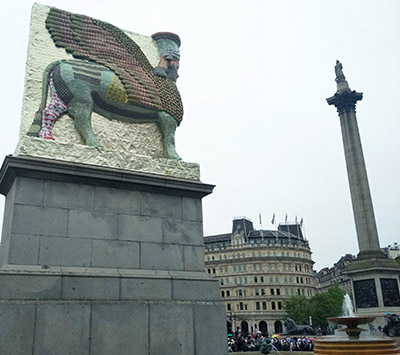
Lamassu at Trafalgar Square in London Photo: Farrokh Jijina
Rakowitz, a professor at Northwestern University in Chicago, has never been to Iraq although his Jewish family resided there until 1946. While the original sculpture was carved from Mesopotamian stone, he chose to work with colorfully designed cans of date palm syrup, a commodity once vital to the Iraqi economy. According to Reuters, Iraq once produced three quarters of the world’s dates but after years of war, insurgency and mismanagement, the country’s stake in global production has fallen to around five percent. Actually The Invisible Enemy Should Not Exist is just one component of a much larger decade long project of the same name to which Rakowitz has been committed.
"No photograph will prepare you for quite how huge the sculpture seems atop the plinth… And rather than jarring with its uniformly gray surroundings, the sculpture’s colors — subtly varying tones of green, gold and red — create an effect that is at once arresting and oddly solemn. This is pleasingly at odds with the jingoistic effigies of monarchs, empire builders and kings with whom it shares space, yet even if this appears to be speaking a different language, it is still in dialog with these other statues,” noted a write-up on artsy.net.
Commenting on Rakowitz’s creation, Deboo remarked, "The frontal is striking, especially the face and the headgear. Having a pair of binoculars to examine the detail would help. Unlike Persepolis, Rakowitz’s artwork is deliberately not symmetrical but it is beautiful. On one side there is an inscription in Cuneiform which reads, ‘Sennacherib, king of the world, king of Assyria, had the inner and outer wall of Nineveh built anew and raised as high as mountains.’” It is estimated that nearly 20 million viewers will see the new Lamassu whilst it is on display until March 2020.
"For Iranian and Zoroastrian visitors, it should remind us that our ancestors admired beauty and they had the vision and aptitude to borrow and then fuse by making it their own, just like many other artistic depictions at Persepolis including the artistic image of the Fravashi. But we should be thankful to Ahura Mazda and those Iranians who rallied to Persepolis in 1979 after the Islamic Revolution to protect their cultural heritage from religious fanaticism,” remarked Deboo.
◆ ◆ ◆
From the archive