
Zoroastrians Abroad
Martab in Mississauga
The first youngster from his generation in Canada to be ordained as a martab on December 23, 2017, 14-year-old Ervad Nekzad Illava performed his maiden boi ceremony in the Ushahin gah at the Bai Motlibai Wadia Agiary in Bombay’s Malcolm Baug where he underwent the final paces of the ritual. It was the same Agiary where he had earlier been navjoted and initiated as a navar.
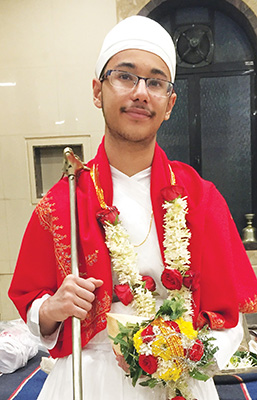
Ervad Nekzad Illava: promising priest
"The martab training took a lot more time, hard work and dedication than the navar training. I had to spend more time reading and memorizing the prayers,” Nekzad responded to Parsiana’s queries. Having completed his navar training at the age of 12, he has been participating in most of the religious ceremonies in the Greater Toronto Area and at jashans held by the Ontario Zoroastrian Community Foundation (OZCF) in Mississauga and the Zoroastrian Society of Ontario in Toronto. At private ceremonies too, the young priest has been regularly joining in at jashans, navjotes, weddings, srosh and uthamna prayers, according to a write-up by erstwhile OZCF director Meher Panthaky.
Son of Tanaz and Aspi who are in the banking industry, and younger brother of Sherezad who is in the automobile industry, Nekzad is a student of R. H. Secondary School in Mississauga. His other interests include playing the guitar, figure skating and swimming with him currently working towards becoming a life guard.
For his navar and martab training, Nekzad was under the tutelage of Ervad Jal Panthaky of Mississauga. Realizing that children of athornan families in India and overseas, desiring to undergo navar/martab ceremonies are not familiar with the Avestan or Gujarati script, Panthaky took it upon himself to transliterate into English and produce six works — Yazashne complete, Yazashne concise, Yazashne Rapithvan, Visperad, Vandidad-Ba-Nirang, Baj-Dharna ceremonies along with pictures of alat (religious implements) and an explanation on their significance. For the last six years he has been devoting four to five hours each day on this self-imposed mission, he informed Parsiana.
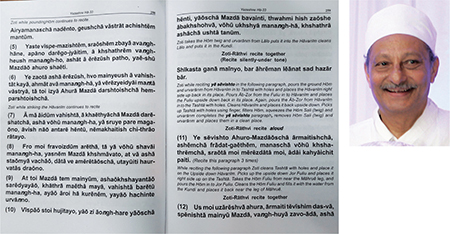
Above: Ervad Jal Panthaky; left: comprehensive Vandidad-Ba-Nirang
He initially used the typewritten, concise version of Yazashne in English that had been readied by his late brother Ervad Rustomji Panthaky, former principal of the Dadar Athornan Boarding Madressa since renamed Dadar Athornan Instittue (DAI). But Jal found that the original high liturgical books in Gujarati used the term "jawat without providing appropriate references… whenever paragraphs, has, kardas or chapters were repeated.” This was possibly done to restrict the number of pages and the cost of printing. To simplify learning for the novitiate, Jal’s books have inserted the relevant sections and done away with "jawat.” He therefore considers the high liturgical books that he has transcribed with their full extensions as "unique” since it will "make it easy for present and future priests to recite the prayers without having to go back and forth.”
He forwarded Parsiana the 1.855 kg hard bound copy of the 604-page Vandidad-Ba-Nirang, admeasuring 29 cm x 23 cm x 3.5 cm that carries the prayers in a large, bold font, and the instructions for their recitation in a smaller font. The large font is necessary since the "vandidad is performed after midnight in dim light,” explains Jal. The printing cost of the six books will be borne by Dhunjishaw and Manijeh Gamir Charitable Trust of Ahmedabad (the late Manijeh being his elder sister) and distributed for free to the high priests, atash behrams and agiaries where the navar, vandidad and nirangdin ceremonies are performed, Zoroastrian libraries and universities offering world religion as a subject, overseas Zoroastrian associations, the DAI and members of the North American Mobeds Council.
The youngest of 10 siblings, Jal was born in Ahmedabad and raised in Nargol where his father Noshirvan was a practicing panthaky. He completed his navar and martab training at the age of 11 years. After his early education at the Tata Wadia High School, he did his Inter Science from K. C. College and earned a diploma in mechanical engineering. He gained work experience at Voltas and Glaxo Laboratories before migrating to Canada in 1967, three weeks after his marriage to Meher Dastur, according to his life profile. During the last 50 years in Montreal and Toronto he has performed hundreds of jashans, Parsi and mixed weddings, navjotes of Parsi and mixed marriage children, and after-death prayer rituals.
◆ ◆ ◆
From the archive