
Events & Personalities
Drum roll for Mistry
Dr Aban Mistry’s "was a huge struggle, to conquer a peak (milestone in a field), unimaginable for a lady to even enter — Indian classical percussion music,” Firoze Katila joint honorary secretary of the Swar Sadhna Samiti (SSS) recalled about the tabla maestro. He was speaking to Parsiana on February 20, 2018 about Mistry (1940-2012) being posthumously awarded the national First Lady Award for her musical achievements.
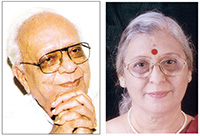
Keki Jijina (left) and Dr Aban Mistry
The Award was presented on January 20 at a function at the Rashtrapati Bhavan by the President of India Ramnath Kovind at an event officiated by cabinet minister Maneka Gandhi who heads the Ministry of Women and Child Development. The Award was collected by Samiti member Yamini Zaveri. The 112 women recognized for being first in their respective fields include mountaineer Bachendri Pal, Paralympic winner Deepa Malik and Miss Earth title winner Nicole Faria.
Proficient in the tabla and the sitar, Mistry was fluent in both Hindi and Sanskrit. "Under her teacher and mentor Keki Jijina’s guidance and after researching for over 15 years, she discovered in the caves of Bhaja, Maharashtra (1980-81) ancient but clear depictions dating to 200 BC of a lady playing the tabla,” Katila said, noting her achievements. This discovery reportedly shattered the previously held belief that Persian Sufi musician Amir Khusro introduced the tabla to India and "present(ed) evidence that the tabla was indigenous to India and that women in ancient times played it.” Along with her written records of ancient compositions and musical notations to each, this formed her doctoral thesis.
Mistry’s thesis "was the foundation of her first book, Pakhawaj aur Tabla ke Gharane evam Paramparayen (Musical ideologies and traditions of the tabla and two headed drum).” Reprinted several times and translated into English, both versions are a part of the curricula in Indian universities in courses for music studies. Another volume by her, Parsis and Indian classical music – an unsung contribution, shattered the stereotype that Parsis were proficient only in Western music. Her last work Tabley ki Bandishein (Poetic compositions for the tabla) "has (also) joined the ranks of curricula and libraries of Indian universities… This is her rich legacy – to her Samiti and the world.” The Samiti, established by Mistry with Jijina in 1961, "encourage(s) young (musical) talent and organize(s) their stage performances” and holds monthly programs of Indian classical music and dance, as per their website.
As a Parsi woman, "she bravely defied social stereotypes,” appreciated Katila who lists Mistry’s "own values and beliefs that form the very pillars” of SSS. All of the Samiti’s programs are free and open to all. Musicians irrespective of age, gender, race, status or religion are encouraged. He elaborated about the third pillar, propagation and preservation: since its founding, the Samiti has conducted 677 programs for budding musicians. Fifty-three annual all-India competitions in classical music and dance have been conducted, including 38 concerts for the young and very young (under 14 years). "Today, SSS has second and third generation family members in active roles, ensuring the Samiti stays relevant and true to Abanji’s and Guruji’s (Jijina) vision…Her books, lectures, columns and articles are all treasure-troves that she bequeathed to Indian classical music lovers.”
◆ ◆ ◆
From the archive