
Those Magi again!
The lore of the Three Magi is intricately interwoven into Zoroastrian and Christian tradition
This essay sets out instead to show how, when and where the legend in Matthew’s Gospel (2.2-12) originated. What does his Gospel say on the Magi? Both Greek and Latin versions employ magos; the English renditions show varieties from "there cam wyse men from the est to Jerusalem” (Tyndale, 1526) to "astrologers from the east arrived in Jerusalem” (Revised English Bible, 1989).
They brought gifts fit for kings to the infant Jesus as "kynge of the Jues:” "and offred unto hym gyftes, gold, franckynsence, and myr.” For their return journey, Matthew ranges over to "they retoured ito ther awne countre another way.” That country was unspecified in his Gospel.
There is no indication in Matthew of those visitors’ numbers. The Churches of Syria and Armenia reckon on 12. Three, with their three gifts, figure as favorites on reliefs, mosaics, paintings and very many Christmas cards.
For some 500 years of English Bible followers these anonymous "wise men” were star-gazers, dream-interpreters and magi-cians. Anciently, Herodotus [5th century BCE (Before Christian Era)] had explained that they were Median free-lancers; after suppression by Darius the Great (r.522-486 BCE) for their unwise political ambitions, they wisely decided instead to opt for the official religion of Mazdayasna. Neither had mentioned Zarathushtra until the Magupats (read Magi!) began to claim him as one of theirs.
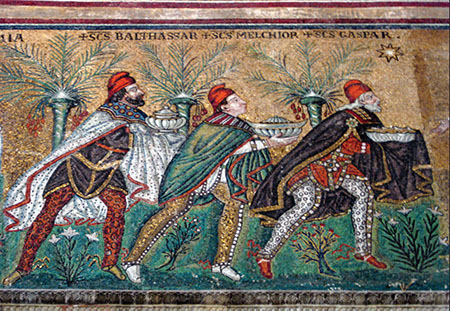
The Three Magi on San Apollinare Nuovo Church mosaic, Ravenna (6th century)
A note on Matthew’s Gospel: it is dated, at the earliest, after 70 CE (Christian Era); some even opined a dating of 110 CE! It was compiled in Greek for the Greek-speaking Jews of Syrian Antioch; its actual author remains anonymous! The historical Matthew, a tax-collector, was among the apostles associated with Jesus (the) Christ who was crucified in 30 CE. Why then had he not written in Hebrew or Aramaic?
The Common Era reckoning fails to account for a confused dating on Jesus’ short life. Arriving in Jerusalem, the Magi had naively enquired "where is he that is borne kynge of the Jues...?” A vastly perturbed Herod the Great, anxious to protect his regnal line, slyly obtained details from them on the newborn Christ child’s whereabouts, then promptly ordered the slaying of all children below two years born in Judaea — so claimed Matthew’s Gospel.
Does the blame for those terrible infanticides rest with the Magi? Herod had died in 4 BCE, leaving unharmed the infant Jesus, taken into Egypt for safety by his parents, who would then have been at least a year old, and therefore born around 6-5 BCE, and not 1 CE. The time-line fog thickens.
The legend of the Magi expanded with the spread of Christianity. Centuries after their visitation, the three gift-bearers were at last given names. A noteworthy Anglo-Saxon account by the 8th century Bede the Venerable reads: "The first was called Melchior; he was an old man, with white hair and long beard; he offered gold to the Lord as to his king. The second, Gaspar by name, young, beardless, of ruddy hue, offered to Jesus his gift of incense, the homage due to Divinity. The third, of black complexion, with heavy beard, was called Baltasar; the ‘myrrh’ he held in his hands prefigured the death of the Son of Man.” The word ‘myrrh’ in the Semitic languages originally meant "bitter.” Mixed with wine it was a painkiller.
A carved whalebone box of the 8th century from Northumberland, England, popularly known as the Franks casket, shows the three wise men presenting their gifts to the Holy Babe in his mother’s arms. The leading figure bears a solar symbol. Above and between the lead and second magus is an Anglo-Saxon runic label that reads MÆGI.
Concerning the nature of the three kingly gifts, there is an early precedent from the 3rd century BCE when the Hellenistic Syrian king Seleucos II offered gold, frankincense and myrrh to the Miletus temple of Apollo, the Greek solar god of truth, healing and prophecy. Such gifts were considered fit for kings and gods. Also, the story of the three Magi being three kings makes sense when Matthew informs that the trio had access to Herod before whom they prophesied the kingly destiny of the newborn Christ. Three gifts; three Magi; three kings: QED ?
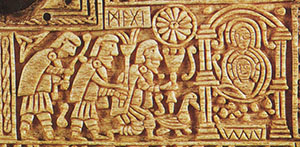
Details of the three Magi from the front panel of Franks Casket (Northumbria, 18th century)
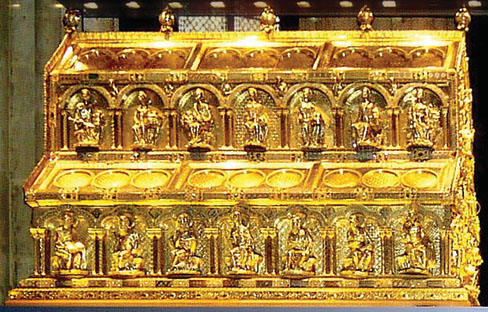
The Three Kings Shrine at the Cologne Cathedral (12th century)
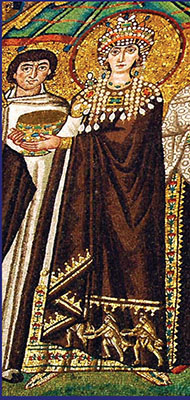
The Three Magi on the hem of Empress Theodora’s regal attire
Gaspar alone bears an Iranian-connected name: Gaspar or Kaspar was linked to Gondophares, the Indo-Parthian king who ruled (20 to 10 BCE) from his capital Taxila over North-West India and Punjab. Gondophares is the Indo-Greek equivalent of the Avestic Vindafarnah, "he who finds glory.” Both names are of recognizably Zoroastrian provenance.
But who was the black Magus? Was he an Indian star-diviner? Someone of South Arabian or Ethiopic origin? Since the times of Cyrus II and Darius I, the Persian empire had rapidly expanded to include Middle Eastern, Indian and North African territories, several of whose inhabitants had made their way or were taken to Persia. The Persepolis reliefs show tribute-bearers from far-flung lands. A person with dark or swarthy features could have supplied the model for Baltasar.
On a factual note, the affair of the 1st century CE Partho-Armenian king Tirdad/Tiridates bears retelling. Younger brother to the Parthian monarch Valakhsh, he was conferred the throne of Armenia in 62 CE. Armenia, long embroiled in conflict with the western Roman superpower of the day, was ruled by the Zoroastrian Parthians; it gave rise to an invitation in 63 CE by the emperor Nero — the mad one who "fiddled” while Rome burned (64 CE) — to Tiridates for a state visit and official investiture by the Roman to a soon to be made client king.
The Parthians, despite some oddities of observance, were largely Zoroastrians. Tiridates demurred the offer at first, explaining that as a Magus he could not make the journey because the religion forbade his crossing over water, a sacred element which could not be thus defiled. Affability itself, Nero declined Tiridates’ counter-invitation for him to visit Armenia, very pointedly pressing instead the Magus who finally relented.
In 66 CE the Parthian and Roman rulers finally met in a newly rebuilt post-incendiary Rome: Tirdad was accompanied by his entire family, a contingent of Magi, and some 3,000 Parthian princes and nobles. The formal state reception and solemn investiture were very grand occasions, with Nero even behaving as an equal of Tirdad. Reliable Roman sources are agreed that Tiridates was a Magus — a genuine priest-king. Arguably then, this visit of a priest-king to an emperor had provided the Christians with the inspiration for their Magian visitors: pagan Rome had become Christian Bethlehem!
In the early 4th century CE pagan Rome gradually accepted Christianity under Constantine the Great, who founded his capital Constantinople (today’s Istanbul) as the New Rome. By the 6th century the Byzantine Emperor Justinian I with his consort, the Empress Theodora, had registered Magian representations on the dazzling mosaics in the churches of San Vitale and San Apollinare Nuovo at Ravenna.
Fixated as ever on saintly relics with their miraculous powers, the Wise Men industry took on fresh impetus. The bones of the Three Magi miraculously (?) surfaced in Justinian’s new capital and were transported to Milan by its bishop in the mid-4th century. There they remained until Frederick Barbarossa ("Red beard”), the first German emperor of the Holy Roman Empire — which was neither Holy, nor Roman, nor Empire — took them off in the late 12th century to Cologne whose bishop arranged for the construction of a massive stone-built cathedral to house the sacred relics. Work began in the mid-13th century, and after a long non-constructional interruption, was completed some 600 years later (1880) to form the largest Gothic cathedral in northern Europe.
The bones of the Three Kings were enshrined in a triple bronze and silver-lined wooden sarcophagus, with length, width and height of approximately 7’ x 5’ x 4’, splendidly decorated with fired gold, precious stones, and likenesses of several early Church Fathers and high dignitaries. Placed above the cathedral’s medieval high altar it became a unique example of the finest ever Rhineland decorative art with its deep relief sculptural carvings.
In 1864 the three coffins were opened and their bony human remains were unwrapped from their moldy flax shrouds. Expert witnesses apparently agreed that these "could be assembled into nearly complete bodies: the one in his early youth, the second in his early manhood, the third was rather aged!” Believe this?
Whatever the truth of the matter, the Three Kings shrine remains among the most visited by pious believers from across the world. Matthew’s Gospel seems vindicated inasmuch as it enshrines "gospel truth” for millions of Catholics the world over. And despite such differences, the Magi remain stubbornly Zoroastrian.
By way of afterword, and on a less disputatious note, extracts from the joyous text — "The Three Kings” — of a wholly delightful Argentinian Nativity Mass in the folk idiom are happily given (in translation from the Spanish):
"They had come, the kings, and they were three:
Melchior, Caspar, and the black Balthasar.
Sugared grapes and honey they brought
And a white poncho of royal alpaca. ....
The God Child was very pleased
He ate the honey and wrapped Himself in the poncho,
And then He smiled,
And the sun shone at midnight.”
The late Farrokh Vajifdar very kindly wrote this piece for Parsiana prior to his death on November 21, 2017.
Born in Bombay into a Navsari high-priest clan, Vajifdar enjoyed his primary and secondary education there and acquired his tertiary nurture in London, where he remained to settle, out-marry and procreate. He developed a deep and abiding interest in Indo-Iranian civilizations, with strong bias towards Zoroastrianism, its languages, literature, history and philosophy, and was a fellow of the Royal Asiatic Society. Occasional radio and TV broadcaster, lecturer, and midwife to aspiring and published authors, he, as independent researcher, continued as full-time writer and, as international consultant, had translated books and articles from French, German and Italian. He taught physical sciences at the National Association for Gifted Children.