
Bawa Musings
Connecting with Zarthost
We need to be more passionate about our Prophet
We are not adoring our Prophet enough. Nor are we capitalizing on his exalted superhero status. Jesus nailed to the cross, Krishna preaching Gita from the chariot, or Prophet Muhammad’s march on the city of Mecca, evokes strong passion in their followers. A dying community can be rejuvenated by an enlivened faith. For multiple reasons, Zarathushtra can be the focal point for such a revival. Historically, intellectually and spiritually, Parsis need to connect more with their Prophet.
Occult literature of the East and West accord the status of a Great Initiate to Zoroaster. He is spoken of in the same breath as Rama, Krishna, Hermes, Moses, Orpheus and Jesus (The Great Initides: A Study of the Secret History of Religions by Édouard Schuré). Helena Blavatsky, in her seminal work, The Secret Doctrine extols the great antiquity of Zoroastrian scriptures, as laid down by Zarathushtra. She considers Zoroastrian cosmology to be ahead of the Book of Genesis, and the Prophet himself to be the "earliest lawgiver and ruler.” Most scholarly Greek and Christian literature regards Zoroaster as the inventor of both magic and astrology. His followers have been referred to as the Magi, from which ‘magic’ emanated. It is widely believed that the "three wise men” who bore gifts at the time of Jesus’ birth were Zoroastrian Magis. The famous philosopher, Freidrich Nietzsche, made Zoroaster the anti-hero of his work, Also Sprach Zarathustra (Thus spoke Zarathustra, 1885) and Strauss composed an opera by the same name. W. B. Yeats, the Irish poet and his wife claimed to have contacted Zoroaster through "automatic writing.”
Most Parsis know Good Friday to be the day on which Jesus was crucified; few will instantly connect Zarthost no diso to be the day on which the Prophet was martyred. According to legend the Prophet lived upto the age of 77, he had two older and two younger brothers, his first two wives bore him three sons and three daughters, while his third wife, Havovi, was childless (Mary Boyce; West). Few realize that he influenced Islam and that he is venerated as Prophet by the Baha’is and the Ahmadiyya Muslims, amongst others. Paul Kriwaczek, a BBC journalist, has observed in his book, In Search of Zarasthustra: "Every country I had ever visited in the area was overwhelmingly Muslim. Yet nobody could have helped noticing an undercurrent of something else — the spirit of Zarathustra, still powerful after 1,300 years of Islam.”
Occult literature of the East and West accord the status of a Great Initiate to Zoroaster. He is spoken of in the same breath as Rama, Krishna, Hermes, Moses, Orpheus and Jesus (The Great Initides: A Study of the Secret History of Religions by Édouard Schuré). Helena Blavatsky, in her seminal work, The Secret Doctrine extols the great antiquity of Zoroastrian scriptures, as laid down by Zarathushtra. She considers Zoroastrian cosmology to be ahead of the Book of Genesis, and the Prophet himself to be the "earliest lawgiver and ruler.” Most scholarly Greek and Christian literature regards Zoroaster as the inventor of both magic and astrology. His followers have been referred to as the Magi, from which ‘magic’ emanated. It is widely believed that the "three wise men” who bore gifts at the time of Jesus’ birth were Zoroastrian Magis. The famous philosopher, Freidrich Nietzsche, made Zoroaster the anti-hero of his work, Also Sprach Zarathustra (Thus spoke Zarathustra, 1885) and Strauss composed an opera by the same name. W. B. Yeats, the Irish poet and his wife claimed to have contacted Zoroaster through "automatic writing.”
Most Parsis know Good Friday to be the day on which Jesus was crucified; few will instantly connect Zarthost no diso to be the day on which the Prophet was martyred. According to legend the Prophet lived upto the age of 77, he had two older and two younger brothers, his first two wives bore him three sons and three daughters, while his third wife, Havovi, was childless (Mary Boyce; West). Few realize that he influenced Islam and that he is venerated as Prophet by the Baha’is and the Ahmadiyya Muslims, amongst others. Paul Kriwaczek, a BBC journalist, has observed in his book, In Search of Zarasthustra: "Every country I had ever visited in the area was overwhelmingly Muslim. Yet nobody could have helped noticing an undercurrent of something else — the spirit of Zarathustra, still powerful after 1,300 years of Islam.”
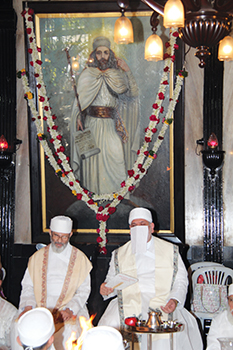
Portrait of Zarathushtra
Photo: Jasmine D. Driver
Unlike Buddha or Mahavir, the Prophet did not advocate abstinence or fasting or penance or forsaking the worldly life. His is a religion of joy and freedom of choice and spreading universal happiness. It is a fallacy, however, to presume that Zoroastrianism is a simple faith. It is a treasure house of esoteric knowledge. The Gathas and other prayers which Zoroaster composed, when recited properly, unleash the most powerful vibratory effects on all of existence. Numerous magical formulae are embedded in these prayers, which dispassionately speaking, are the most potent ever known to mankind.
Parsis hardly display any devotional fervor for their Prophet. Hindus swooning to the chants of "Hare Rama, Hare Krishna” Muslims ecstatic while hearing qawwalis in praise of Prophet Muhammad, Christians delirious with joy adoring Jesus at evangelical gatherings, Baha’is worshipping Bahaullah; virtually every other faith goes ga ga over its Prophet. The once mandatory picture of Zarthost saheb on the wall of every Parsi living room is missing; only a few reverentially touch his feet in the large photo frame in atash behrams and agiaries. Prayer lamps bearing his image on the glass covering are hardly to be seen. Nor are there many artefacts like a marble bust or motifs on wall coverings. Old songs extolling him and recorded by a Parsi music group from Calcutta are seldom played: (Nabiji, vandan ho shutvaar, amara bhuv bhuv na aadhar — a million salutations to our Prophet who is our savior over incarnations) or the touching rendition by the chorus of the Bai Avabai Petit Girls Orphanage, at Parsi functions (Koi poochhé mané, kya chhé tara Zarthost paygambar; dil chiri né bataoon, mara jigar ni andar —If someone asks where is your Prophet Zoroaster, I will tear my chest to show that He resides in my heart!) or the more recent monajats sung by the melodious Mani Rao (Khudavand o Khavind, O parvardigaar; namoo tari dargaah né hoon khaksaar — I reverentially bow before Thee, O Prophet of Prophets! and O dadgar, O davar, O parvardigar; tu gyaani, tu daani, daya no bhandaar — ‘You are knowledge, you are munificent, you are an ocean of compassion). Our inner spiritual zeal appears to have dulled. No devotional fervor absorbs us.
Ilm-e-Khshnoomists and other occultists believe that it is possible to attune oneself to the all encompassing consciousness of Zarathushtra. Clairvoyants say that his aura is so resplendently bright that it occupies a huge part of the cosmic realms. One very effective and beneficial spiritual exercise is to invoke him as soon as you wake up (preferably at dawn) and fervently pray that his great aura lights up your home and hearth; he protects you against black magic and evil by providing you with the shield of prayers (mithravaani); he expounds to you the significance of Ahunavar (Yatha Ahu Vairyo); and he extends his field of protection over you and your family. Aspirants can hope that their body and mind becomes so pure that it is possible one day for them to momentarily interlock with the great cosmic consciousness of Zarthost. This exercise, done with a clean heart and for non material wishes, is a giver of miraculous boons.
Since he is the only smiling Prophet, better to end on a lighter note. The Prophet’s greatness rubbed off on a horse too. Terence Gray, an Irish writer and philosopher, named a thoroughbred horse as Zarathustra (1951-1967), which won the Irish Derby, Irish St Leger, the Goodwood Cup; and finally, was ridden to victory in England by the legendary jockey, Lester Piggott, in a thrilling finish in the Ascot Gold Cup, defeating the favourite, Atlas, owned by the Queen herself. Zarathustra returned to Ireland to stand as a stallion. The Parsis of London led a delegation to the British racing authorities to have the name of this horse changed as it offended their religious sensibilities. However, the delegation’s efforts did not succeed.
Unlike the Hindus and Muslims, Parsis seldom name a child after the Prophet. The residents of any Parsi colony, known for their penchant for colorful abuse, must heave a sigh of relief at having thus been spared from cardinal sin.
Berjis M. Desai, senior partner of J. Sagar Associates, advocates and solicitors, is a writer and community activist.
◆ ◆ ◆
From the archive