
Politics and Policy
Walk the talk
Vehement protests sought to sabotage the heritage walk at Doongerwadi conducted by Ervad (Dr) Ramiyar Karanjia at the behest of the Asiatic Society Mumbai Research Centre
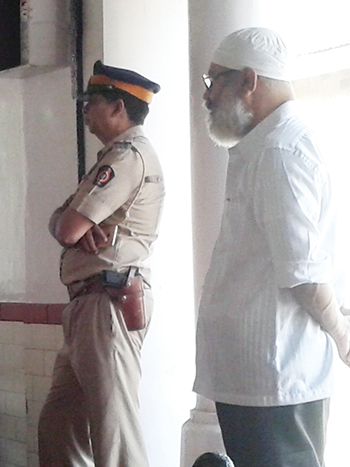
Inside the pavilion at Doongerwadi, Ervad (Dr) Ramiyar Karanjia, principal of the Dadar Athornan Institute, was explaining the fundamentals of the Zoroastrian religion and its philosophy on death and disposal of corpses to over 30 members of different communities who had registered for the heritage walk organized by the Asiatic Society Mumbai Research Centre on December 11, 2016. An equal number of traditionalists led by The Parsee Voice editor Hanoz Mistry and the supporters of Bombay Parsi Punchayet (BPP) trustee Viraf Mehta were standing vigil outside the pavilion to ensure that the walk was confined to the vicinity of the pavilion and bunglis. A police van and a posse of policemen and policewomen from the Malabar Hill Police Station too were on standby duty at Doongerwadi for the orthodox had threatened to disrupt the heritage walk that commenced from the entrance near Khareghat Colony and culminated at the pavilion adjacent to the Allbless bungli.
Among the motley group that included people of varying ages, faiths, nationalities, vocations, there was one foreigner who did not speak English but understood Hindi and had earlier commented, "Itna shor kyun hai (why this commotion)?” when the activists tried to voice their protests. Thereafter as Karanjia elucidated on the religion, members of the audience, many of whom had their heads covered, were seen taking notes. At different times, the gathering outside tried to drown out Karanjia’s voice.
Although prior permission from the BPP trustees had been sought and obtained for this activity, as in years past, this year it became a contentious issue once the announcement regarding the walk was carried on zorastrians.net. The Parsee Voice spokespersons Mistry and R. F. Doctor wrote to the trustees asking them to rescind their permission. But the trustees showed their support for Karanjia. As explained by BPP chairman Yazdi Desai in the Parsi Times of December 10, "We have full faith and confidence in this erudite religious scholar, a respected orthodox who understands the sensitive nature of Doongerwadi and who will ensure that the sentiments of the community are his prime consideration and will not be offended.”
Whilst Mehta had neither voted for nor against the permission granted by the trustees, in a subsequent message circulated on WhatsApp he wrote that after speaking to orthodox activist Hushang Vakil, Mistry, Karanjia and Ervad Parvez Bajan he was of the view that "as trustees it is our fiduciary duty to ensure maintenance of peace and dignity of such sacred lands.” In light of the orthodox Parsis threatening to stop the walk, "to satisfy my personal concerns, and in exercise of my duty as a trustee…I will remain present at the Doongerwadi on Sunday,” added Mehta.
Among the motley group that included people of varying ages, faiths, nationalities, vocations, there was one foreigner who did not speak English but understood Hindi and had earlier commented, "Itna shor kyun hai (why this commotion)?” when the activists tried to voice their protests. Thereafter as Karanjia elucidated on the religion, members of the audience, many of whom had their heads covered, were seen taking notes. At different times, the gathering outside tried to drown out Karanjia’s voice.
Although prior permission from the BPP trustees had been sought and obtained for this activity, as in years past, this year it became a contentious issue once the announcement regarding the walk was carried on zorastrians.net. The Parsee Voice spokespersons Mistry and R. F. Doctor wrote to the trustees asking them to rescind their permission. But the trustees showed their support for Karanjia. As explained by BPP chairman Yazdi Desai in the Parsi Times of December 10, "We have full faith and confidence in this erudite religious scholar, a respected orthodox who understands the sensitive nature of Doongerwadi and who will ensure that the sentiments of the community are his prime consideration and will not be offended.”
Whilst Mehta had neither voted for nor against the permission granted by the trustees, in a subsequent message circulated on WhatsApp he wrote that after speaking to orthodox activist Hushang Vakil, Mistry, Karanjia and Ervad Parvez Bajan he was of the view that "as trustees it is our fiduciary duty to ensure maintenance of peace and dignity of such sacred lands.” In light of the orthodox Parsis threatening to stop the walk, "to satisfy my personal concerns, and in exercise of my duty as a trustee…I will remain present at the Doongerwadi on Sunday,” added Mehta.
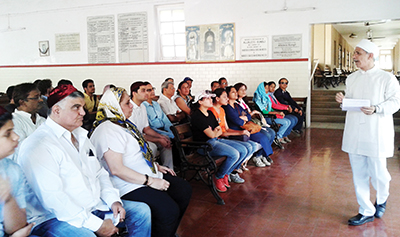
Ervad (Dr) Ramiyar Karanjia at the pavilion at Doongerwadi
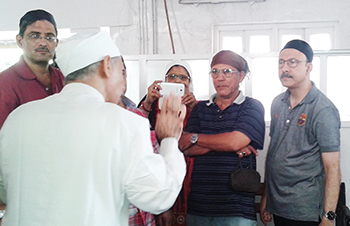
Top: Karanjia appeasing the vigilantes led by Hanoz Mistry (far right) while
Havovi Mistry shoots the video; (above) police on guard
Dastur (Dr) Firoze Kotwal had recommended, "Please allow him to enlighten the non-Parsis on the subject and it is my fervent appeal to all of you to desist from creating unnecessary controversy.”
Had the traditionalists attended the talk, they might have learnt from Karanjia that nearly 110 Towers of Silence were built in India; that the Avestan word for death is irista which means passing away (passing away of the physical and spiritual constituents); that according to the Zoroastrian view the corpse should be consigned to the dakhma as soon as possible — in the same watch of day or the same day; that a dog is brought in several times during the funeral ceremony since negativities in nature flee from a dog’s sight; that after death a soul like an infant needs nurturing, caring, love; that by the fourth day we should leave our attachment to the deceased and let his/her soul progress; that feeding a corpse to a carrion is not necessarily an act of charity (only if you give that which belongs to you and of use to you is a deed deemed charitable).
During the subsequent interactive session Karanjia was asked to explain the Zoroastrian view on conversion, reincarnation, worship of fire when the audience was explained that Ahura Mazda is visualized as light and therefore fire is meant to fight darkness and ignorance. The fravashi or asho farohar denotes one’s personal guardian angel which, when invoked, comes flying to you like an eagle in flight. Like in other religions, Zoroastrians too believe in the coming of the second Prophet, Shah Behram Varzavand, and since we are now in the fourth or the last epoch of time, "people hope and pray it may be anytime soon.”
In her vote of thanks, Dr Shehernaz Nalwalla, managing committee member of Asiatic Society, thanked Karanjia, the BPP trustees and their chief executive officer Cawas Panthaki who was present that morning, the Malabar Hill police station for deputing their force, and members of the audience who had joined in the walk despite the preceding 10 days being tumultuous. As she further related to Parsiana, this is an activity that she has been conducting over the last 15 years and since last year under the auspices of the Asiatic Society when around 80 individuals attended. Associate professor at Wilson College, she had initially started this for her students, she stressed. It is primarily "to get rid of misconceptions.” The accusation that we are "making money out of Doongerwadi” should be cleared "for we have not charged anything,” she further clarified. On behalf of the audience community activist Aspi Daboo too expressed his appreciation to Karanjia for sharing his knowledge.
When the visitors were studying the model of the dakhma kept in an enclosure at the far corner of the pavilion, the restless gathering outside barged into the pavilion with accusations of the sanctity of Doongerwadi being marred. When they questioned how the organizers could have permitted women, not knowing whether they are in menses, to sit in the pavilion, Karanjia challenged whether anyone asks those who come to pay their respects to the dead whether they are in menses. The pavilion not being a sanctified place, he stressed, "There is no objection if anyone in menses comes here.”
Hanoz Mistry was urging the Parsiana reporter to record these statements. Havovi Mistry captured the dialogue on video and was keen to show it to her supporters who goaded her to share it on social media which she promptly obliged. Outside, she was heard telling her friends that they had unnecessarily stopped her from creating a noise earlier! "Tamé tamaro dharam chhori naakho (you should forsake your religion)” was the advice given to Karanjia.
Within the next 24 hours, social media was buzzing with messages: A disgruntled Mistry’s message circulated on WhatsApp read, "We know of no other community whose authorities allow its funeral grounds to be used for tourist interest… Instead of channelizing his efforts to improve the religious basics of our own misguided community members who built a prayer hall and are encouraging a spiritually devastating system like cremation, he chooses to waste his time with mere tourists and thrusts their presence on us… The actions of the BPP are even more reprehensible… Kotwal is equally responsible because he gave Karanjia a clean chit to proceed with this misadventure…”
Another questioned, "Why open our property to non Parsis when there is no need to do so? Today it is Ervad Karanjia, tomorrow it can be Al Hussain Travels with 500 Muslim tourists walking around our property.”
The Ilm-e-Khshnoom group had posted online: "The question which was asked by the late Adi F. Doctor in 2012 still holds true. Do the BPP "trustees, have the autocratic right to take unilateral decisions, which go completely against the very grain of the trust deed of 1884?”
Dr Viraf Kapadia who was detained at the Malabar Hill Police Station was proclaimed as "the real man of the moment.” Earlier he and Eric Dhatigara, known to be supporters of former BPP chairman Dinshaw Mehta, had lodged police complaints with the Malabar Hill Police Station claiming the walk was "hurting their religious sentiments.” But after the police officials received a clarification from Desai on the night prior to the walk they apparently chose to summon Kapadia to the police station.
On the website of Traditional Zarathushtris Mailing List was posted a comment: "Prophecies are coming true that there will be tara (locks) put on agiaries, atash behrams and even at the Doongerwadi… What our ancestors preserved and died for, we are freely giving away!”
But as BPP trustee Noshir Dadrawala observed, the traditionalists’ "concerns are misplaced… non-Parsis have been taken around Doongerwadi since the time the British ruled India and these visits are recorded and documented. All of them have lauded the system and the environment at Doongerwadi after their visit.
"One must remember that there are non-Parsi malis (gardeners), watchmen and workers at Doongerwadi and no one, not even a Parsi is allowed to go near the towers. Why then we are making an issue out of a non-issue?”
◆ ◆ ◆
From the archive